

Witchcraft – A Sad Reality of Our Times
11 February 2023
Liberation from the Flesh – Father Theologos
14 February 2023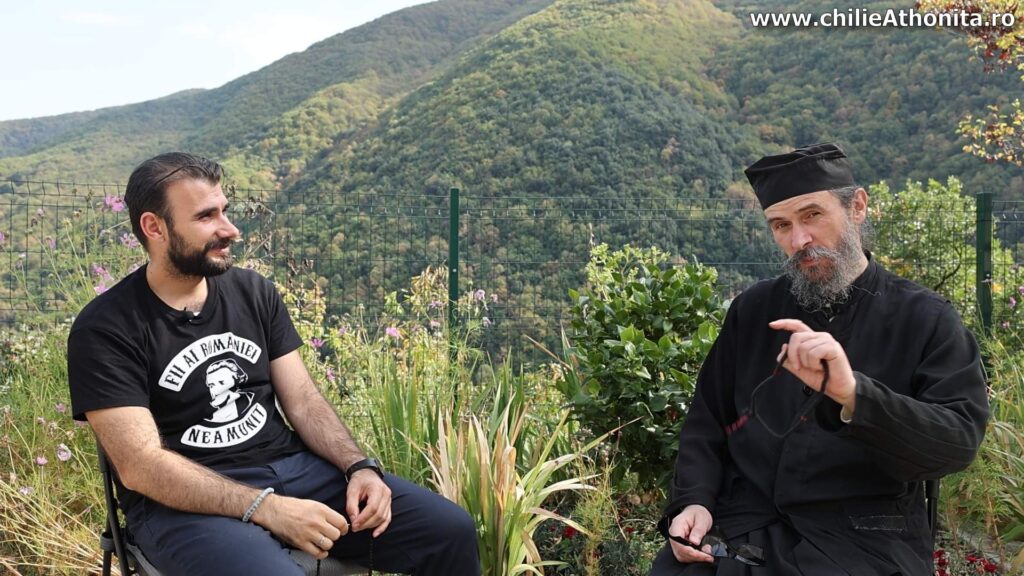
Orthodox art and especially movies are a very painful subject today, if we consider the fact that our civilization is highly dependent on the visual.
Watch a video on this topic made with Cristian Ciorăneanu, the director of the artistic documentary about St. Neagoe Basarab, one of the best-known documentaries of this kind produced in our country. We promoted the documentary here:
https://www.chilieathonita.ro/2022/10/01/pe-urmele-mariei-sale-sf-neagoe-basarab/
Enjoy!
Fr. T: Glory to the Father, and to the Son, and to the Holy Spirit, now and forever and unto the ages of ages. Amen! Through the prayers of our Holy Fathers, Lord Jesus Christ, Son of God, have mercy on us! Amen!
We are now with Cristian Ciorăneanu whom I know, and you know him best from a famous documentary called “On the Footsteps of His Majesty,” right?
C.C: Yes.
Fr. T: A documentary made mostly in the Holy Mountain, but not only, about St. Neagoe Basarab, right?
C.C: Yes, the Holy Voivode Neagoe Basarab.
Fr. T: Holy Voivode Neagoe Basarab. How did the idea come to you or how did it start?
C.C: Practically, the project was born here, on Mount Athos. I was a student in passing, so to speak, doing an internship in Mount Athos at the Faculty of Theology through the Erasmus scholarships – I am happy about the privilege to be a pioneer and one of the people who took advantage of this traineeship grant in Mount Athos full-time, both for master’s and bachelor’s degrees. I thought about leaving Mount Athos, leaving something behind: a film about the Holy Mountain. Upon arriving at Vatopedi, I spoke with your reverence, with Fr. Vasile the doctor, with Fr. Chiril, and Fr. Vasile in his laboratory said: “Making a film about Mount Athos is too vague. Find a niche, a guide!” So, we thought and concluded that it would be good to highlight the life and patronages of Holy Voivode Neagoe Basarab – since 2008 he is canonized as a saint. And I didn’t know very much either, I didn’t have such a vast knowledge about what St. Neagoe accomplished on Mount Athos, but I had the opportunity to follow in the saint’s footsteps, to find many documents in museums and not only, buildings that have been standing for over 500 years.
And by coincidence—or rather, by God’s providence—the film we made in 2021 marked exactly 500 years. When we finished it, 500 years had passed since his departure to eternal life. So, the movie was born here, in Mount Athos, more specifically at Vatopedi Monastery, with [you being] one of the people who guided me, saying, “Cristian, you still have to learn!” You probably don’t remember. It’s been seven years now…
Fr. T: Yes, I remember something, yes…
C.C: “Cristian, you still need to learn a bit more, to see…” And of course, I learned many things. The film was also a learning experience for me. About two years later, I enrolled in a documentary film master’s program. Father Vasile assigned me and the cameraman to work on a project outside of the movie – while we were at the Athonite Academy. To make this movie, I had to enroll at the Athonite Academy for two years. We made a seven-minute project that got first place in Athens, and the Athonite Academy, as the school that hosted this project, was very well regarded in Greece. The Bishop of Piraeus came and accepted the award on behalf of the Athonite Academy and because I accomplished this, without pride or vain glory, they said “Alright, we’ll keep you for another year and allow you to film around the Monastery of Vatopedi and obviously Mt. Athos.” And thus, we were able to do so many shootings in Mt. Athos.
Fr. T: What was the impact of the movie?
C.C: After we finished it, we launched it right on the feast day, September 26 – we went to Curtea de Argeș. We had also filmed His Eminence Calinic of Curtea de Argeș, the Archbishop, who also attended the premiere and spoke as well. Because it was during the pandemic, only 100 people could come, but there were 100. We also had a beautiful choir that sang – a children’s choir. And at the beginning, I thought it was a rather ordinary reception, barely noticed or appreciated by the public, so to speak. Then, being a high school religion teacher, I shared it with my pupils. They said it was a bit too long, which is why – indeed, very long and dense, let’s say – I condensed it and made a simpler version for high school, about half an hour. I made a half-hour version which was published on YouTube.
Fr. T: How long was the original?
C.C: The original film runs 93 minutes, and together with the senior gentlemen from Osea Film—Aureliu Surulescu and Cristian Filip—we will condense it into four episodes, each about 25 minutes long. Actually, not so much compressing as reshaping it into a series. And then we hope to pitch it to Netflix or at least to a TV channel that will take it as a series, which is a better fit.
Fr. T: Any plans for the future?
C.C: We’re now working with Osea Film. I’m involved there too, and on this occasion, we have several projects lined up—four in total. One of them is a series on the seven days of creation, exploring both theological and secular perspectives.
Fr. T: Scientific?
C.C: Scientific and theological, yes. By secular, I mean it includes psychology, medicine, biology – and especially, in my case, because I am a student, a PhD candidate in bioethics – matters of bioethics and neuroscience, which are current.
Fr. T: Oh! Let’s see!
C.C: A series that aims to be brief and to the point, yet thorough from multiple points of view. Just as some were saying that people don’t watch two- or three-hour films anymore. Well, they want 25 minutes, but with all the depth.
Fr. T: Yes. This idea of the seven days of creation is interesting. Very, very interesting! On a spiritual level — a life of a saint, or something like that?
C.C: Yes, we have. We are in a project already, or I am in a project as I’ve just met with the gentlemen, and we planned it, so to speak. It’s a project that’s underway. The only novella written by St. Nikolai Velimirovich: “The Unattainable Land.” It is famous as a novella, it’s the only one he wrote, and we want to adapt it into a movie, we want it to be in English.
Fr. T: Very good!
C.C: With soldiers and everything. It’s a scene from World War II. I won’t give you any more spoilers on this occasion either, but it will indeed be something authentic because we gave the script, we gave the book to be…
Fr. T: Oh! Is the script written?
C.C: We’ve sent it, but no…
Fr. T: Oh, it’s not finished yet.
C.C: Some girls from the screenwriting department came and wrote a draft, and I said: no. For it to be a script that we publish, that we make into a movie, your hands must sweat while you’re reading it.
Fr. T: That’s right!
C.C: It has to be very intense, because it’s a short story, but it is very intense. And the script has to be very intense as well, and very conclusive and deeply spiritual. And just how I liked to tell others, even from the university, because those in acting would ask me – since I was studying directing, in the documentary master’s program – they’d say, “Why don’t we work with the people there?” And I told them, “Well, what can you do?” And they said, “Anything.” “Well, that’s why we can’t work together, because I, and not only me, but anyone with a Christian conscience says—when I work on a movie, it’s like I’m working on an icon. I go in there in a certain state of prayer. If you say you can do anything, it means you can’t make a movie with a Christian spirit, even if it’s not only a Christian movie. It can be an educational film. You have to have a certain modesty; you convey that beyond the camera. You must have a certain integrity and Christian morality, a purity of heart that is felt and seen beyond the camera.
Fr. T: A spirituality that shines through.
C.C: Exactly. And for me – it’s like I’m painting an icon. If I’m working on a script, I’m not hungover or drunk or anything like that. I have to be in a certain spiritual state, I fast, just like when an icon painter works on an icon – they fast, undertake a black fast until noon, they go to Divine Liturgy in the morning, they do their canon, Confession, Communion. I was talking with the brothers about the “Leader” platform that I’ve proposed and said we are brothers to the extent that we are at the chalice, at Holy Communion. We can indeed share with others, but we must be rays of light ourselves. We give to others of other denominations, but we must be the ray of sunshine, and from there we start, that’s who we are, if we can do something, it will be only with God’s help, otherwise it’s something that can’t be accomplished.
Fr. T: How has the Holy Mountain influenced you? Has the Holy Mountain had any influence on you?
C.C: Yes! I can say that I grew up here. And spiritually… Father Iustin who is my spiritual father – Fr. Iustin Miron from Oașa – said, “Dear one, well, you got there, know where you came from, but mind your prayer!” And I tried to focus on my prayer, here it was like a kind of spiritual marathon because you had to attend to it. Here, if you attend to it, you are fine; if you don’t attend to it, you are not fine! It’s simple!
Fr. T: That is true. So, the Holy Mountain gave birth to you, spiritually.
C.C: It gave me a spiritual rebirth and I believe this happens to every person who comes here, to you, to Mount Athos in general and to you and seeks this. The Mother of God does not leave anyone thirsty. She nourishes everyone spiritually and not only. There are callings and searches on all levels, and many people find them here.
Fr. T: Glory to God! How do you see… I carry many pains inside, one of them being Orthodox audiovisual art. In this case, I mainly refer to Orthodox movies: documentaries and especially feature films, which, if I paraphrase Caragiale, “It’s sublime, we could say, yet utterly missing.” What could you say? What could we do?
C.C: They are influential; I’ve seen people, but they are not yet united. We are trying to unite these people in their energies and channel them toward making spiritual art because it exists, it is strong, people are very creative, but they have not yet united, they have not yet come together to make quality things. There must be people who study, of course, people who are in the grace of the Church, on its porch, who want to show the world that the Church is worthy of its place in the world. To show the world the Church is what it truly is. Because there are people – I have even met some in Cannes, I went twice to Cannes with “St. Neagoe” and not only – they would say “It’s niche.” “Yes, but if you made a movie that wasn’t niche but had perspectives, it could be watched.” That’s why people are drawn to spirituality, especially to authentic Orthodox spirituality.
Fr. T: Yes, yes.
C.C: Only we have to know how to sell our product. And now, indeed, we are into marketing, so, come on, let’s see what Orthodoxy has and try. So, I’m one of the pioneers, I think, in this Christian art for now, but there are other people working and they are fighting guerrilla battles, so to speak. If we united, and we hope to unite in one way or another, to promote Christian art, to promote Christian values in such a way as to, of course, reach the purpose of this art, which is to help people attain salvation of the soul. That is, to urge people to understand that this life is not the last one, that it is not everything, and that they have resources providing ways to connect with God, because ultimately that is the purpose of art: to bring you closer to God regardless of the art form.
Fr. T: To reach perfection, right?
C.C: Yes, meaning to God.
Fr. T: Exactly. Glory to God! So, I see that these tendencies exist, but what do we do, how can we promote this art? I mean, can we promote this art? Like on Netflix, or how?
C.C: Yes, and they’re very interested. I saw they released a film all about Mount Athos – “Athos,” that’s exactly what the film is called.
Fr. T: Really?
C.C: I was surprised to see it on Netflix, bought by Netflix, and not only that, there have been many spiritual films. The problem is that platforms like Netflix buy everything so your discernment is knowing what to watch, when, and how. In general, Christian films are not invested in. I’ve had a lot of trouble with this, but I don’t want to complain now. Until a few months ago I was still in debt, but, eventually, God helps you. I mean, when I started the movie about St. Neagoe Basarab, I thought it was utopian to believe you could do something, there were many obstacles, but you go forward with prayer and hope that in the end St. Neagoe will make the film or he makes it and helps you, so to speak, and that’s how it was – the Mother of God wanted to let me stay here, to be healthy and so on, and she helped me, I mean, I felt this reality. It was a spiritual journey doubled by the miracles of God, of St. Neagoe Basarab and not only.
Fr. T: Could you share a real example?
C.C: I’ll tell you a concrete fact. When I was here, a father from Lacu – I won’t say his name, from the skete where we are now – came, it was Holy Pascha, Bright Week, and I was leaving for Romania. I didn’t really have money for cameras, I didn’t really have much, and I needed footage, especially drone shots. And he came to me. I was in the port of Dafni. Those who go to Mount Athos know this port well. I was in the port of Dafni and he comes to me there. He says, “Why are you downcast? You are not allowed to be sad during Bright Week! You’re not allowed! It’s canonical, you’re not allowed!”
Fr. T: Yes.
C.C: “I’m not very sad, but, look, I’m working on a film about St. Neagoe Basarab and so far it hasn’t gone very well because I haven’t had any kind of funding, it was all from my own scholarships, I’m also at a certain age, I should be working, but I’m here, I’m doing two master’s degrees, I don’t have a lot of money.” He says, “Look, here’s what I’ll do! I’ll give you a drone, I’ll buy you a drone.” And that father came with me to Thessaloniki, he paid for my trip, so he gave me the money for the trip, he came with me to the drone store in Thessaloniki, he bought me the most advanced drone at that time – it cost about 3000 euros.
Fr. T: Glory to God!
C.C: With a card and all, so all I had to do was turn it on and shoot around Mount Athos with the necessary blessings, of course. And I hope on this occasion that those whom I disturbed in one way or another will forgive me… It was a miracle, pure and simple.
Fr. T: Truly a miracle, especially that he was from Lacu, from our place…
C.C: Yes, I didn’t even expect to… it’s one of the few that… Many things have happened, I can’t even say… But this was immediate, the conversation lasted five minutes, he didn’t even ask me “Are you really making a movie or not?” And he didn’t know me, it wasn’t like he had known me for a long time. He came directly to me and said, “Yes, I have devotion to St. Neagoe, it’s from God, I’ll help you!” He went with me, bought the drone, and I went to Romania, where of course we filmed at Turnu, and we filmed with that drone… [everywhere].
Fr. T: Glory to God!
C.C: And, yes. I give glory to God for everything. And this was one of the financial miracles, let’s say, but there were also those of a purely spiritual nature. We were able to have the premiere, despite the whole pandemic, at the 500th anniversary, at the feast of St. Neagoe Basarab in Curtea de Argeș, the movie being completed.
Fr. T: Glory to God! So everything…
C.C: Everything, completely everything was arranged just like a miracle!
Fr. T: … Like a miracle. Mother of God! Glory to God! What do you think about – I am very interested in this, you know it’s a favorite subject of mine – the youth and their consumer power in terms of audiovisual art?
C.C: Yes, it is indeed the most powerful form of expression and the most powerful channel today – the audiovisual is everywhere. Unfortunately, it also has serious repercussions on the conscience, on spirituality, and on the brain, and life as a whole. And there are already programs in other countries and there will be in Romania too – associations and programs that will dilute this harmful power. It’s not only harmful, it is also good, but it also has the other side of the coin.
Fr. T: Side effects…
C.C: Effects which we should see, and being older young people, as we’re of different ages, and we’re already older as young people…
Fr. T: I’m young too…
C.C: Exactly, but we need to figure out how to help those younger than us – how I, as a teacher, can help my pupils. And in my garden, to preach the truth which, of course, is one. But I also preach it there, and regarding this issue and this phenomenon of digitization, urgent measures must be taken to raise awareness, first of all, for parents to realize that they need to do something, to spend more time with children, as Mr. Cristian Filip said in a podcast, to give them more love, and we as teachers, as educators, to be a model in this regard and to leave the digital era a bit in the things we can do differently. We make them write instead of typing on the computer…
Fr. T: Yes, yes, to write on paper…
C.C: Exactly. I have calligraphy and chess classes…
Fr. T: Really? Glory to God!
C.C: I love calligraphy, and young people have also started to be very drawn to calligraphy because it’s something special, beautiful and good for the brain. It forms a more organized mind. Chess, for example, which indeed helps in its own way. Reading. We guide them to use their minds and creativity because it is diluted by the digital, but if you start reading, composing poems, playing with words… There are things and exercises that we do, and if they do them conscientiously, they can be a role model for other young people. And they can recover because there are young people that come, who unfortunately are already in a degrading state of health due to the digital era – phones and all kinds of screens. Well, we must help them, and they see that they can regenerate. And it can be regenerated. By God’s grace!
Fr. T: So, it is possible, glory to God! I’m really happy about these things. I have a concern now. It’s about – yes, put it on Netflix, it’s true you have to make money too. Won’t you put something on YouTube for the general public?
C.C: Actually, yes.
Fr. T: Or for free, that’s the idea.
C.C: For free. On my birthday, November 9, I released the movie for free, for everyone. There were 40,000 people who watched it and they still watch it for free, in full, on YouTube.
Fr. T: We put it on our website, yes, we promote it.
C.C: I have no problem with that. I know, a lot of work went into it, some said, “Well, wait, you didn’t even get…” But I gave them the account number, there was only one person who said, “Yes, we will donate for future projects,” but I don’t necessarily expect to receive donations from people.
Fr. T: So only one person donated to you?
C.C: Yes, in one year, only one person and I never knew their name and I always think about and remember that person, but I don’t know their name.
Fr. T: Glory to God! May God bless them! We will also put Cristian’s account in the footer if anyone wants to donate.
C.C: Yes, there are projects, but God helps us in that respect too. However, people in the Church, unfortunately, do not understand that they need to get involved both civically and in the life of the city they live in, to turn off the television, to better discern what they do and, as I said, civic involvement. I have dignity, I have a dignity that I must defend. Romanians must regain their dignity.
Fr. T: That’s right, because unfortunately today…
C.C: Yes, and this is also the message of Holy Voivode Neagoe Basarab. Holy Voivode Neagoe Basarab was, if we could say, lest we offend him, a political man of great Romanian dignity, a model for Romanian politics of all times, and a model of Christian integrity for all people.
Fr. Theologos: Exactly. May the Saint help us!
C.C: Thank you!
Fr. T: Through the prayers of our Holy Fathers, Lord Jesus Christ, Son of God, have mercy on us! Amen!
Online commemoration lists and donations
May the Lord help us!
Online Commemoration Lists and Donations
May the Lord help us!
If you have a bank card and wish to send commemoration lists and donations online using your card, and/or to support our philanthropic activity, including this site, please fill out the form below to make a small donation. The form is secure – we use Stripe for payment processing – a world leader in this field. We do not collect your personal data.
If you do not have a card, or do not wish to use it, visit the webpage for Online Donations and Commemoration Lists.
We will pray for your loved ones! (Please do not include inessential details like wishes, degree of kinship, introductions etc. JUST the name!)
Especially for recurring commemoration lists, we ask that you please keep them to under 20 names long. If you include a member of the family, we add “and for their families.”