

Great Lent – Father Pimen Vlad
23 February 2023
Saint Gerasimus of the Jordan: The Simplicity of the Sinless Man – Father Pimen Vlad
2 March 2023
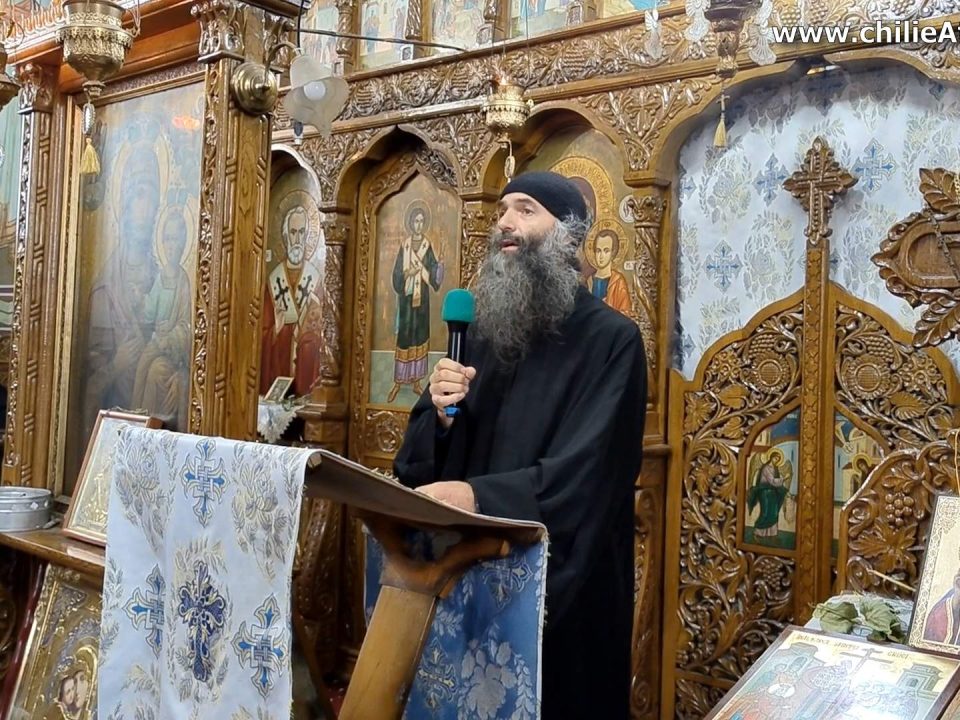
The (dis)honoring of the Holy Icons was an issue that the Holy Fathers resolved more than 1,000 (one thousand) years ago—an issue that, however, has resurfaced with the rise of neo-Protestantism in recent times.
Watch this material to discover an analysis of this topic, as well as what challenges we face today in relation to the visual civilization in which we live.
Enjoy!
Glory to the Father, and to the Son, and to the Holy Spirit, now and forever and unto the ages of ages. Amen. Through the prayers of our Holy Fathers, Lord Jesus Christ, Son of God, have mercy on us! Amen.
The Lord said in the Ten Commandments, in chapter 20 of Exodus – the famous chapter 20 – He said, “You shall not make for yourself a carved image—any likeness of anything […] you shall not bow down to them nor serve them. For I, the Lord your God, am a jealous God, visiting the iniquity of the fathers upon the children […] of those who hate Me.” In the text of the Septuagint, which is considered the divine text (textus receptus), that is, the official text, the word used is Εἴδωλον (idol) or in Hebrew “Fesel” – which is translated as “carved image.” It can also be translated as “idol.” This forbids having any object stand as god. In place of God. This is the idol. When you have an object, something material that you worship in place of God, it becomes a god, it becomes an idol and it cannot save us because it is lifeless. That is the great problem with idols. Do you understand?
Of course, this second commandment is directly connected to the first commandment and serves as its logical continuation. You should know that in Catholicism, it is actually considered to be one and the same commandment. We say that they are two separate commandments. However, it is certain that they are very closely connected, linked to each other. You know the first commandment: “I am the Lord your God, who brought you out of the land of Egypt, out of the house of bondage. You shall have no other gods before Me.” That is, at the beginning it says that the Lord is the only God, and then it says not to have other gods besides Him, because you know that at that time, due to Adam’s fall, there were many false gods, many idols. And this is because our minds grew darkened and we can no longer distinguish, we can no longer have a connection, a proper communication with the true God, the purely spiritual One, the One beyond all matter.
The sinful man, having lost the clarity and illumination of his mind, his spiritual sight, can no longer see spiritually, but only materially. Now, within each of us is seeded the fact of God’s existence, as the psalmist says, “The fool says in his heart, ‘There is no God.’” Only a fool can imagine that all this, which we see around us – especially man – appeared by chance. The odds, meaning the statistical probability that the entire creation you see around me just as it is, just simply happened, is very, very small, brethren. Infinitesimal. However, I won’t dwell on the details of creation now.
I will tell you only one thing. Let’s say you go to a foreign planet and see the desert there, uninhabited, desolate, strewn with stones, and there, you discover a perfectly working clock. Would you call it mere chance? No, brethren! Only a fool would say that, as I have also given you the quote from the Psalter. Also, see Chapter 1 of the Epistle to the Romans where St. Apostle Paul clearly shows that this whole world, all creation, is a ladder to God – as it says there that “…because what may be known of God is manifest in them,” – meaning the pagans, the nations, at that time, “…for God has shown it to them.” Through creation. “For since the creation of the world His invisible attributes are clearly seen, being understood by the things that are made, even His eternal power and Godhead, so that they (the pagans) are without excuse,” they cannot say they did not know.
And why? Why is that? “…because, although they knew God, they did not glorify Him as God,” – as the Holy Apostle Paul continues – “or were thankful, but became futile in their thoughts, and their foolish hearts were darkened.” Do you understand? It is the distortion of the darkened mind. However, you see that no one has questioned the existence of God. No one, except today. And in fact, atheists appeared when people, through their pride and wealth, detached themselves from nature, from God’s creation, and through this, from God, that is, somewhere around the 18th century, which is very close to us. And they too, in fact, have a god, you know, an idol, but usually the most dangerous idol possible, that is themselves. The unwavering belief in their own mind. The existential implosion. Closing oneself off. “I see only myself and my thoughts and in that alone I believe.”
As you can see, the question is not whether God exists or not, but who He is. And this is what God wants to protect us from through the second commandment, brethren – of having material gods instead of Him, the personal, totally spiritual, immaterial, and transcendent God. God does not say not to make images of Him, more precisely, icons, but – I quote what it says there – “…of anything that is” of creation brethren, and “you shall not bow down to them nor serve” these likenesses of creation. So that you do not make yourself a stone – of rock, gold, wood or anything – and bow down to it, expecting salvation from it.
The icon is not an idol, for we do not seek salvation from the wood it is painted on, nor from the respective colors, brethren. As St. Basil the Great and St. John of Damascus say, veneration ascends from the prototype to the archetype, that is, from the image to the original. The moment we look at a photograph or a screen, we do not think about the photographic paper or the pixel technology on the screen, but about the image there – the one depicted. When we see a loved one on the screen, we do not say, “Wow, look at those pixels!” – let’s be serious. Only a half-witted would do so.
St. Basil gave the example of Caesar’s statue. The saint said that the moment someone is asked “Who is this?” and points to Caesar’s statue, the other responds “Caesar” and does not say “You asked the wrong question because that is a statue and not a person,” nor does he answer “It’s Caesar’s statue,” but simply responds “Caesar.” So, you see that natural human thinking goes from the image to the original.
So, when we pray, we do not pray to the paints and the wood, but directly to God, because God, being incarnate in the person of Christ, can be “photographed,” so to speak, can be painted in an icon, and also, we pray to the saints to intercede for us before Christ, who is true God and true Man. We pray to the saints to help us, just as we would ask a household member or an acquaintance of the Emperor to put in a good word with the Ruler. Therefore, the saints do not save us of themselves. The saints are not gods by nature, but gods by grace, because they are united with God, and being united with God, they help us, intercede with Christ, and Christ intercedes with the Father as a form of humility. Do you understand? And Christ is united with the Father.
I say this especially for those influenced by uneducated neo-Protestantism, because you should know that even educated Protestants accept icons and their didactic role. However, the problem of educated Protestants – not the neo-Protestants, woe to them, may the good God forgive me – lies in believing we worship the very material from which the icon is made. But if you explain it to them, they understand. Their difficulty is distinguishing between “latria,” that is, the worship of God, and the veneration of icons. If we speak on a human level, it is the difference between the love we have for the most beloved person in our life, a person we do not see – let’s say they are away at war, God forbid, far away for a long time or even have passed – and the care, the honor we give to their photograph of that person, especially if it is a good photograph, even more so if it is the only memory we have of that person, when it is unlikely or impossible to see them again in this life.
Of course, if someone is unyielding, set in one’s ways, obstinate, and on top of that uneducated, we are just wasting our time. Of course, God in His being, which is purely immaterial, cannot be represented, cannot be photographed, but in His boundless love for people, He took on flesh and became like us so we might see and touch Him. However, see that on the other hand – in contrast to idols, God tells Moses in Exodus—when speaking of the Ark of the Covenant and the construction of the Temple (the church of that time) in chapter 25:
“And you shall make two cherubim of gold; of hammered work you shall make them at the two ends of the mercy seat.”
So, representations are allowed – including those of angels, the very beings without bodies (yet man can have an experience of them). Representations are permitted by God and are allowed to be placed in places of honor – even in the Holy of Holies, which the high priest entered only once a year – but, of course, not as idols. In the next chapter of Exodus, God says:
“Moreover you shall make the tabernacle with ten curtains […]; with artistic designs of cherubim you shall weave them.”
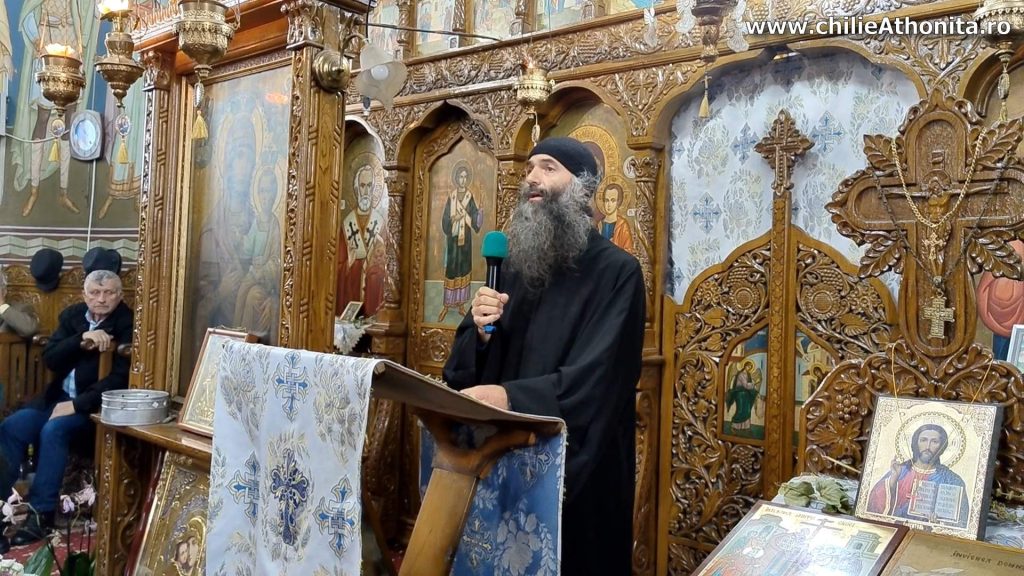
See? Of course, representations are necessary because man is very dependent on the visual; fallen man is a visual being, but, of course, these representations are not idols, I repeat. They serve as “a mirror,” to see dimly, as Holy Apostle Paul says in the Epistle to the Corinthians. In fact, brethren, as I said at the beginning of the word, all creation is a mirror and an approximation for the ascent toward God. Yes, brethren, the Mosaic temples and, of course, Solomon’s temple had such representations, and following its model, all Mosaic temples and, as a continuation and spiritualization, our churches. This is essential because through representation, through the image, we reach the Person.
Even our Lord made the connection between the image and the person when the Pharisees brought Him a denarius and the Lord asked them, “Whose image and inscription is this?” They said to Him, “Caesar’s.” Then the Lord said to them, “Render to Caesar the things that are Caesar’s, and to God the things that are God’s.” See? Through the image, the mind rises to the person. You see that the visual is very, very important for people. You know well that it is crucial. I said that man is a visual being.
Especially today, brethren, we are a civilization of the visual, and this is not only from the physical perspective, so that we can orient ourselves – that is, to know where we are – but also from a psychological and spiritual perspective – to orient ourselves psychologically and spiritually. Man needs assurance in what he knows—he must see it. The English say “seeing is believing.” “If I see, I believe.” St. Thomas said, “Unless I see…, I will not believe.” This is the drama of fallen man, brethren.
Let me give you a concrete case: abortion. Yes, it is dramatic. Many claim it is good– God forbid! – to have an abortion, [they say] it is not a crime, and why do they say this? Because, in fact, they do not see that there is a human being who has a natural, continuous, and smooth development from the very second of conception. When does he become a human being? From second zero. The moment they see the child, then they no longer want to kill it, except for the Chinese who kill their newborns as they wish, especially if they are girls – let’s not go into details.
I recall a metropolitan with a spiritual life from Greece who, with difficulty, convinced a young woman not to have an abortion. So, the man really struggled. After she gave birth and was holding the little newborn very happily and with much love, the metropolitan said to her, “Now if you want, you can kill him yourself! You can take a knife…” The woman was horrified and began to cry. Do you understand?
As you can tell, seeing, the visual, is the assurance, the reminder, the sedimentation of knowledge, if you wish, it is the bringing into existence of knowledge, of thoughts. We must know that when a person becomes spiritual, their sight becomes spiritual too. He sees everyone as God’s people. I remember a bishop preaching when a high-end harlot passed by, and he looked at her long and with sadness. The people said to him: “Your Eminence, don’t look at her like that; if you knew who the lady is…” and the bishop replied: “Ah, if I had tried to please God as much as she tries to please her lovers, I would have become a saint by now.” The man was indeed a saint – Saint Nonos.
For us, it’s not good do this, but rather guard our gaze because, as we know, the visual— that is, who we look at and how we want to appear—decisively influences our lives, unfortunately. That is why the Church, from its earliest days, placed great importance on the visual, and when I say this, I am not only referring to icons, that is, to what we see, but especially to what we do not see, brethren. You see, today our minds are shattered because of the visual. Today, the idols of current society are screens. People worship them today and expect their salvation and redemption from them. The attraction is so great that, if in the case of icons, the problem was resolved over 1300 years ago at the Seventh Ecumenical Council through the contribution of two super geniuses of the era – St. Theodore the Studite and especially St. John of Damascus – the problem concerning what we DO NOT see remains practically unresolved to this day.
On the one hand, God works many wonders through icons. Entire books have been written, and many miracles have been passed down orally, that icons have worked. For example, I recall at one point, there was a relatively small icon in a church on Mount Athos that during a service shone very brightly and emitted a beam of light that struck a young man among the pilgrims. He fell to the ground, the others asked him what had happened, and he admitted that he had been involved with magic. From that moment on, his life changed completely and he broke free from that temptation. This happened a few years ago. I could tell you about other miracles; as I said, there are a lot of miracles, but now I won’t tell you many – Father Abbot Pimen tells us very beautifully in his videos, and I recommend you watch them.
I will only remind you that especially lately, many icons have been weeping and exuding myrrh. Why is that? Because the situation truly calls for tears, brethren! That’s why the icons cry. Yes, that’s how it is. We have also posted a few videos on the site with weeping icons; I know someone who even has little bottles of myrrh collected from such icons. I know of them both in [Romania] and abroad. However, I will tell you what makes an icon miracle working. Perhaps that is better than listing a multitude of miracles.
All icons are, actually, miracle working, for the greatest miracle is the transformation of a person for the better. When we say that an icon is miracle-working, we are saying that God’s grace works in a special way through that icon. And why does grace work like this? Generally, tradition says there are several factors: the icon was painted by holy hands, the icon was touched by holy lips, and the faith of the people. Beyond that, sometimes, of course, God performs miracles by His own foreknowledge, as in the case of icons not made by human hands.
Icons are very, very important because they remind us of the victories of our Lord Jesus Christ, the victories of the Saints, they remind us of our heavenly homeland, of our destination, of our home. On the other hand, as I said, the problem of what we do NOT see is still unresolved and that is not because of the Church, but because of us, people, especially those outside the Church. In the case of icons, there are painting canons to avoid carnal attraction – meaning all the saints are painted with dark hair, black eyes and spiritualized – I don’t know if you know, just as a side note, the Savior and the Mother of God were blond with blue eyes.
On the other hand, in today’s visual avalanche, brethren, everything is done to distract the mind and not let it rise to God. Today we are witnessing a spiral of hysteria surpassing any balance, any common sense, because people’s senses are dulled by the avalanche of stimulating visuals with which they are bombarded everyday. And here I’m not only referring to shameful, indecent things – of course, that’s not even up for discussion, it’s a form of drug. So, when someone is watching shameful content – pornography – the exact same chemical reaction is triggered in the brain as when a person takes heavy drugs, when they take cocaine, brethren. It’s exactly the same thing [happening].
So, I’m not referring to that, because that’s clear, it’s death, it’s poison, brethren. But I’m also referring to other things such as sensational, apocalyptic news or all visual “arts” from movies to games that are made to shock, to excite – I include cartoons here too, brethren, unfortunately. A big problem. Lots of special effects, each more exciting than the last – you watch a trailer and you don’t understand anything other than a string of shocking sequences. I don’t follow very closely, I am a monk, but I know that there are entire entertainment companies centered on these superheroes and there are special effects studios, called VFX studios, that work so intensely that VFX specialists have nervous breakdowns and sometimes have to go into recovery after finishing a movie.
I’m speaking very seriously, I know specific cases. Some VFX studios actually went bankrupt after winning the Oscar for special effects. They were worn out, brethren. Brethren, it’s madness! And how could it not be, brethren, when our very daily life today is based on the excitement produced by the visual? The excitement produced by the visual can be seen starting from the way ladies dress first and foremost, but also gentlemen and, especially, young ladies, ending up almost totally addicted to the user interface of cellphones which, brethren, is designed to be visually exciting and not useful – let’s be clear!
Let me give you just a small example: the contact list in the phonebook or the chat list on WhatsApp or Telegram or any other communication program. Believe me, it would have been much simpler and faster in every way to have made two buttons called “Next Screen” and “Previous Screen” that you press to display the next “x” contacts. It is much simpler to program, much faster to execute, and requires far fewer resources from the phone’s processor, especially from the graphics subsystem, the graphics processor. But those who designed it said “No!” Steve Jobs – because it was him – said “No! We don’t want a useful, fast system, we want an addictive system; a system that generates pleasure, addiction, a system that drugs.” Jobs characteristically said, “I’m going to make you an operating system that you’ll want to lick!” He knew very well what he was doing and forbade his children from touching what he was doing until they were of age. Understand?
What did he do? He did many things, but in the case we’re discussing, he created animations that gave a sensation of power, adrenaline, dopamine, satisfaction, speed in scrolling through contacts on the screen with a simple gesture, the feeling of a drug. And he filled the operating system with such sources of pleasure. Well, the moment we are continuously exposed to this, don’t we have a constant state of excitement? This then becomes something normal, and people want more and more to feel the same pleasure because the sensation of pleasure doesn’t come from the amount of chemical substances in the brain, of neurotransmitters in the brain, but from their variation, brethren. Well, this is the classic path of addiction that the Holy Fathers talk about. And then we wonder why we don’t have balance in our lives, why we no longer have the capacity to concentrate, why our patience is reduced to zero, why the attention span today is very, very short – of only a few seconds, on some online platforms even less than one second, brethren, you should know. People are addicted to dopamine that comes through visuals and, of course, to a lesser extent, through audio.
Things are even more complex because in the case of these animations, and especially of immersive visuals, the brain shifts from the awake state, of attention in reality, to the state of relaxation, of focusing on the virtual; it narrows – hence the expression “narrow-minded” with all its negative meaning, of course – and a person reaches a state almost like a trance, brethren, because it is no longer conceptual, like in the case of writing and reading or in everyday life in dealing with current problems, but much faster and superficial.
And that’s exactly what is sought after, brethren. I don’t know if you know, game studios use many volunteers to test games before releasing them on the market – this phase is called Closed Beta, and these people are called Beta testers, where volunteers sign contracts not to disclose what they see there – and one of the things monitored at big studios is exactly excitement, addiction. More precisely, they measure heart rate and, if within five minutes they fail to raise it by a certain percentage, it means not enough adrenaline has been released and therefore the respective game is not addictive enough, meaning it won’t sell as well and something needs to be changed about it. So that’s how the matter stands with games, brethren. I’ve talked about this before, brethren, it’s a big problem; there’s big money involved. They don’t play around with games.
Let’s talk a little about what we can do or what a parent can do if their child has started to develop a very strong attraction to screens, addiction… So, how do we get out? Brethren, certainly we cannot do it alone, let’s be clear. We need God. It is a devilish war, but a scientific one, not chaotic, one in which the most capable minds today – I almost said the most enlightened, but in fact, they are dark regarding people’s souls – the most capable minds are in the service of the enemy, without the poor people knowing (we don’t judge them – poor them). They don’t even know or cannot do anything on a macro level because they are caught in a cyclopean mechanism.
Clearly, brethren, to get out of there we must pray and fast from the visual. Prayer, especially cyclical prayer with “Lord Jesus, have mercy on me,” is soothing, it calms the person and especially the young person. Prayer cleanses our channels of information, our senses and mind that are crammed and darkened by pleasure. All these must disappear through prayer which is absolutely necessary because prayer is not a mantra, brethren, an emptying without meaning, but a fulfillment and a purely personal encounter with the divine and loving Person of Christ. Here, the spiritual visual, the icon, helps a lot because it’s a calming factor, a source of love, a reminder of the certainty of eternal love, of victory over death. The services help a lot, especially Holy Communion and confession. Also, definitely a constant spiritual program. A daily schedule.
As I said, we must fast from the addictive, worldly, carnal visual. We must fast from the cellphone, brethren. We should stand face to face with the loving God. With the Creator. We should get out in nature. Brethren, it is beautiful outside! Look around me, how beautiful it is! The silence is very beautiful! Yes, I know that what I am saying now may sound crazy to some. Also, let us do something practical, work with our hands, together with other people we love. The person is above the screen.
The person with God’s grace is truly an icon of God. A person without grace is a dirty, distorted icon. Let us be examples, let us be icons! Let us offer time to others. Even a trip helps a lot. Even more so, meetings at church. Let us do all these things, but let us also do them with a preventive purpose, brethren! That is, as soon as we see signs of addiction, we must cut off the source.
Addiction and passion are first and foremost seen in someone’s daily screen time and their neglect of others. I know children who were wasting their time on screens, and would jump for joy because they had 3 likes and because they succeeded at something in the games, while neglecting their mothers who needed a doctor. I remember a case where a mother was hypertensive and the child didn’t even pay attention to her. Do you understand?
Here, we must also be careful about withdrawal symptoms. If we have been or are addicted, we must be patient with irritability, impatience, tics, and compulsive desires caused by the passion. We must have patience. At first, it will be worse before it gets better. But it will get better.
Take heart! Let us not forget the icon of Christ within us! Thank you for being together with me until now! May the good Lord help us! Through the prayers of our Holy Fathers, Lord Jesus Christ, Son of God, have mercy on us! Amen.
Online commemoration lists and donations
May the Lord help us!
Online Commemoration Lists and Donations
May the Lord help us!
If you have a bank card and wish to send commemoration lists and donations online using your card, and/or to support our philanthropic activity, including this site, please fill out the form below to make a small donation. The form is secure – we use Stripe for payment processing – a world leader in this field. We do not collect your personal data.
If you do not have a card, or do not wish to use it, visit the webpage for Online Donations and Commemoration Lists.
We will pray for your loved ones! (Please do not include inessential details like wishes, degree of kinship, introductions etc. JUST the name!)
Especially for recurring commemoration lists, we ask that you please keep them to under 20 names long. If you include a member of the family, we add “and for their families.”