

Romanians at the Beginning of the Journey – Fr. Pimen Vlad
12 January 2023
Fasting, Guarding the Mind, Christ and the Devil – Father Theologos
17 January 2023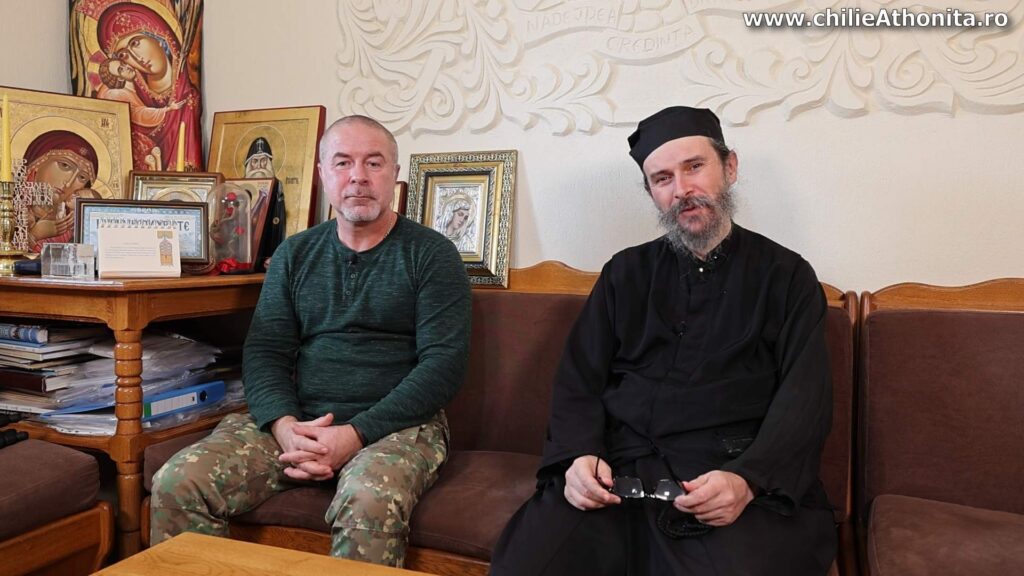
What awaits us in the future? What will we offer our descendants in the future?
Listen to a discussion between Cristi Bumbenici and Father Theologos who, based on the retrospective of the past year, draw conclusions about what we have to do and to pass on to those who come after us.
Enjoy!
Fr. T: Glory to the Father, and to the Son, and to the Holy Spirit, now and ever and unto ages of ages. Amen. Through the prayers of our Holy Fathers, Lord Jesus Christ, Son of God, have mercy on us! Amen.
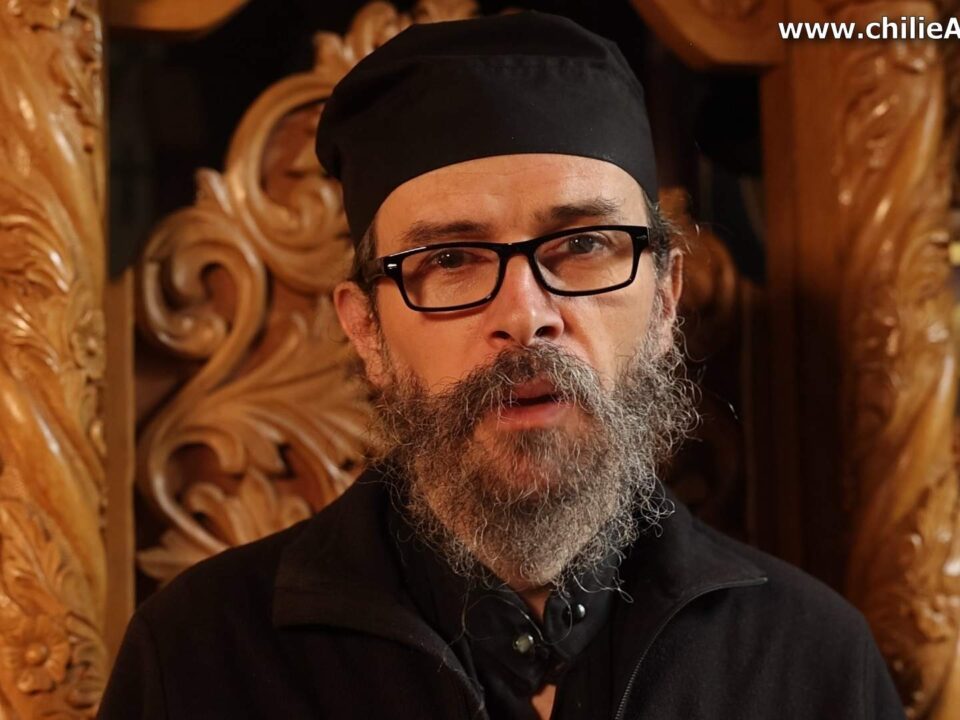
Dear ones, we are once again joined by Cristi Bumbenici whom I love very much, you know him from his channel and from the videos we made together last year. Today, I’d like to have more of a conversation than just a Q&A, even though I’m the host. I want to ask him a question and then discuss freely–the spiritual retrospective of the past year, 2022. I don’t want a standard answer or the “right” answer. Cristi, the only correct response from you is the sincere one. How do you see the year that has passed, 2022, from a spiritual point of view?
CB: Thank you for the opportunity to be with you again! I can offer a journalistic yet spiritual response within one context: I strive to filter my entire professional activity through a spiritual lens for several reasons. The most relevant is to avoid mistakes, to present things as they are, and ultimately, to ensure that these accounts are positive and inspirational for our audience seeking spiritual insights. I took the few seconds I had to reflect on what I might say in the context of a retrospective. I think it would be useful to somehow discuss how – we will probably expand the discussion – Romanians, our friends, emerged from a complicated period—not so much traumatizing as complicated, especially since we lacked the courage to make personal decisions. Some acted quickly, while others took their time, but eventually, they all took this step forward, and others, I believe or hope they are, unfortunately, the fewest, delayed. And this delay can be translated from a spiritual perspective by assuming a behavior in which fear is the dominant feeling. I still see people on the streets in Romania and Greece wearing masks and avoiding others. Their expressions tell a clear story —they are frightened.
Fr. T: Yes, I think fear has become a way of being and I’m not just talking about the pandemic; it reflects a broader range of issues.
CB: Yes, well, I referred primarily to this topic since it has dominated our lives for the past three years. I repeat, this year marks nearly one year since we freed ourselves from the dictatorship of this more or less embellished or overhyped virus.
Fr. T: Yes, indeed, I believe the world has changed a lot. I think that today, especially this year as Romania emerged from the pandemic—while in Greece, as you’ve seen from the testing the pandemic still lingers—many people have lost touch with reality. What do you think about this?
CB: That’s right. It’s very easy to notice but only if we’re willing to open our eyes enough and look around us a little more carefully. There’s a significant disconnect from reality, especially in how we interpret the events around us. This misinterpretation can lead anyone—whether Romanian, German, or from any nationality—down a disastrous path in the medium to long term. We must be very careful in terms of description, translation of reality and above all, to pay close attention to those who insist on describing it to us. In a highly subjective and self-serving manner, detached from our true interests.
Fr. T: Yes, because you see, it impresses me deeply, it always has, but especially this year or well, lately, that the Savior said, “I am the Way, the Truth and the Life.” I mean, God is the one who is, as He said on Holy Mount Sinai— that is, He is truth and reality in and of Himself. And the moment you detach from reality, you detach from Christ. In that moment, others will present you with false christs and gods, leading you into heresy.
CB: In this context, understanding is straightforward: it is very easy to compare. You compare using your own values. Let’s take, for instance, a happy case, a natural case of the man who relates to God: he has understood and accepted, finding himself fully in this space not just of protection but also of growth, where God continuously seeks to optimize him, offering opportunities and many solutions. And then, indirectly, you have countless elements to compare and you compare. [You ask yourself] what is my vision of a phenomenon, of an idea circulating in society, in relation to the other or others who, in the same way, present their own arguments and value systems? And then, when we find common ground, and the same points of reference, it’s clear we are on fertile soil, a place where we can build alongside others. But, again, if we notice that we’re on two parallel paths—one filled with fanciful ideas disconnected from the complete and complex reality God offers us—it’s best to go our own way. We shouldn’t force or persuade anyone, as that’s done only by God, who works in His own way. It is wise to stay within our protective space.
Fr. T: Do you think there’s an ideological war that intensifies, it diminishes?
CB: It’s been around for a long time, but now, glory to God, we, the great mass, can understand it more easily. Why is this so? Because we have access to information like never before. That’s the upside of communication that is also facile for us. Even the often distorted political news give us enough insight to form a somewhat objective judgment. If we look back at the consequences of certain statements—without knowing the communication strategies behind them—we can make a judgement somehow in the opposite direction, and we can draw conclusions. It doesn’t matter how eloquently you speak, whether you’re a politician, a businessman, a social actor, if your legacy is barren land or, worse, corpses are left behind.
Fr. T: Yes.
CB: It’s clear that there’s a disconnect between beautiful words, well-organized communication, institutionally, and the real effects in our lives. We need to care a little; it’s essential to engage if we want to change something in this society, starting with ourselves.
Fr.T: Do you think people are indifferent?
CB: Yes, unfortunately, I do. And it’s not a belief; it’s a bitter observation shared by many who are active in this sea of information we all find ourselves in. We live in an ocean of information. If we don’t carefully sift through what’s necessary and focus on the objective elements that help us understand what’s truly happening, someone else will always make sure to provide their own recipe (version).
Ignorance is very easy to spot through our behavior, through a general behavior. I offer you just one example: look at how easily large social groups react—tens, hundreds, even millions of people in Romania—during a sports confrontation, I mean a dispute between two top teams in the national football championship. Passions, tens, hundreds of thousands of people or millions gathered, mobilized in front of the small screens that consume some fantastic energies. Now, let’s see how many people rallied similarly when we discussed pressing issues just weeks ago, like the decline in our quality of life, the obviously aberrant, unjustified rising cost of living and so on.
Fr. T: What about children’s education?
CB: There are many topics to cover, but I’ll just make a brief analogy because our viewers are always smarter than us and grasp things quickly. We need to get involved. If we only get upset because someone didn’t pass the ball to another, and we spend the whole week discussing that, we’re missing the point.
Fr. T: Yes, and the tragedy that the team lost 3-0 or 2-0, so what?
CB: Meanwhile, when our bills for electricity, gas, or diesel skyrocket three, five, even ten times, we only make scabrous comments at home, possibly in the company of our husband or wife and that’s it, we have no excuse to say we’re not doing well. We’re not doing well because we don’t act!
Fr. T: What do you think people should do, concretely?
CB: People don’t need to do anything spectacular. If someone claims, “It’s complicated and requires years of preparation,” that’s a great lie and it takes us away from God’s project—the project called “Man.” Man has a historical problem with himself, why is that? Each generation, in its time, has faced – is facing – similar situations, and will continue to do so in the future. Until man understands that he is the creation of a higher intelligence, until he accepts that God is the source, the cause, the healing, and the consequence of all movements in our lives, they will grasp nothing. They will flail about like someone trapped in a room, desperately trying to escape through a window, inevitably hitting their head against the glass because the window is closed. Yet, God has given man the wisdom to open the window, to open the door. Until we find at least the curiosity to seek answers to the three fundamental questions, answers which have been given for a long time and we can all grasp—who are we, where do we come from, and where are we going — we will be like that horsefly, spinning aimlessly in a room.
Fr. T: Good, so where are we headed?
CB: Right now? In this way? In this way, we’re going nowhere. We’re heading toward a social and, obviously, individual suffering unlike anything we’ve seen before. You don’t need to be a clairvoyant or a super-sociologist to see that the whole world is boiling. All the countries, especially those leading Europe and the world, are sitting on a time bomb, literally. The one who doesn’t take these issues seriously, he doesn’t live in this reality or has drawn a curtain to avoid seeing. It will not bypass him, as the bills, behold, they’re not bypassing us. Hidden behind a curtain we will still receive bills and not only for electricity, or for gas, we will receive bills with immense social costs and dramatic personal costs.
You might ask me: okay, what’s the solution? You know the solution better than I do. I only come to confirm, as a journalist, that the only way out of this dire situation is a swift return to God. We must reestablish ourselves on the initial foundation He has shown us from the beginning. And He shows it to us even now, He didn’t hide it it’s in plain sight: we need to build a lasting connection with God and start very quickly to work on our individual grounding. God doesn’t ask us—neither you nor me nor many others—to change the world. He simply asks us to change ourselves. Be the change, and many around you will follow suit, some even finding salvation.
Fr. T: Yes. That makes sense and it is something we can discuss at our age and so on. But how many young people will recognize this or how can we help them see it?
CB: Here I believe there are two answers. The number of young people who understand this reflects the number of parents who had discernment, parents who in turn took things seriously and now have a very beautiful relationship with God. Those parents ensured that their children also grew up in this spirit of normality. When we talk about God, we speak of the natural and the normal. We’re not discussing something extraordinary that turns us Orthodox Christians into elites. No. An Orthodox Christian is someone beautifully connected to God, a genuine person, a natural person who creates, seeks the good, brings it to life and shares it.
The second point is that young people need role models. What kind of models? Who provides them? What examples do we set, and how committed and eager are we—those who understand—to attach ourselves to a common project where we not only talk but to share, in an elegant way, horizontally, the goodness we’ve experienced? Further, I believe that God will intervene – well, I am convinced that it will be so but I don’t want to sound too definitive.
Fr. T: So be it!
CB: Perhaps by seeing the desire of some of us to make this happen, it is possible that God will intervene in His own way, to accentuate, to make it so that this horizontal spread of goodness and sharing of positive experiences reach more swiftly and more easily in the minds and the hearts of young people in particular. I sense you’re asking this for a reason. We must be aware continuously that we have been given a baton and, in turn, will be passing on a baton: what inheritance are we leaving behind? Money, house, the account? It’s childish to think like that in these times. The only true inheritance is one that offers our child—tomorrow’s adult and parent—a spiritual optimization so that he too may navigate life through the lens which is God.
Fr. T: Yes, our greatest wealth to leave others is the tradition of experiencing God.
CB: But there is no other.
Fr. T: There is no other, obviously.
CB: In this context, let’s imagine a happy scenario where, for as long as a person lives on this earth—whether in the Amazon jungle or Bucharest—they live because God allows it. They live because God cares for and loves every soul. There are no premium souls or second-tier, lower- tier souls. There is no such thing. Knowing this, what is so hard about being natural? We just need to be natural. It may sound repetitive, but living authentically isn’t a miracle, because to be good is simply to be good. It’s like recognizing two colors—white and black. We can’t call white brown; we see it’s white, and black is black because that’s what it is. That’s how we defined it. So it is with us.
Fr. T: Yes, as Father Rafael Noica said, Orthodoxy is the nature of man. What do you see as the greatest challenge facing the Romanian people right now?
CB: I’m not sure if there’s just one.
Fr. T: Yes, this is why I said the greatest. Or what comes to mind for you now? Speaking of retrospective.
CB: The greatest challenge, which also has a quick solution, is the urgent understanding that, given the events we’re experiencing right now—not in the future, but right now—without God, we risk falling into a dangerously pointless sacrifice.
Fr. T: Yes.
CB: That is the biggest challenge, but the solution lies in our relation with God. God gives us the chance to decide, even in this very moment—if I choose right now to stop the madness, to listen to God, I relate to Him, and I do what He told me. That is the solution.
Another challenge arises somehow as a consequence of what I’ve mentioned so far. Let’s consider a few recent examples from just a few months ago. There were some incidents in our Church—our Church, meaning all of us who enter it, from the patriarch to the last beneficiary of the liturgical act, the layman who walks in every Sunday or constantly, a seeker. I noticed, with displeasure of course, that a number of people —though not a majority— who call themselves members of the church, instead of managing some slip-ups of a few people of the Church, pounced on them. They didn’t just share their opinions; they condemned these individuals, forgetting that those who erred—human as we all are—had been beloved spiritual guides. These were people who had likely helped tens, hundreds, thousands others rebuild their lives, and [those who condemned] behaved like vultures. I sat there, slightly stunned, wondering how it was possible that I, a self-proclaimed Orthodox Christian and man of the Church, could transform into a hyena in mere seconds. I thought, “Man, there must be something wrong with me because I’m naive to believe that once you say you love God, you want to follow His example, you can’t just change like that, in an instant…
Fr. T: Overnight.
C.B.: Not overnight, an almost instantaneous transformation. And I didn’t understand it then, at the moment. Later, the answer I gave myself, come let’s say this is a public confession of sorts—not a guide, just my own reflection.
Fr. T: Yes, yes…
CB: Before we become critics, before we condemn and make absolute judgments, let’s take at least a few minutes, to look towards ourselves in an inner mirror of honesty and ask ourselves, “Who am I to judge this or that person?” I need to reflect on my own life, for there isn’t a soul alive who doesn’t know or recognize their own foolishness or the wrongs they’ve committed.
Fr. T: And if he sees what he has done and how difficult it would have been for him in that situation…
CB: I truly believe that when you look honestly at yourself, you stop criticizing others, even if someone ran a red light or did something else. You just shut up.
Fr. T: Of course.
CB: Secondly, I have a professional suggestion for those working in communication departments of institutions that are also linked to our Church. Brethren, if you represent the Romanian Orthodox Church professionally, do it with professionalism. Don’t turn into critics of those who until recently were pillars of our community and brought a high “rating” (the term is not suitable) to our Church. Anyone can make mistakes. Instead of trampling on them, follow the advice of the Holy Fathers: lift them up, help them stand again on the right foundation, and move forward together. We do not trample on the heads of those who have erred. We help them so we can go forward together. That’s how I interpret the call of our Savior and the apostles: to help one another move forward well.
Fr. T: Yes, we should not validate sin, but we must care for the sinner!
CB: Of course, we must help him! The saints are up there, and down here are those who need treatment, starting with me, obviously.
Fr. T: Yes, that’s right. I am very optimistic about the future, but I see that things will be quite critical in the coming year, in the future. Are you optimistic?
CB: I’m not pessimistic.
Fr. T: Oh, you’re not pessimistic.
CB: No, I’m not. Especially during this time, I prefer to adopt a realistic outlook, as much as I can manage. Everyone has their limits. There are many external factors we can’t control or understand right now, but the only concrete element that has remained, is, and will be and that gives us complete certainty that no matter what will happen – if it happens, if God will ordain it or allow it to happen – the only constant in our lives is God. Together, with God, even if we face storms, we will have either a tree to shelter under or an umbrella that God will guide us on when and how to open.
Fr. T: Yes, I think that’s what the Church is. I think Romanians face a significant challenge: the challenge of unity within the Church, which I’m not sure we fully have.
CB: And it’s not just that, father! Here I come again, maybe this time I’m very optimistic. It is not only about the Church because choosing to follow Christ means going beyond mere civic, moral, and social balance. To live by moral principles, we shouldn’t have to struggle. We know we shouldn’t kill or steal, and so on.
Fr. T: Yes, although the passions…
CB: When a person takes that step into the Church, it signifies a complete restoration: battling their passions, understanding them, freeing themselves, and the shaping of man according to the original design. Why do I say that I am optimistic here? Because people who live by sound moral and civic principles—those universally recognized across all nations—hold great positive potential. They instinctively seek a deeper good, including spiritually. Glory to God, I don’t know why, but we have this incredible chance to be born into this wonderful nation—the Romanian people, an Orthodox people. We didn’t start from minus ten; we began from plus ten. We know these things. When we’re baptized, we receive a kind of visa-free passport. It serves as both a passport and a record of our behavior. The final visa will come from God once we leave this world.
But referring strictly to these friends of ours in the Romanian society who live rightly and seek goodness, and I think we could at least offer them for study this project that God has left for everyone’s study. Now, our only advantage is that we’ve read the instructions, know how to use them, and have some experience in our relationship with God. It’s our duty to bring it to their attention, providing information and engaging in dialogue, just as you do so beautifully and helpfully, to help them take the next step. That next step is simply a choice. What can we do? We multiply God’s message, nothing more.
Fr. T: Yes, and we can offer examples. May the good Lord help us!
CB: Lord, help us!
Fr. T: Through the prayers of our Holy Fathers, Lord Jesus Christ, Son of God, have mercy on us! Amen.
Online commemoration lists and donations
May the Lord help us!
Online Commemoration Lists and Donations
May the Lord help us!
If you have a bank card and wish to send commemoration lists and donations online using your card, and/or to support our philanthropic activity, including this site, please fill out the form below to make a small donation. The form is secure – we use Stripe for payment processing – a world leader in this field. We do not collect your personal data.
If you do not have a card, or do not wish to use it, visit the webpage for Online Donations and Commemoration Lists.
We will pray for your loved ones! (Please do not include inessential details like wishes, degree of kinship, introductions etc. JUST the name!)
Especially for recurring commemoration lists, we ask that you please keep them to under 20 names long. If you include a member of the family, we add “and for their families.”