

Young People Face-To-Face With the Values of Life – Father Pimen Vlad
21 January 2023
The Desire for True and False Miracles – Father Theologos
24 January 2023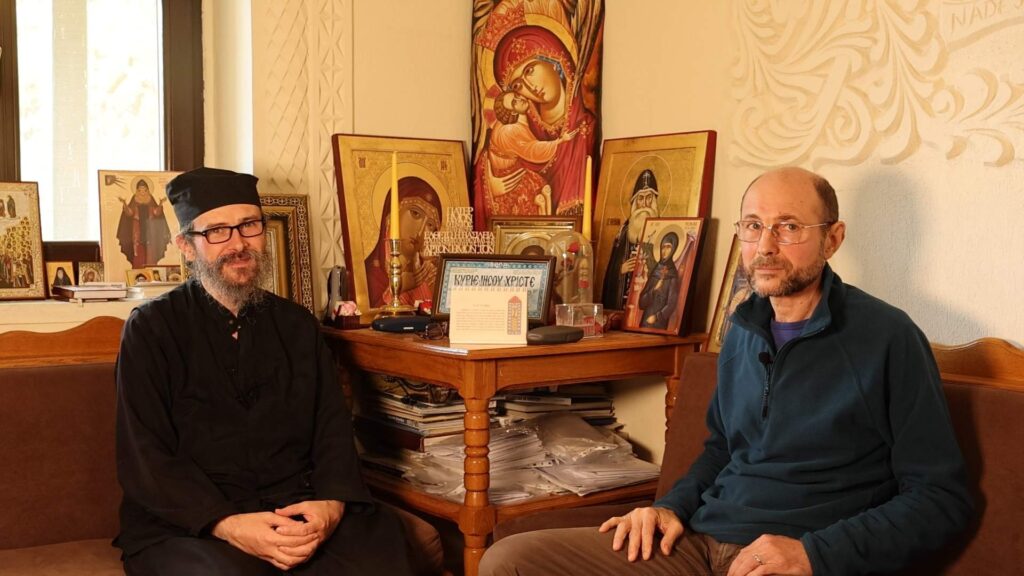
Watch an extremely important discussion with Cristian Filip, president of the Parents’ Alliance of Romania, about the challenges and grave temptations the family is confronted with today.
Enjoy!
Fr. T: Glory to the Father, and to the Son, and to the Holy Spirit, now and ever and unto ages of ages. Amen. Through the prayers of our Holy Fathers, Lord Jesus Christ, Son of God, have mercy on us! Amen.
We are here with Cristian Filip, whom I have known for some time, who is the president of the “Parents’ Alliance.” Here at our cell and on my initiative, we are going to do a little… well, let’s not call it an interview, we will have a small discussion with Cristian because the Parents’ Alliance is sadly a very necessary structure today for parents and especially for young people. I would have preferred it not to be [necessary], but unfortunately, the conditions and especially the education – and when I refer to education, I don’t necessarily mean school education, but generally to the unorthodox cultural imperialism. These unfortunately make this organization, this structure, very necessary. Could you tell us a little bit about what it does?
C.F: The Parents’ Alliance is a non-governmental organization. It emerged primarily in response to the increasingly pronounced tendency of state interference in the life of the Romanian family, repeatedly trampling on the fundamental rights of parents to educate their children according to their own moral, philosophical, and religious beliefs. It arose initially as a reaction to the growing trend of introducing comprehensive sexual education in Romanian schools. Our attention was drawn to this issue by parents and, not least, by teachers themselves, because at that time teachers would tell us, “Sir, since organizations have come in and started to introduce sexual education in schools, we have practically lost our teaching authority.”
Fr. T: So they were actually forced?
C.F: In a way, yes, because the moment these organizations came in, [the teachers] said, “When the sexual organ is placed on the desk where the grade book is, where the teacher stands and teaches, from that moment the child no longer sees the teaching authority in front of him.”
Fr. T: God forbid!
C.F: Yes, and these things happened over time without sex education having been specifically included in the curriculum. Thus, we, a group of parents, took a stand, and this organization called Parents’ Alliance of Romania was founded about six and a half years ago, and basically, it’s not nice to say so, but we have been like watchdogs for the parents, as I said, in response to the increasingly pronounced intrusions of the state into family life.
Fr. T: But I’m thinking now, from what I understood from you, it is not really the state, but actually some non-governmental organizations that have the initiative, right?
C. F: That’s very true, however, these organizations have managed to exert influence over the ministries, slowly but surely, implicitly within the Ministry of Education, of course, which has a predominant role, and from there this tendency to introduce comprehensive sexual education has started. I say [comprehensive] again because it’s not the same thing as providing a delicate education in the area of biology and anatomy from a certain age, and another to want to introduce, according to the standards of the World Health Organization, from the age of four or six, that children should be explained how it would be good to move toward the area that is so much discussed now, called LGBT, how it is appropriate to feel like a girl today, tomorrow a boy…
Fr. T: Gender fluidity…
C. F: …the day after tomorrow all kinds of fluid genders such that you no longer understand anything. And in this context, it’s clear that there’s an intervention in family life so that parents and children no longer have a natural life as we have known it for so many years. Aside from that, trying to introduce sex education is nonsense because, thank God, for over 2000 years, Romanians have constituted a healthy nation, a nation that has given the world so many recognized figures of value throughout history in all fields. That is, we have inventors in all areas of interest in the world, from the medical field to Coandă’s famous jet aircraft, of course.
Fr. T: Yes, I am very struck by this issue too. That is, it’s not about, how to put it, traveling to Mars or artificial intelligence or new biotechnologies being a topic for discussion. It’s a very old topic; this area of sexual problems has been known for a long time, and of course the results are also known.
C. F: Moreover, I have a definite example. One of the people who has spectacularly marked my life, I could say, is Mr. Dan Lucinescu, with whom I started on this journey 14 and a half years ago, when together we founded the Fr. Arsenie Boca Christian Foundation. Mr. Dan Lucinescu is one of the former confessors and political prisoners who served 15 years in prison. And I have brought him multiple times to speak to the youth. We even organized camps with young people, and one of the things he would say was this: dear ones, try to stick to your studies until you finish high school! You have time to do the things of life after that, like drinking and girls or boys, depending on what you are, and so on. I mean, there’s another aspect, if sexual education were to be implemented, it should start with scientific terms to understand the fact that the prefrontal cortex is not sufficiently developed. If we want to talk to the youth, we should discuss hormones and pheromones, how a girl should know that if she plans to have a relationship with a man, with a boy, well, a young man, if she stays longer than 16 seconds in his arms, she will be greatly influenced in her relationship with this boy by her closeness to him. Why is this so? Because that is when the chemical processes take place, specifically the pheromones we discussed. These are simple matters for scientists, that are known, of course. At a young age they react emotionally and don’t yet have a fully formed mind…,
Fr. T: [Don’t have] the maturity necessary…
C.F: … the maturity for informed decision-making. Condoms that are not even 100% safe are often promoted, various methods leading to the termination of pregnancy are advertised, and I have noticed that over the many years of advertising, even adults, even some elderly, have appropriated this message which our, let’s call them opponents, have succeeded in promoting throughout the years. Namely: too many abortions, too many young pregnant women, and too many sexually transmitted diseases. However, studies conducted in the United Kingdom, Denmark, Sweden, Italy, and France, countries where sex education has been implemented for over 50 years, since the introduction of sex education, the number of abortions has increased, and sexually transmitted diseases have surged by as much as 500% compared to what it was before. We, as the Parents’ Alliance, requested some documents from the National Institute of Public Health to understand exactly what happened over time, from 1990 onward, because until ‘90 abortion was prohibited. And we found a significant decrease in the number of abortions up to today compared to the year 1990.
Fr. T: Glory to God! A decrease?
C. F: A decrease, when one of the first laws passed at that time – very, very interesting what the government did back then -, the Romanian government, let’s call it, enacted the law granting freedom to choose abortion. Following that decision, the number of abortions surged in 1990, and since then, it has been significantly decreasing. This decline does not imply that they ceased entirely. It is true that not all cases are recorded by the Institute of Statistics, as many private clinics operate outside the official count. However, a growing number of doctors across Romania recognize that abortion is not merely a termination of pregnancy, a technical matter; it is, in fact, a crime against an innocent child who cannot defend himself.
Fr. T: A crime… Yes…
C.F: As adults, we must remember that one always pays a price for committing a crime.
Fr. T: Of course.
C. F: And sometimes it could be… I don’t want to say something bad especially from a theological point of view, that is to say that it could be justified. We have the case of war now, right? Some argue, “We are defending ourselves; we can shoot the others or kill them.” There is a basis for it in his mind. On what basis do you kill a child in the mother’s womb?
Fr. T: Yes, and especially the mother being the one who does it…
C. F: Exactly, with the mother’s consent. Often, mothers make this choice under outside pressure—from parents, society, or the partner with whom…
Fr. T: The father, yes…
C. F: Exactly, yes.
Fr. T: But beyond these technical, medical effects, are there also spiritual and psychological consequences, are there traumas that…?
C. F: Always, always. From all the discussions I’ve had over many years, there are many, many testimonies from mothers who have terminated their pregnancies, who have had abortions, and afterward have experienced all sorts of psychotic episodes, cancers, and personal tragedies, often finding they can no longer bear children although they deeply desire to.
Fr. T: Yes…
C. F: Today, we are talking exactly about this demographic winter, this negative birth rate, and look, the Romanian population has decreased dramatically.
Fr. T: To explain, negative birth rate means births fall below sustainable levels, where more people die than are born.
C. F: Exactly. Let’s not forget we had a census this year.
Fr. T: Yes. And?
C. F: We concluded that our population has decreased by several million…
Fr. T: Seriously?
C. F: Yes, I don’t know how many millions, 18, 19?—have participated in the census in Romania. We used to be between 22 and 23 million. At this rate, where are we headed? Estimates suggest that in a few decades, Romania’s population could dwindle to 10 million. Professor Ioan Aurel Pop, President of the Romanian Academy, has stated that a territory that’s no longer populated will inevitably be inhabited by others. Is this what we want in Romania? For others to come and populate our Romanian millennia-old land?
Fr. T: What exactly does the Parents’ Alliance do?
C.F: Over the past six and a half years of existence, the Parents’ Alliance has often intervened in the public sphere with memoranda, notifications, and… not least, even protests when necessary, addressing various topics of general interest, at a time when, effectively, the interest of parents and children was affected at a national level. Because the interference I speak of extended beyond the attempt to introduce sexual education in Romanian schools. It has escalated into an effort to re-educate parents, calling them to schools to be prepared and to agree to explain to their children that it’s good to agree with the new gender ideologies, with all the garbage… Because, look, the West has brought us some good things, but also a lot of very, very grave things for society.
Fr. T: Exactly… I believe the price we pay for technological ease, for technological convenience, is the price of our souls, it is the spiritual price, which is a great cost.
C. F: Unfortunately, yes… Over time, to be concrete, we have done, regarding protests but also amendments, repeatedly…. We have a legal office at the Parents’ Alliance that is very warm-hearted and very sacrificial.
Fr. T: May God bless them!
C.F: The key figure here is Marina Ioana Alexandru, our lawyer, supported by Adrian Aciu, but over time, many others have also contributed to all the works of this legal office. Their sacrifice over the years has been extraordinary.
Fr. T: May God bless them!
C.F: Lord help us! For the cause of the Romanian family, particularly concerning the mandatory vaccination issue where… People are unaware, for the most part, some believed it was about vaccinating children, not understanding that the law mandated vaccination for the entire Romanian population. And we even faced an absurd situation with individuals who claimed we opposed technology, science and so on. This was because they believed it was about children, vaccinating children. When they found out that it also included the vaccination of adults, so this story included them too – “Oh, but that doesn’t seem right anymore!” So what kind of parent are you?
Fr. T: You sacrifice your child…
C.F: Exactly. The situation was very insidious. What people failed to understand was that what was being introduced through that law was the notion of presumed consent. Presumed consent assumed that regardless of your position, you are considered to agree to…
Fr. T: Oh, so you are implicitly agreeing. You must act to disagree…
C.F: In this context, lawyer Marina Alexandru made an extraordinary remark to a health minister. She said, “Madam Minister, in a situation where presumed consent is understood to apply to mandatory vaccination, that implies that the individual lacks discernment. This means that neither you nor anyone in the leadership of this country possesses discernment. How can we resolve this issue?” They realized, of course, that it was absurd and, for now, things have calmed down, so to speak…
Fr. T: Glory to God!
C. F: Indeed, these events unfolded before the pandemic, which stirred things up even more.
Fr. T: Oh, so it happened before the pandemic?
C. F: This was before the pandemic, certainly. So the challenges were very, very insidious, cunning, I don’t know, even persistent, and they are escalating on more and more fronts. Of course, some of the parents recognized this and grew angry with the so-called authorities—those we believe no longer represent the interests of the Romanian nation.
Today, much of what is done seems to oppose the Romanian ethos, to oppose national identity, and the very existence of our people. It is undeniable!
Fr. T: How do you see the situation in the future?
C. F: As people of God, I believe we must look to the future with hope. I think it’s crucial to return to our roots and reflect a little on the past in order to have a bright future. What am I thinking about? I am thinking about the fact that parents must embrace their roles seriously, engaging with their children not just with authority but, first and foremost, with love. When you approach your children with love, they see you as a model, and they carry that example forward into their lives.
Our educators must somehow reclaim the same model of love. Why is this so? I reflect on our history, such a rich and beautiful history, and one example comes to mind right away, because we have before us a book titled “The Poem of Prisons,” and the example of Nichifor Crainic comes to mind, a man born into a financially extremely modest family, so they could hardly support themselves materially, and at that time his family would have greatly needed to have him continue to support them to get by. And yet, Nichifor Crainic at that time had an exceptional teacher, his name was Constantin Stâlpeșteanu, who recognized the potential, the genius that the little child – at that time, Nichifor – had. And he persevered in asking Nichifor’s father to send him to school further, instead of keeping him at home to work the land, to tend to animals and so on. His father was a peasant like many Romanian peasants throughout history, that is brilliant, with a pure soul…,
Fr. T: Yes, illumined.
C.F: …and when you have a pure soul, God gives you the grace to understand many things. So then, his father decided to send him to school, and since he had no money for tuition, what did he do? He sent him to study theology at the seminary. At the seminary gaining admission was difficult, as even back then, there were all sorts of arrangements, and both his father and the teacher Stâlpeșteanu were aware that it would be very hard to get in. His only chance was to get in first, and then they had no choice but to let him in, and he attended the seminary. From there he became the great…
Fr. T: So he placed first?
C. F: First or anyway among the top three and became a great thinker of our nation, the one who initiated the current of “Gândirism” and we know the whole story.
Fr. T: Exactly. University professor.
C. F: Indeed, he brought God into the Faculty of Theology through Dostoevsky. He introduced Dostoevsky to Romanian theology, teaching courses that even Father Arsenie Boca attended, those of Nichifor Crainic. A monumental figure in our history.
C. F: Speaking of fathers, how do you view parental rights over children and the relationship between parents and children, especially today when children often react immediately when something happens? This is particularly prominent in the West.
C. F: Yes, here I think that again, it’s love that serves as the foundation, because if you approach your child with love, educating them in a spirit of love, of spiritual purity, and closeness to the church, I don’t think any issues of not recognizing parental authority can arise anymore.
Fr. T: Yes, yes. Of war…
C. F: Of war, exactly, because it’ something that is earned naturally. A leader, for instance, is recognized by others; they don’t impose themselves through force. I was thinking about the animal kingdom, where dominance is established through strength. But in the case of humans, a leader is someone acknowledged by their peers.
Fr. T: That’s right. …much like parental authority is recognized by others. I’m thinking here of one of my closest friends, Aureliu Surulescu, with whom I founded – speaking of leaders – a civic platform called Lider [Leader]. I remember one evening, as he shared stories from our childhood, he spoke of how his father’s word was law. He would simply look up or glance in a certain way, and though he had a strong personality as a child, he never argued. This is why I believe authority is earned naturally through the example you set as a parent.
Fr. T: Exactly. You must be an example.
C. F: The same authority exists at school. Let’s not forget that there are countless teachers who don’t need to be harsh with children, and yet the children listen to them.
Fr. T: Of course.
C. F: Why is this so? Because they convey something. I truly believe in this power of the soul that is transmitted from one person to another. I have an example of a former colleague from the Father Arsenie Boca Christian Foundation, who graduated in Theology and became a religion teacher. At one point I asked her, “Hey, how is it at school with the kids, how do you manage?” Because everyone was saying the children are becoming increasingly wild, unruly, loud, they don’t listen to you anymore. Why is that? Because they come from homes burdened by the misunderstandings between their parents… there are many aspects to this. And she replied, “Only now do I understand how much God loves us!” An extraordinary image.
Fr. T: Yes, yes.
C. F: “How so?” “Well,” she said, “You can only hold these kids in line with a lot of love.” That idea stuck with me, and I connected it to how deeply God loves us.
Well, if you, as a teacher, struggle with 30 children from the same country and similar backgrounds, and the same social class more or less – as things have levelled a lot today – the how does God manage billions of people from all walks of life? It’s a thought worth pondering deeply, with much attention…
Fr. T: …With much attention and much gratitude, I believe, yes…
C. F: Exactly, exactly, yes. So that’s how I see it briefly– love is what solves everything. Let’s not forget what Valeriu Gafencu, known as the Saint of the Prisons, once said in prison. He told his friend there in prison, “Aristide, Aristide…” – he was talking to Aristide Lefa – “…love is the most powerful weapon in the world, much more powerful than the atomic weapon.” And here we are, at a moment in history where we face a dramatic situation nearby, somehow. Yes, I had forgotten we are no longer in Romania now; we are in a different Romania. Here, at Lacu Skete, I truly feel this other Romania.
Fr. T: That’s right.
C. F: So we are in the vicinity of a war, people are more and more frightened and tense, scared of what lies ahead, not realizing that love can resolve everything. We do not realize that it starts with each of us, from within us. If we each manifest this love now in a historical context where normally Romanians could look quite harshly at Ukrainians and yet they responded remarkably in history, before God, through the way they helped and welcomed them. Also brother Aureliu Surulescu said that a Ukrainian told him – “Well, we wouldn’t have done such a thing in your place.”
Fr. T: Yes, obviously…
C. F: He said, “We would have waited for you with guns at the border and would have shot you one by one.” So this is what a Ukrainian said, but what did we do?
As Fr. Justin Pârvu used to say – after he got out of prison, he was at the Monastery of Bistrița, and at one point the man who tortured him in prison shows up at the monastery. His abbot told him, “Give him something,” since he was in obedience at the bee hives. And he said, “He gave me gall, and I gave him honey.”
Fr. T: Glory to God!
C. F: Yes, so this is the Romanian ethos and if we integrate in this ethos, if we reintegrate, we return to our roots, we have every chance for a bright future for our country and our children. Therefore, what should we pass on to our children? Let’s pass on love to our children!
Fr. T: Exactly! So, in the end, talk about the spiritual life in the family and the relationship with God.
C. F: It’s necessary, we can’t otherwise.
We, as a family, are the small church. Our relationship with the Church starts from our home, from the way we relate to that church of which we are an integral part. I think again of our ancestors, as Father Dimitrie Bejan used to tell. He described how his parents knelt in prayer each evening before the icons, with their three children gathered around and the mother would say, “Lord, what should I do? Look, this child is a little naughty, the other is well-behaved, but I don’t know how to handle this one.”
The father would place his hand on their heads and say, “Lord, today I had nothing to feed them. The hen didn’t lay enough eggs, and the cow didn’t give milk.” And, the next day, the cow would provide milk, and the hen would lay eggs. Life is so simple, yet it has grown complicated today for our children and for us because we hand them TikTok and smartphones. We think we’ve solved the problem. Instead of spending time with them, giving our time to our children, we have other things to do. We have a match in the Champions League, we have, I don’t know, anything else, we have…
Fr. T: …to make money!
C. F: To make money. For sure. [Saying] “I’ve given them money; I’ve done my part.” It doesn’t work that way! I’ve been a poor example in this regard. In my youth, I was caught up in the same distractions. God allowed me to understand this later on, but now, this is what I can say from my own experience and that of those I’ve known in this life.
Fr. T: Thank you very much! I believe Romania nevertheless will have a bright future even if it may be a bit painful at times, because I believe the Romanian people have shown their worth, especially in their relationship with the Ukrainians, and there is much devotion in our nation. I believe that devotion exists, and God will not extinguish this flame.
C. F: I believe even more than that. Besides this ethos that we need to go towards, there are still people who also look at the pragmatic side of things. These are individuals who sacrifice their time and family life to stand before God and answer the question, “What have you done for this nation? What have you done for these generations?” And in this regard, I want to mention the fact that a few months ago, this civic platform appeared in Romania, The League for the Awakening of Romania, briefly named LIDER, at the initiative of the Neamunit Association and of Aureliu Surulescu, which managed to unite several organizations from the Romanian civic area, organizations that have done something over the years in the civic realm and who are trying to come together to further defend the rights of Romanians, our rights to express ourselves beautifully on this God-blessed land called Romania.
Looking ahead, LIDER aims to create a different kind of Romania—one that is more beautiful, where Romanians feel at home and comfortable both in their skin and in their country.
Fr. T: May the good Lord help us! Through the prayers of our Holy Fathers, Lord Jesus Christ, Son of God, have mercy on us! Amen.
Online commemoration lists and donations
May the Lord help us!
Online Commemoration Lists and Donations
May the Lord help us!
If you have a bank card and wish to send commemoration lists and donations online using your card, and/or to support our philanthropic activity, including this site, please fill out the form below to make a small donation. The form is secure – we use Stripe for payment processing – a world leader in this field. We do not collect your personal data.
If you do not have a card, or do not wish to use it, visit the webpage for Online Donations and Commemoration Lists.
We will pray for your loved ones! (Please do not include inessential details like wishes, degree of kinship, introductions etc. JUST the name!)
Especially for recurring commemoration lists, we ask that you please keep them to under 20 names long. If you include a member of the family, we add “and for their families.”