

Youth and (Lack of) Values – Fr. Theologos
28 January 2023
The Greatest Temptation People Face – Father Theologos
1 February 2023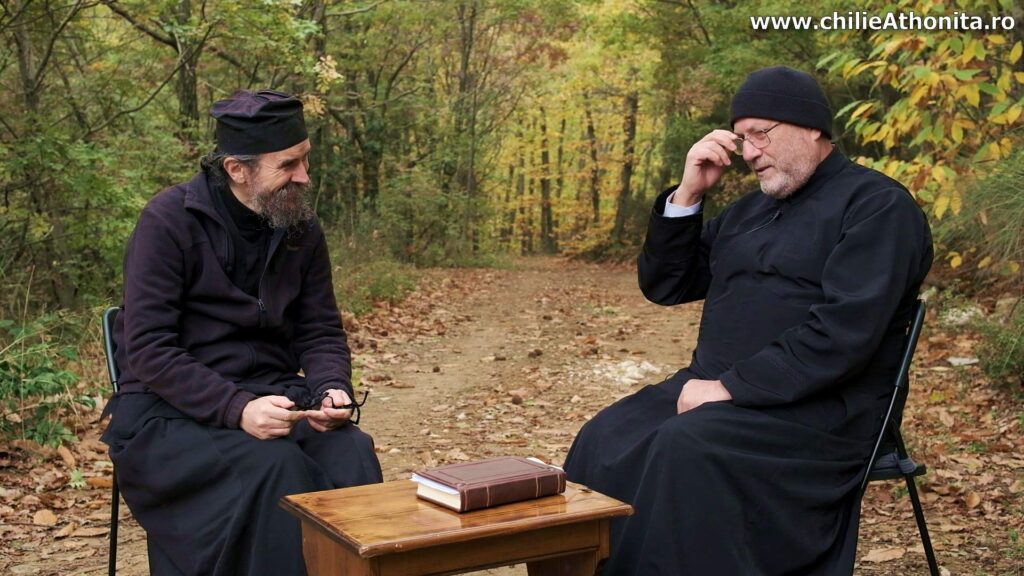
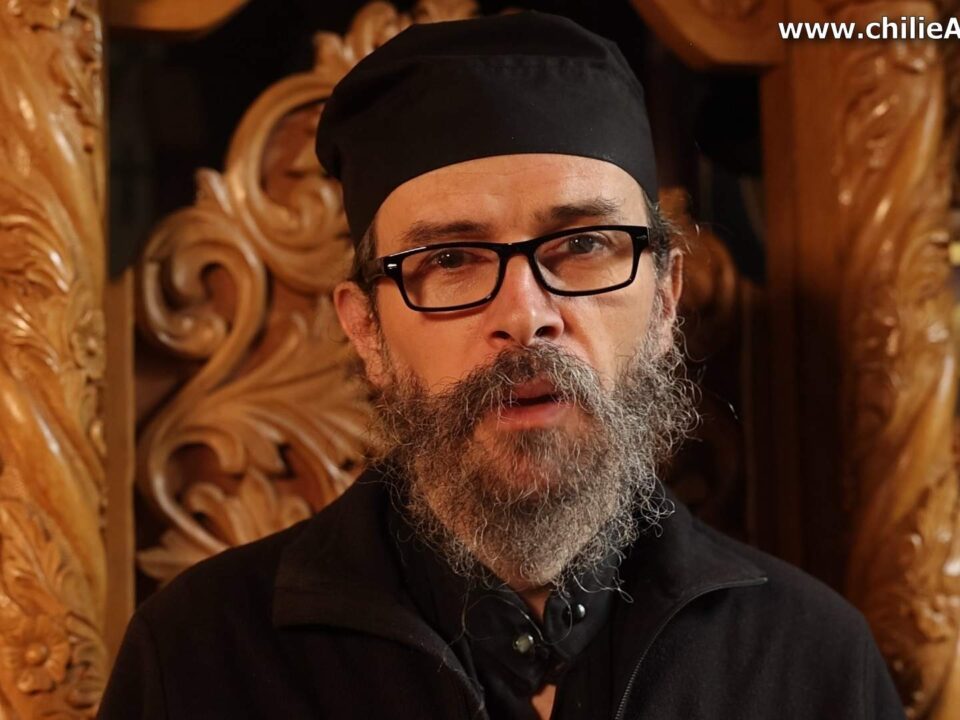
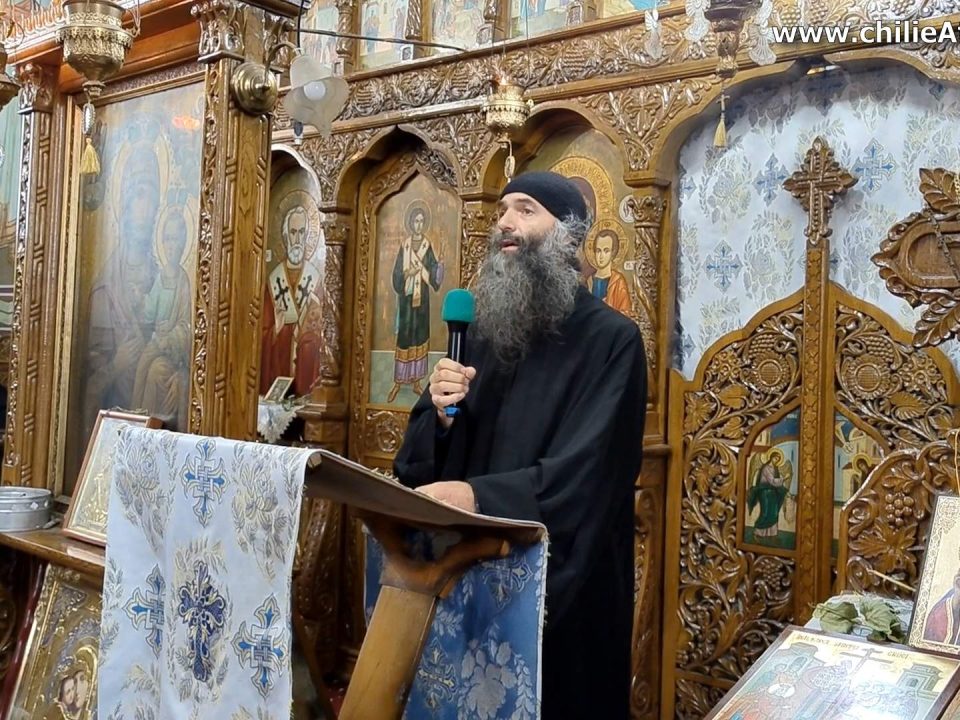
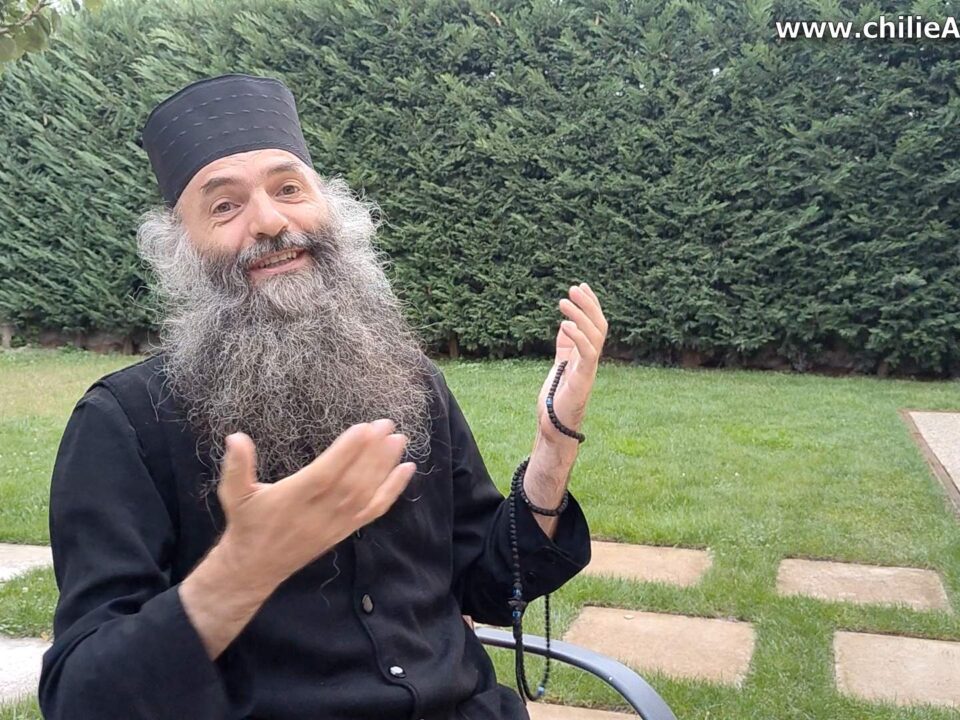
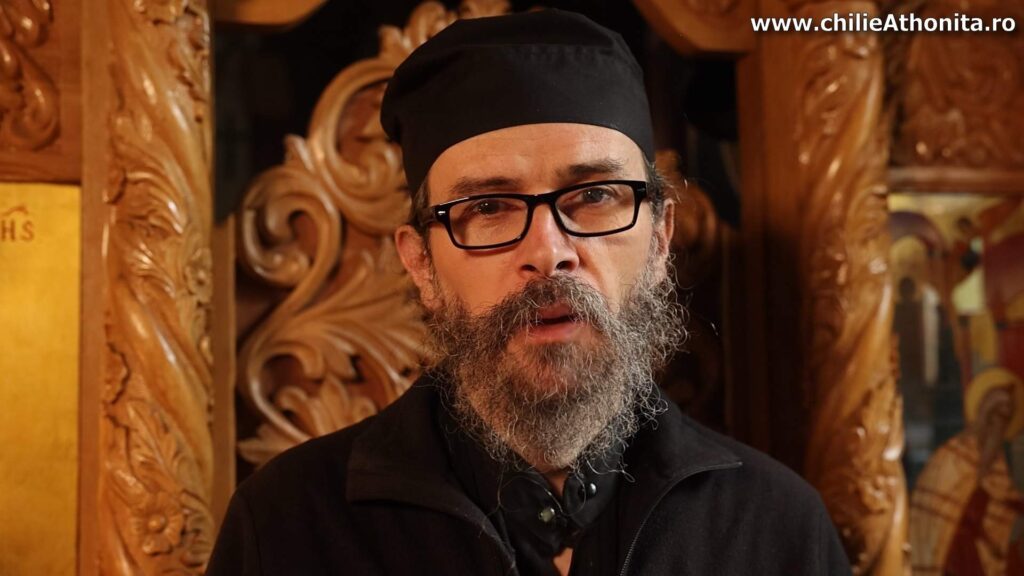
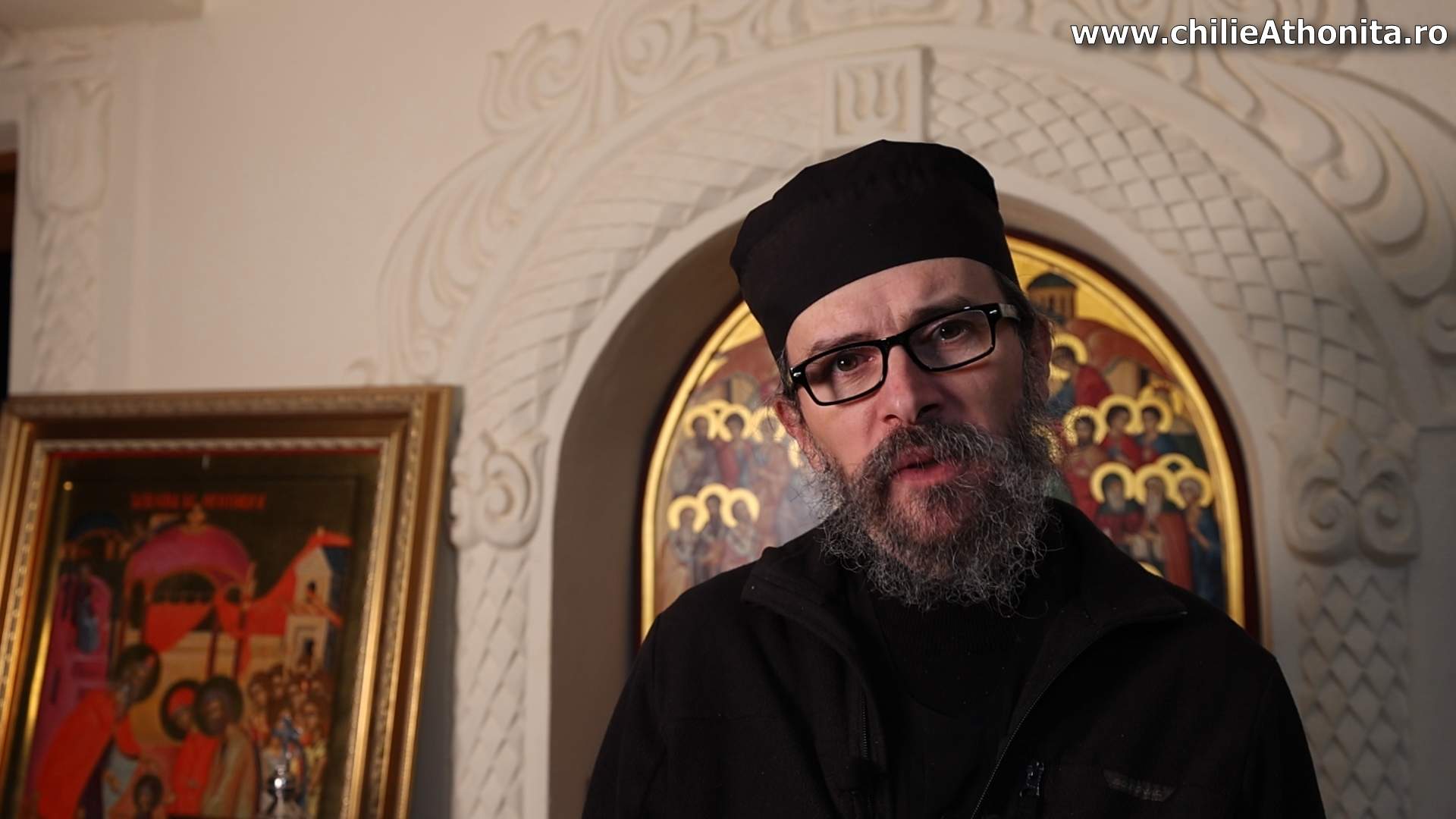
Watch a personal and delicate interview conducted by Father Radu Brînză, coordinator of the ‘Pro Vita’ Association in Iași, with Father Theologos, in which aspects of a young man’s journey from layman to monk are revealed.
Enjoy!
Fr. T: Glory to the Father, and to the Son, and to the Holy Spirit, now and ever and unto ages of ages. Amen. Father, bless!
Fr. R: Lord Jesus Christ, our God, through the prayers of our Holy Fathers, Lord Jesus Christ, Son of God, have mercy on us! Amen.
Fr. T: I interviewed Father Radu Brînză, and now he wishes to interview me. I will let him take the lead.
Fr. R: Yes. Obviously, I’m nervous because this is the first interview of my life, and I’m doing it with all my love because I am in a place that is very dear to me here at Lacu and in the very dear presence of your holiness. If I were to give it a title, I would call it “On Changing Places” or “A Dialogue in the Mirror,” as it is all in my benefit. I aim to remain grounded in the Pro Vita mission while engaging in this conversation with you. I will start with a truly Pro Vita question: Why Pro Vita? If I ask myself this question – it’s because I coordinate, I have this mission at the diocesan level – but the question now is for you. Why is Pro Vita a cherished topic for Father Theologos?
Fr. T: It’s not. Let’s understand why. I’m trying to love Christ. I’m trying to love Christ, and within Christ, through Christ, we must love people. Because St. John the Theologian says that he who says that he loves God and does not love his neighbor is lying. Well, how can you not love the neighbor you see and love God whom you do not see? How is that possible? It cannot be! When we love Christ, love for people naturally follows as a consequence of our love of Him, of God. If our love for people distances us from Christ, it is no longer love of people, it is a perverted love. But if we see that within ourselves, our love for God grows, through our love of people, then that love is true and genuine, and then we progress. In this case, we help Pro Vita and many others through our actions, because, in fact, we engage in these efforts not for monetary gain or any other motive, but for the sake of people because in this way love grows within us. Our love for God grows, we receive grace.
Fr. R: In other words, in perfect love, there must be both Christ and man.
Fr. T: Of course. Through Christ…
Fr. R: Through Christ to man and through man to Christ.
Fr. T: Of course.
Fr. R: Often, we discover Christ through our neighbor, through his attitude, through their reflex of love that sometimes appears in…
Fr. T: Of course. Usually, sometimes, today, all sorts of short-circuits occur, you should know, meaning sentimental love appears, as you’ve reached this point. For example, a boy passionately loves a girl or passionately loves an idol, that’s actually what it’s called – a composer, a singer, someone – this is a short-circuiting of love, it is not through Christ, and this burns the other person to ashes, effectively finishing them off.
Fr. R: This is what the Holy Fathers refer to when they talk about love; they talk about three levels: supernatural love, natural love, and unnatural love.
Fr. T: Of course.
Fr. R: We’re here in a realm of unnatural love, when it’s extremely selfish, the love when you’re focused only on your own pleasure.
Fr. T: That’s right.
Fr. R: We’ve moved past the first question, let’s tackle the second. The child… or the childhood… Of course, respecting intimacy and the monastic vocation in which only the face of Christ is seen, and should be seen, there are some experiences from my childhood that have helped me greatly in life and continue to help me. For example, I grew up in a family of five, with four older sisters, and because I had the feminine image before me, I was left with a certain sensibility, in the sense that I believe a man should be extremely gentle in front of a woman. Lacking a brother, sadly, it taught me to value friendships and to long for that brother and I must say that I have some very good friends ever since high school, from the first years of school and we are still, as we say, like brothers. Can you share how your experience before becoming a monk has helped or is helping you now? The child Theologos…
Fr. T: There are two distinct aspects here: one thing is the child Theologos and another is how my experience before becoming a monk helped me.
Fr. R: Yes.
Fr. T: They are two different things. What helped me a lot in school was that there were some outstanding, eminent professors, among them a hacker who taught me how to think. This is crucial. I mean, we need to learn how to think, and we go to school not just to learn facts, but to have life examples, people who are examples for us, and I especially thank all the teachers, mainly from high school, as it’s now called, “Moise Nicoară” National College in Arad, may God bless them, and from the university I attended. Because beyond the details that I’m not sure I remember, it’s about how to think. We must learn how to think. The child Theologos and, in general, my youth, at this time, when you asked, was a blackout, meaning everything disappeared. Because living in Christ is so intense that living in memory is a passion. Man must live in the present.
The devil always tries to steal a person’s present or pushes them into the past “How good it was…” in the barrel of melancholy and so on, or into the future: the Antichrist, 666 and what will be. No, we must live in the present. The present is salvific. We must live now. Here. Here and now. That’s why a monk, a spiritual person – the monk, should be an example of a spiritual man – your misfortune is that you came across me, the monk must have a crystal-clear mind so that he can love Christ and through Christ, love everyone. He must be free of parasites—that is, thoughts devoid of substance in daily life —like “How nice it was in Geoagiu,” and I don’t know what else. I think I went to Geoagiu once or twice; I don’t remember what happened there. As I was saying, it is vital for a person to live like a diamond, with an undistracted mind, this is actually the fruit of prayer and this is actually the fruit of Orthodoxy, brothers. Orthodoxy heals the human mind, transcends death, overcomes torment, and overcomes fragmentation. This is the role of Orthodoxy, brothers.
Orthodoxy is not, how shall I say, the bread, koliva, and the candle, which of course will be present at the right moment, during the service, but it is about restoring the fragments of Adam. This is man, and so at the moment when the monk walks through obedience, through humility and all the others… as I said, your misfortune for encountering me, all these things of the past disappear. They vanish. And then man effectively doesn’t remember. They only remember when grace allows them to share a beneficial story from their experience. They tell it, but otherwise he does not remember what happened.
Fr. R: But the childlike state…
Fr. T: Yes, yes…
Fr. R: That should never leave you.
Fr. T: Never, never. The childlike state, this is something else, the Holy Apostle Paul says, “Brethren, do not be children in understanding; however, in malice be babes…” meaning, the mind must be like a diamond, as I was saying, it must be made of steel, very strong, but very loving. This is a paradox of God, but it can happen through God’s grace, and it must happen through His grace.
On the other hand, you must be childlike regarding sin, that is, to be pure, having no tangency with sin, to be simple. Not simplistic. Simple. Yes? And this simplicity leads to perfect knowledge because God is simple. Even Einstein used to say: if you want to explain a physical phenomenon and you can’t explain it to a five-year-old, it means you haven’t understood the phenomenon well. And then a great comedian, who of course, behind the fact that he was a great comedian, was also a very smart man, a very wise man, made a pun with a very deep meaning that said, “Mr. Einstein, the Professor, was right, our problem is to find a pure five-year-old child.” Because we are totally distorted by sins, by hypocrisy, self-interest, and so on.
Fr. R: This brings to mind the concepts of innocence and infantilism…
Fr. T: These are two totally different, opposite things…
Fr. R: Let’s beware infantilism, but let’s preserve and discover our innocence. Your answers are very beautiful and are throwing my planned agenda off course, but I’m glad we’re exploring unexpected areas that are beneficial.
Next question: my mother and our Mother? What is the relationship between our biological mother and our Mother, the Mother of God?
Fr. T: Yes.
Fr: R: Where do we place our mother in our existence? And how do we bring her alongside..
Fr. T: We must love all people, of course, so that includes our parents who collaborated with God to bring us into existence. This involves a counsel of five: the three Holy Persons of the Trinity and two others—a man and a woman. I mean we are talking about something very profound, very high. Yet, the Holy Fathers say the following, often shared in the Holy Mountain, and there is a true story related to this. Someone came to a monk with a holy life, and told him, “Father, your father has died.” And he replied, “Do not blaspheme; my Father is immortal.” Thus, a person must—it’s a rather harsh word now, but they must mortify these short circuits of love towards their parents, relatives, and friends. They must love everyone with crystalline, total, selfless love, and this can only be through Christ. Because otherwise, it becomes a sentimentalist existential bubble in which they find themselves with their family, based on feelings, and then instead of the monk lifting his parents up, he goes down together with them. This is why, in the Holy Mountain, we don’t see our parents, except in clear cases, like when a power of attorney needs to be drawn up, or a document needs to be signed or for other necessary matters.
Fr. R: Yes, it may sound harsh, but, in fact, it’s the most beautiful way to bring our biological parents into eternity.
Fr. T: Of course, of course, because what’s happening? It is very harsh. Why? Because there are different perspectives. There is the Christic perspective: Christ always aims to maximize, so to speak, human happiness in eternity, paradise, perichoresis, our perfection and the purpose of fallen man, of which I am also one, meaning existential stagnation in sin, in matter, in the depths of matter, in feeling. Because matter is directly related to feeling, as we experience matter through our senses. Sensualism.
Fr. R: Yes. I confess that by saying these things, I thought of my biological mother, who is still alive.
Fr. T: May good God bless her! Glory to God!
Fr. R: I’m grateful for her. I cherish her, but as a priest in a parish in the community, in the city of Iași, I still have her by my side, watchful and praying and I am very fond of her when even now she still reminds me, “Be careful with people; watch what you do!” This does me a lot of good.
Fr. T: Yes, of course.
Fr. R: Because it’s also guidance rooted in Christ.
Fr. T: Of course.
Fr. R: At first glance, in a sinful mindset, I might think, “I’m an old man now; please, leave me alone. You don’t understand how a parish works.” But I welcome her advice with great joy because I know it comes from a mother’s care, wanting her child to avoid mistakes while working with and for Christ.
Fr. T: That’s right.
Fr. R: Because that would hurt me very much and I confess that I have felt many times in my life and continue to feel the power of my mother’s prayer for me, which I too have children and grandchildren.
Fr. T: The Mother of God.
Fr. R: The Mother of God.
Fr. T: The Mother of God. Here, concerning the Mother of God, three levels can be considered. The first level is that the Mother of God was a Jewish virgin, who was raised in the temple, she was very pure, and whom our Lord Jesus Christ chose for her perfection. Let’s not forget that God has done three perfect things; there are three things He could have made no greater than He did. These are the joy of Heaven, the Incarnation of the Word, and the Mother of God. Thus, the Savior chose the Mother of God to be His mother and, by extension, the mother of all Christians and she is a swift helper. Because of this, the prayers addressed to the Mother of God are immediately heard. This is the first level.
The second level is: It is truly meet to bless you, O Theotokos, ever-blessed and most pure, and the Mother of our God. The third level is silence mingled with tears… I mean, some things are beyond explanation. Do you understand? Yes…
Fr. R: Thank you. Now, returning to the family I work with. In the Pro Vita work we speak frequently of the child, for he is the most vulnerable, then, besides the child must always be the mother, for she cradles him in her arms, offering the protective care that only a mother can provide. The father always remains in the background. Often, it feels as though he is absent from the family. This absence from the family is sometimes a sad reality; we must acknowledge that many times we encounter situations where children are raised solely by their mother, and one of the harshest moments is when a mother with 13 children recounted how she breastfed and rocked her baby while both her arms were in casts due to a beating she endured from the father. Unfortunately, such situations do exist, but most of the time the father is not present because, and this is the good level, he is away to provide what is needed.
Generally, fathers are often not close to their children because they are usually the ones who work from morning to evening to create comfort for their families. How much can we turn towards the father? And I confess to you here and dare to await a response, a piece of advice, for I have pondered this for years. We have, for example, the Pro Vita program, a day just for mothers. We have countless programs for children. We do have programs that are generally for families, where the father is certainly included. But a day just for the father… or, I don’t know.
Fr. T: What should the father do?
Fr. R: Or how can we highlight the father’s role more effectively?
Fr. T: The father’s role… so the father must be at home, it is true that he must go to work and so on, but he must be at home, he needs to be a protector. He must be a protector, the one who defends his family. In the past, he would defend it with a sword, yes, and now he must also defend it, meaning he must pass on his experience, his courage, his manliness to the family members. He should give courage to the family members. He should teach the child to hammer nails, meaning to pass on his experience, his trade. “Come child, let me teach you a trade! Come, let me teach you how to do that!” This is how it is. Because the mother is an eminently comforting presence, the father is a guiding presence.
The man is a guiding presence, and the father must teach the child what the mother cannot. And the father, of course, being tougher – not in an impassioned manner – like, “God forbid if he is there!” He must teach the child to be a man, to be brave. Today, we are the “Pampers generation,” and the main blame is ours, of men, for being feminized and so on, we are not men. We must be men. Men are at extremes – either some who beat their wives or, God forbid, behave harshly with inappropriate words, swearing, God forbid! And then there are those who are effeminate and so on. No! A man must be a man, he must protect, as I said, his family be an example of manliness, and be a teacher, passing on his experience.
Fr. T: I am very glad you mentioned the second category, those who are effeminate. Because I have noticed that a father should not only assert his authority over…
Fr. T: His love…
Fr. R: …over his children, but men must also support the mothers in their role in order to move forward.
Fr. T: Of course.
Fr. R: I noticed one thing in the Pro Vita activity. A woman who has a protective, loving man by her side, a man she can trust, because true masculinity does not lie in the physical, it does not lie in passionate strength, but lies, for example, in the power to make decisions. A woman needs a man to lean on. In such circumstances, she carries with indescribable joy in her womb the precious fruit of their union.
Fr. T: She demonstrates a spirit of renunciation that a man cannot reach.
Fr. R: Absolutely, however, if the man is absent, if he is violent or effeminate, lost in infantile pursuits, the moral author of the abortion is ultimately the father.
Fr. T: Yes, and this question arises during confessions. Since, obviously, men come to the Holy Mountain, “Are you the moral author of an abortion?”
Fr. R “Oh, no. Not me. It’s my wife…”
Fr. T: I will tell you a case, because I want to address the women who don’t have a man, who have children, but don’t have a husband. There is a spiritual father who is still alive. I won’t mention his name, and the name doesn’t matter in our discussion. At one point, he went to Crete; he is an Athonite, and in Crete the people are very tough, that’s their style there. A Cretan woman comes to confess to this spiritual father. “Father, I wish to confess.” “What is it?” And she says, “I have a husband; I married him out of love, but I realized that he wastes all his money all the time, everything, gambling, drinking, and so on. We also have many children, and I didn’t want to separate for Christ’s sake, for the love of Christ. And then I said, ‘Lord Jesus Christ, help me. For Your sake, I do not wish to part from my husband, even though he doesn’t bring home money, offers no help, and drinks it all away. Help me, be my husband!’” And then Christ appeared before her, every day or very often, and He said to her, “Today go and buy clothes for the children and go to that store, but be cautious because they’ll see you as a single woman and tell you the higher price, and you will insist that it’s not that one, but the other price.” Then He said, “The day after tomorrow, fresh yogurt will arrive. Go and ask for it; make sure to get the fresh one, not the old, for the children” and so on. And this went on for I don’t know how many years.
So, I know that it is very difficult, try as much as possible to put your hope in Christ because Christ helps. Christ is not only multiplying loaves, even though He can do that too, including for your family, you should know.
Fr. R: Yes, another way in which Christ works, I dare to believe and hope, is regarding an experience I had in the early years. Years ago, I served as a priest at a maternity hospital in Iași. I obviously encountered the joy of birth, but also the terrible situation when abortions occurred. I can’t forget a woman, she held a child by the hand and clutched in her other hand the money for an abortion, her eyes were bruised, swollen from blows. When she saw me, I didn’t say anything, we crossed paths, but my presence as a priest affected her somehow and without asking her anything she told me, through tears, through swollen eyes, “I know it’s a sin, I don’t want to, but he won’t accept me at home, he beat me, and he won’t take me back unless I have an abortion. What should I do?” I felt overwhelmed, helpless; I carried this burden for years, and I thank you for reminding me of it now, because when years later I ended up managing this Pro Vita issue, this woman with tearful eyes, with the money for the abortion and the child in hand, has been and is the motivation to grow in the hope that: whether or not she killed him, God knows, but surely from her experience, others will make it, through the work being done in our church.
Fr. T: May the good God help!
Fr. R: The final word?
Fr. T: Yes, the final word: it’s either Christ or chaos! By no means think that Christ is a frog in formaldehyde that you take out during biology class to examine. This is also blasphemy. Christ is active in our daily lives and solves our problems in our everyday life. Without Christ, without His balance, there is the darkening of the mind, and we bang our heads against all the walls. Figuratively, and sometimes, quite literally. That’s it.
Fr. R: Thank you! Glory to God!
Fr. T: Glory to God! Through the prayers of our Holy Fathers, Lord Jesus Christ, Son of God, have mercy on us! Amen. And take heart! Have courage! And let’s not forget to love!
Online commemoration lists and donations
May the Lord help us!
Online Commemoration Lists and Donations
May the Lord help us!
If you have a bank card and wish to send commemoration lists and donations online using your card, and/or to support our philanthropic activity, including this site, please fill out the form below to make a small donation. The form is secure – we use Stripe for payment processing – a world leader in this field. We do not collect your personal data.
If you do not have a card, or do not wish to use it, visit the webpage for Online Donations and Commemoration Lists.
We will pray for your loved ones! (Please do not include inessential details like wishes, degree of kinship, introductions etc. JUST the name!)
Especially for recurring commemoration lists, we ask that you please keep them to under 20 names long. If you include a member of the family, we add “and for their families.”