

The Toxicity of Judging Others – Father Pimen Vlad
16 February 2023
Orthodoxy: Definition, Analogies, Heresies – Father Theologos
21 February 2023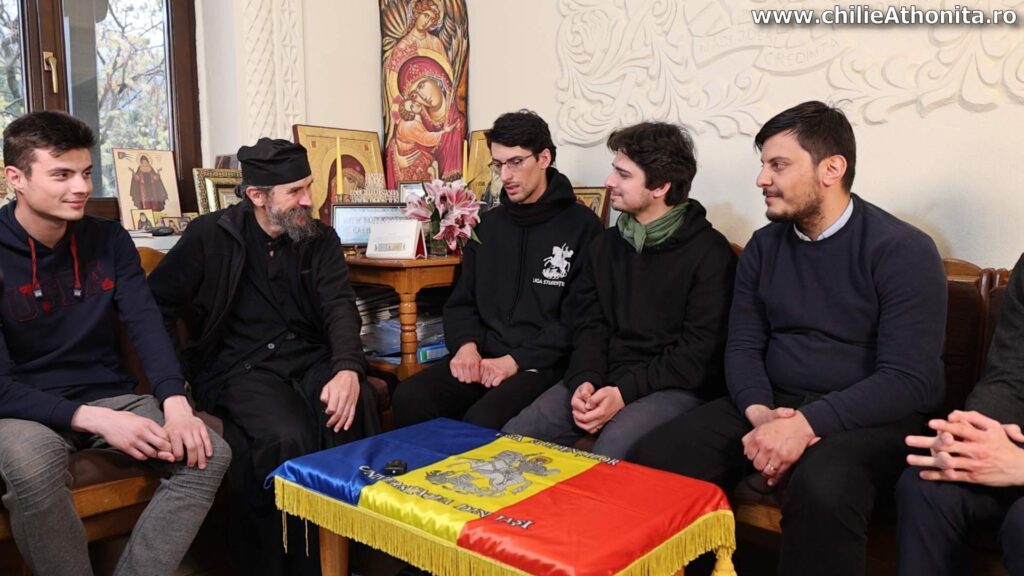
What problems and what value system do today’s students have? What issues are they facing? What is the level of love for God and for the nation among students?
Listen to the answers to these questions, as well as others, in this video.
Enjoy!
Fr. Theologos: Glory to the Father, and to the Son, and to the Holy Spirit, now and forever and unto the ages of ages. Amen. Through the prayers of our Holy Fathers, O Lord Jesus Christ, Son of God, have mercy on us! Amen.
Dear ones, we are here with the representatives and the leadership of the Students’ League of the University of Iași, whom I love very much, I have known Silvian a little longer, we did a podcast together and now I would like to extend our discussion a little bit on the problems of young people today and in the future – how the evolution of young students in Romania is seen in the future. Before giving the floor to them, I must tell you that I really like these podcasts that I do with guests. Why? Because I learn a lot of new things.
You have to know that they are not staged, meaning they are not set in stone with predefined answers, but I truly learn and truly humble myself before them and things are very simple, very sincere and I really ask you to listen for I always seek to ask people about what’s in their area of expertise and experience, and in this case, they have experience with student life and Romanian education. Therefore, I would ask someone, I don’t know who, Toma or Silvian, who is somewhat older, so to speak, not only biologically but also in terms of experience – what are the problems faced by students today? How do you see them?
Toma Tătaru: First of all, I want to introduce myself, my name is Toma Tătaru and I am the president of the Students’ League of Iași. I have just finished my bachelor’s degree in history and I am currently pursuing a master’s in the same field. From my perspective as a student and as a member of these organizations for about three years now, I can say that, first of all, students’ problems are largely related to psychological issues. In the sense that this mentality that the state or anyone else has to take care of us has remained ever since the high school days of the communist regime.
Fr. Theologos: They. Where “they” is sometimes abstract.
Toma: “They,” exactly, yes. Without us doing anything in that regard. Somehow, this whole issue is often inherited from the family as well, in my own case, when parents say, “Hey, don’t do this because there must be someone up there who is already thinking about it…”
Fr. Theologos: “The state will take care.”
Toma: Yes, somehow it’s this statist way of thinking that has penetrated all social layers, in all aspects of our daily life, and then the question arises for us as students… Well, what do we do? How can we get involved because we see that, even though the communist regime fell, the communist ideology or way of thinking has largely persisted in Romanian society because the repression was so strong that the mindset was profoundly altered in this way. And then, we said okay, there must be a way for us as students to have a say because, as many of us may know – young generations are the ones who actually bring change to society, and if a generation is well-educated and well-intentioned, it can bring about change for the better. If not, it’s clear that society is heading down the wrong paths, so to speak.
That’s why, when I was younger, I said, “Well, I don’t want to get involved in matters concerning volunteer work,” I preferred to lead a more withdrawn life, so to speak, but I became aware that participating in an organization like the Students’ League of Iași could open doors for me to meet more people, to understand the phenomena happening in society and especially in higher education in Romania. And thus, to be able to contribute to a certain extent, as much as I can according to human possibilities, to the positive change of the higher education system, because there are many problems that actually arose precisely because students in the recent past, starting from the 2000s, were taken over by certain political factions, and this politicization of the education system caused many problems that have not been solved, as there was no willingness from the political factor in this regard.
Fr. Theologos: So, university education is politicized, right? I mean, there are…
Toma: Yes, including professors who are members of certain political parties or parties that recruit from among assistants.
Fr. Theologos: Okay, that’s true, but they act—how should I say—because current politics is not the politics of the Church, meaning the politics of Christ, but it is a divided and divisive politics, global politics. Do these tendencies of division, so to speak, exist?
Silvian Emanuel Man: Somehow, it’s very interesting that a form of social conflict is maintained, so to speak, because on the one hand, there is an apparent division, and this generally happened after 2000; before that, in the ’90s, there was the old national student law system. There were also a few other organizations, but there was a general student collective, immediately after the revolution or, rather, after the revolutionary coup, which had, let’s say, a catalyst moment—the University Square, June 13 to 15, 1990—and which stood in the shadow of some great former political prisoners who somehow passed this on, the most important among them being Petre Țuțea. The very founders of the National Students’ League stood beside Petre Țuțea, in Bucharest, in Cișmigiu, at the end of the ‘80s.
Fr. Theologos: So he was their ideologist.
Silvian: Yes, he was indeed their ideologue, and in 2000, with the famous regime change, political parties began sending agents into universities to establish increasingly separate organizations. Where once these groups operated broadly at the university level, now they formed at the faculty level—sometimes even two separate associations within a single faculty, each tied to a different party. In reality, they actually, let’s say, communicate and the leaders can always say, “Hey, are these yours or are they from the others?” On the ground, the appearance of conflict is maintained: students at such-and-such faculty must argue with those from another faculty, because the associations had some kind of historical, misunderstood conflict between them for 20 years, but which by tradition… And they have a kind of anti-tradition, I would say, of their own that they have to carry forward.
Fr. Theologos: Oh, really?
Silvian: Yes, so there are all kinds of rituals, hatreds that must be perpetuated and so on.
Fr. Theologos: Forget them, folks!
Silvian: So they know they have to argue with each other. On the other hand, there is also the division, the ideological fragmentation. If the political, partisan one is what determines, let’s say, certain stances regarding things happening in society in general. And generally, don’t think that these organizations necessarily hand out lighters, buckets, or electoral handouts. Just like in the ’90s, let there be peace, let there be quiet, let nothing happen, so that is the motto, it remained the same. The intention was therefore to block any free initiative that cannot be controlled by state structures. On the other hand, the ideological ones seek to maintain a certain current, mainly left-wing, among students. That is to say, the openness to everything that means Cultural Marxism, the “cancel culture” is steadily infiltrating, especially through the faculties of literature—where it has always found easy entry—and now through political science and social science departments, and so on. So exactly as it happened in America in 1968 and also in the West when the great red revolution in the Western higher education system actually began, the penetration started the same way in our country.
There were also people discussing, albeit in inner circles, but not publicly, about the third restroom and all sorts of other insanities. So, the wave is coming. From this point, it is very difficult for an organization to assume a right-wing conservative opposition that would hold its ground against all this madness. And especially because – even though there are many students who actually resonate with us, I mean, let’s not believe that those who are left-wing are the majority. Somehow the left tends to be in the majority by the spirit of the age, by the worldly spirit of Netflix and chill.
Fr. Theologos: Through the herd mentality and sin.
Silvian: That’s it. What often makes you ideologically left-wing? Because you join an association that doesn’t necessarily have an ideological plan, but you’re told that in our association, there’s a lot of drinking, just the freshman ball, one charitable activity that’s just a facade, basically dissembling almsgiving, and that’s about it. And then you live with the idea that this is the ethos, this is the spirit you have to assume, and that’s how you move forward in life. The majority tends to be silent. There are many who are vocal; the left-wing has always been more vocal.
Fr. Theologos: Yes, and I think it’s a very toxic and very vocal minority.
Silvian: Correct, but the majority is taught, as Toma said, to stay quiet, not to comment, not to upset, not to confess. We have seen this most serious thing – it happens in medical faculties where student organizations tend to be the most left-leaning in mentality, the most ideologized, so to speak, and there are many Christian students in medicine who are afraid to confess their own faith, to display religious objects, to stand up, or to challenge certain practices, not necessarily anti-Christian, mind you, but unethical. So, referring only to the terms of bioethics, they cannot contest them because they are not modern, they are not in step with science.
If you come to disagree with assisted dying, with the fact that – and mind that we are talking about some legal principles – the doctor has the right to decide absolutely anything over the patient’s head, as if the patient has no rights at all. You are seen as backward, medieval, toxic, a zealot, and all that.
Fr. Theologos: So, it seems to me that this is an ideological war, and again I realize that actually it is no longer about the possibility of a choice because we are already moving out of ideological and into spiritual matters, that is, into the issue of sin and especially, blatant sin. How do you think this could be resolved?
Toma: I believe that at the moment there is also this problem of motivating young people to do something, I mean, as Silvian said, “Netflix and chill” is somehow the general trend, so to speak, of our generation, unfortunately.
Fr. Theologos: For those who don’t know, “Netflix and chill” is a very sinful slogan, meaning you watch some sinful shows on Netflix and then chill, meaning you unload yourself by committing sins. Forgive me!
Toma: And I think the solution would be precisely in motivating young people in this regard, that is, to offer them a different ideal than the one generally offered by society. Because I think it is very hard to find another possibility in this regard.
Fr. Theologos: Only Christ…
Toma: Yes, and once they have found this ideal, they may very well, or could very well, assume it. It’s ultimately about motivation, and I personally admit that at the beginning of my studenthood, Silvian can confirm how much he pushed me so that we could move some things forward because that’s generally how it is: students enter university as freshmen, they are taken under mentorship projects by university leagues, they are told, look, come on, friendship is great, let’s go for a drink, things like that, and friendships form among them, but practically these don’t materialize into something concrete. Yes, more than that, they encourage each other to do bad things.
Fr. Theologos: Yes, a big problem.
Toma: Not to mention the fact that there is a visceral hatred against our league from some student organizations by faculty, this hatred is promoted by veterans to freshmen, and the freshmen end up believing some lies simply because a friend has told them, but a friend they made over drinks or at a freshmen prom, without verifying…
Silvian: And beyond information, there is also mockery, it’s an obsessive thing of some dear colleagues of ours who have no other concern than to scoff at Valeriu Gafencu.
Fr. Theologos: God forbid!
Silvian: They simply have an obsession with this.
Fr. Theologos: A fixation…
Silvian: And this is what is being aimed for a lot – the mockery of holy symbols. So we see it, I mean we know. Our coat of arms, our logo has been distorted in memes and jokes in thousands of ways.
Fr. Theologos: God forbid!
Silvian: I mean, in a way, it’s a form through which they perceive themselves as superior.
Fr. Theologos: Yes, what’s going on? Do you know what’s going on, Silvian? It’s that they live an inner hell and these are echoes of that inner hell, the aggression they show towards someone who does nothing to them shows that they have this thing inside themselves, this stubbornness, and this stubbornness explodes outward, it comes out.
Silvian: And they seek conflict, and Claudiu here can confess, they somehow seek this state of quarrel, of conflict, this passion for control, of submission is constant. That is, “you should do what we tell you.” But based on what? I mean, they want to dominate, to have control. I mean we understand, on the one hand, certain aspects, let’s say, right? It’s very important and we know it as an organization: to have people in leadership roles, maybe to be the first to succeed with a demarche. But they must have a reasoning behind, not just the idea itself of being first, of having, of imposing, those are means, but eventually what is the goal? And there is a general problem here because this is also how this thing with the League came up and Claudiu here is older, he has about six years in the League.
Fr. Theologos: I’d really like him to speak a little.
Silvian: The main issue, because that’s where we started, from contact with former political prisoners who were in communist prisons and who had previously been in anti-communist student organizations. They did things that had nothing to do with what is happening now in organizations, and I said that, however, the minimal objective we must set is for the league to be at least an environment of dispassion.
Fr. Theologos: Obviously.
Silvian: Because before, I had engaged with everything that student organizations represent. In different contexts, I worked with dozens of organizations across the country, all of which were environments for cultivating passions, cultivating sins somehow with the idea that at some point these things were even done in team-buildings with the idea that we do something foolish and that unites us because we have a dirty secret and we don’t betray it. So we develop such bonds.
Fr. Theologos: The gang phenomenon.
Silvian: On the other side was the idea that somehow they were used and are still used, unfortunately, in some student structures as a means of control and power. That is, sin as a form of blackmail or as a bargaining chip to obtain leadership positions, to gain various benefits, you have to commit certain sins. I remember, I’ve even confessed this, leaving from a student demonstration in Timișoara, I passed through Craiova and Brașov where I met Ilie Tudor and Nicolae Purcărea, former political prisoners. And especially Nicu Purcărea who was also the last president of the Brașov state center and who preferred to go to prison rather than sacrificing his association to the communists, he said, “Son, this is exactly like Pitești.”
Fr. Theologos: God forbid!
Silvian: But even worse than Pitești, meaning Pitești after Pitești, as a follow-up.
Fr. Theologos: Claudiu, do you want to say something?
Claudiu: Yes, I agree with what colleagues have said. The main problem, we were discussing it last night as well, is that unfortunately, we young people are no longer aware that we have a soul and… the whole ideology… Actually, people today think they only have a body.
Fr. Theologos: Yes.
Claudiu: And that they are just flesh.
Fr. Theologos: Exactly. As someone has said: “I don’t have a body, I am a body.”
Claudiu: That is the problem, and it is unfortunately cultivated, perhaps in the family environment, some do not have religious education, so to speak, spiritual education in the family, they don’t go to church, they were baptized and received Communion when they were little, but afterward, they sever their ties with the Church.
Fr. Theologos: Yes.
Claudiu: They don’t have a spiritual father, and then they end up in high school, at the university, and even if they deny, claiming they only have a body, their soul still has spiritual needs.
Fr. Theologos: That’s right, and they’re tormenting themselves.
Claudiu: They’re tormenting themselves and there they come across teachers who also teach them that they only have a body, and they meet other colleagues from other associations who teach them the same thing, that they are only flesh. The Church and the Faculty of Theology are sidelined. Especially, as in the case of the faculty of Iași, that’s in another building of the University. Throughout the University, there is no place of worship or any icon, I haven’t seen any, only the country’s coat of arms…
Fr. Theologos: It’s still something, but very little, yes.
Claudiu: And then the students, not having at least visible contact with an icon, with the Holy Cross, do not think about God at all.
Fr. Theologos: Yes, and the big problem is that if they don’t have God, they have no future, they have no meaning, because their meaning can be none other than God, other than eternal personal perfection.
Claudiu: And I have even seen with those who are opposing, that no one questions their intelligence, they are very intelligent, no one disputes the fact that perhaps they are burning inside and they don’t know where this burning comes from and where to direct it. The problem is that if it doesn’t exist, as unfortunately most university associations exclusively promote passions of the flesh and even spiritual ones – this pride, this desire for power, for domination, that’s what they promote – the problem is that they are the majority and so most students follow them.
Fr. Theologos: I understand.
Claudiu: And I had this experience just recently when I was running for a student senator position at the Faculty of Letters. I was literally slandered, they found a Facebook post where I said something against abortion and I was slandered with “Don’t vote for Claudiu because he is against abortion, see, he is a retrograde, he is from the Middle Ages.”
Fr. Theologos: God forbid!
Claudiu: Yes, “…and he is religious, don’t vote for him because…” The same happened at History, my colleagues also told me, I found out later, just recently, that they told them that I would only support Orthodox Christian students, which I didn’t say, I didn’t claim that.
Fr. Theologos: Obviously, obviously, these are indeed forms of war and they come from their inner war. Now, hearing you, I am filled with dread, recalling what Father Rafael Noica and not only him, all Holy Fathers said, that Orthodoxy is the very nature of man. I mean, there is no possibility of choice. The choice is when I choose to photograph and film with Canon – that’s a choice. I’ve also used Nikon and Sony and so on. The moment you leave Orthodoxy, it is hell—that is, this stubbornness, the person can no longer sleep, they are tormented by thoughts, crushed by thoughts, they are troubled, can no longer find peace and quiet. Do you understand? For Christ is our peace. So there is a serious problem. I feel deep pain for them. Now, since you weren’t elected, how should I say, it’s better for you because you have more peace.
Claudiu: Glory to God!
Fr. Theologos: Glory to God, exactly! I don’t want you to get me wrong, but on the other hand, I think about this viscerality, this torment of young people who will never find their heaven because they all seek heaven, all seek peace, all seek love, but don’t know where to look for it. Because, by definition, they have kicked away the source of paradise, the source of peace, the source of love.
Claudiu: And not to mention that the enemy, the devil is effectively ignored, but he is at work.
Fr. Theologos: He’s obviously working.
Claudiu: And he seeks to dominate, and the problem is that this university environment somehow affects the activity of our organization. In what sense? That we also end up being somehow dominated, in the same fight—that is, entering their game, which doesn’t seem right to me.
Fr. Theologos: No, no, avoid it, tackle it differently! You wanted to say something, Toma.
Toma: Yes, I wanted to say that their visceral hatred – they feel the need to externalize it on those who don’t think like them or do not act exactly like them, and because you see that someone, a particular organization, has much better results than you, then you are prone to eliminate the competition somehow, to try to…
Fr. Theologos: The mentality of the executioner. So martyrdom came exactly like this through the desperate attempt of the executioner to take the heaven out of the other, the heaven that indeed exists or, whatever, it seems to him…
Silvian: Sometimes I make the sign of the cross and I say, “Glory to You, Lord, for clouding their mind sometimes!” From certain points of view, there are organizations – especially these at the national level where we tussle quite a lot, well, they try to block our access to various negotiations at the governmental level, at ministries, and for about two years now many doors have been closed to us through a lot of lobbying and political pressure, unfortunately in agreement with the authorities. If some have a clear color, others have the color of money and power, that is, the universal color.
I was actually thinking about this very thing, that if we do some very niche things and you wouldn’t expect it from a student organization, and I admit, when we started the League journey, the first thing we did was to dispute some elections for the dormitory heads. Irrelevant compared to the fact that now we get involved in major debates in the education system; we no longer only solve problems for students in Iași, and since 2018 we have expanded nationally. That, on the one hand, I mean, somehow our activity is visible both in the media and in our initiatives and is comparable to that of student federations, of which there are about three, which altogether have around 250 organizations. I mean, 1 to 250 is a bit of a…
Fr. Theologos: I’m really interested – Toma, you, or Claudiu, who would like to talk about your specific activity? Especially in the field of education, which is what concerns me here.
Silvian: This is what I was going to answer now, because it is very practical – first of all, we monitor everything related to public policies, changes that occur at the legislative level, whether it is primary legislation in parliament, ministerial orders, or other matters that may, on the one hand, affect students, even in a social manner, because here we also have an understanding of almsgiving, so to speak.
Unfortunately, we only imagine almsgiving in this limited form: here, take these alms in the name of the Lord, a small bread ring, and so on. But it is wrong. The best form of almsgiving is, first of all, when you lift a person out of the ditch and help them walk a path, and somehow this is our mentality when we help students who encounter certain problems along the way and have no one to turn to.
They go to their representatives, and we have had some horrible situations, especially with the universities of medicine and pharmacy – students being wronged, for example, at UMF Iași. Tuition fees were increased during the academic year. We have contested the measure, also through conventional means: first by a petition, meaning we didn’t immediately jump into action, but we shortened the time frame and acted efficiently. So, petition, protest, legal action, criminal complaint – we used all legal avenues and in the end… we lost in court. Why? Because the student organizations at UMF Iași issued a collective statement saying they agreed with the increase in accommodation fees and that by representing the students, they are the voice of the students of UMF Iași and not us, although we had the legal right and the statute to do this.
The court relied on the association’s statement, leaving the students to bear the burden of increased fees. So these are the situations where students end up being betrayed by their own elected representatives. Not to mention that there are cases where elections have been falsified at some universities. That is, at some point, you have some student camarillas who, out of fear of the people, resort to falsifying elections to maintain power, knowing they won’t have continuity, because they have a series of benefits: discounts at dormitories, additional scholarships for various volunteer activities, and so on.
And to maintain these benefits and funding from the universities—which is a big problem here—we dare to speak this way because we are independent, not affiliated with any structure, we have our own headquarters for which we have to pay rent, and this is where we gather and collect dues and donations so we can pay our rent. No one can come and say, “Stop talking or we’ll kick you out of headquarters” or “We’ll stop your funding.” We’re off the hook! That’s the answer.
Fr. Theologos: Toma, what do you say now?
Toma: Well, exactly as Silvian said. As an independent student organization, we gain a crucial advantage: pressure can be applied directly to the university leadership without risking harm to the organization itself. We are shielded from threats like losing our headquarters or facing similar issues. We simply take all the mud that is thrown at us as leadership and there is nothing left but to continue our work. I mean, you get to the point where the very fact that they’re throwing mud at you seems to motivate you even more, obviously, in that sense. And here also comes the fact that we have come into contact with former political prisoners and knowing and researching, from both a historical and spiritual perspective, this entire period of communist repression, we have learned a lot that it is very important to stand our ground.
That is, if young people like us managed to survive in prison and say no to the atheist communist regime, surely we can somehow continue this fight, given that we are not in the same harsh conditions. On the other hand, the war is more insidious now; back then it was more overt.
Fr. Theologos: Yes, yes, yes.
Toma: And in this sense, one of the most important activities we do with the League is to interview political prisoners we find alive.
Fr. Theologos: Definitely, definitely!
Toma: Because beyond the documents that can be found in books or documents of the Security, in the archives, above all these, personal testimony is also very important.
Fr. Theologos: Yes, they must be promoted. Their personal example will help you greatly, and it’ll also help many others.
Toma: Yes, because, look, I’ll give you an example. I wrote my bachelor’s thesis on the anti-communist resistance group from Bacău and the documents from the Security archives helped me, but beyond these, more crucial were the personal testimonies, as some of them only started to speak after the 1990s, or even after 2000, revealing what they had feared to confess during the investigations. And seeing and listening to the testimonies of these people and watching their facial expressions and the way they live that moment when they explain what they went through is something, shall we say, extraordinary. I can give you a few names: Father Valerian Grecu or Mrs. Galina Răduleanu, Tache Rodas, Mrs. Elena Poli, sister of Constantin Oprișan. These are big names that I’ve met, many of them, let’s say, colleagues in the organization, as they are senior honorary members— including Father Iustin Pârvu.
Silvian: We gave them this title because they played a crucial role in supporting us morally and guiding us, and that is specifically why we consider them, in a way, our colleagues. And when we carry out an action, that is what we appeal to, think that they are our colleagues and then our very action and behavior must somehow align accordingly.
Toma: And to me, the heart of our work lies in the words of Fr. Gheorghe Calciu: “We will die, but from up there, we will help you.” If a man who suffered so much in communist prisons, who had his falls, but more important than the falls was the rising, if such a man says something like that, it will certainly be so.
Fr. Theologos: Yes, that’s true. What do you see as the greatest challenge facing education today and in the future, and what can you do about it, what do you plan to do?
Toma: In my opinion, I believe that the biggest problem of education, in general, is that it has given up on the idea of promoting national values and on the idea of promoting a strong character that a person should have in society. A state like the communist one, sought as much as possible to shape people in order to be psychologically submissive. Unfortunately, this idea has persisted in society, and we often accept this censorship out of fear of being judged by the ones around us. In fact, this is very harmful, to say the least.
Fr. Theologos: So, people no longer want to vote, and when I say vote, I don’t only mean politically, but also socially, meaning to express their…
Toma: Yes, because they go on this preconceived idea that they cannot change society.
Silvian: I would go even deeper. It’s all a circus, a hypocritical charade. Starting from the expectations and demands of these beneficiaries, meaning the pupils and students, to what the educational institutions actually offer. There is this constant tendency of relaxation, and we see this year by year, especially in pre-university education – to make the baccalaureate easier, how do we increase the pass rate? Well, let’s have them say what 1 + 1 equals, and end the story there. There were all those jokes that from some mathematical calculations we end up saying, “draw a triangle” in geometry. We are always talking about lowering standards, that’s one thing. We actually see the hypocrisy in a crucial issue that is talked about a lot and unnecessarily. So, effectively, idle talk. University dropout.
Why does university dropout happen? Because universities are not honest about the offer they have, they lie to students in promotional campaigns about what they offer, what they do, that “you will discover the whole world if you come to our faculty,” and when the pupil enters as a student at the faculty and gets in touch with reality, they obviously give up. Meaning, they realize the falsity of the offer and then they will not stay where they were lied to, where the idea was sold to them that it is suitable to follow that specialty, and they leave for another place.
And then what happens? Funds are allocated from the government, obviously also from our pockets, funds from various global institutions – the World Bank, the European Commission, and so on – to combat university dropout. How do we combat it? Re-entry programs, where we have to take students and force them to continue their programs where they realized — let them drop out and find their way! So, this is the trend of institutionalization, that if they have followed a certain path, they should stick to it.
I mean, at some point, some people had this idea many years ago that if you followed a social and human sciences specialty, you could only pursue a degree in the social and human field, as was once suggested around here, in Greece. If you went to an exact sciences high school, only that major… I mean, somehow the idea is to be blocked. So, this is very much desired, and we see this hypocrisy in matters related to – I’ll give you an example: the evaluation of teachers by students. It is a central topic we have been dealing with because after ’68 in the West, this was the mechanism by which politically incorrect professors were removed, and so we said we want to master this mechanism, to understand how it works so we can prevent…
And so we started requesting the evaluation methodologies from universities, including the results plus other documents to see how it happens. Because, in the end, it is a practical matter. The student must be asked by the institution and by the professor – hey, did you like my teaching, was it good, did I do well, did you miss anything? In many institutions, we found that this does not happen, and anyway, to get to these documents, unfortunately, we had to sue about 70 universities.
Fr. Theologos: God forbid!
Silvian: It was a total adventure because we had about eight colleagues from the organization who, being actually freshmen, represented the organization in court, but we forced the universities a bit, and humbled them a little, because unfortunately there is this tendency of institutions to say “No, I am up here, who are you?” And even if the law is on your side, they put themselves above the law, they seek this, they put themselves above natural law or divine law. That’s what they look for, and even if we use such means that seem blunt, in the end they are allowed, they are necessary precisely to bring a bit of order, because then the students gain confidence.
When they see that someone is fighting for them, that they even have the courage to fight a bit with the universities, they take heart and begin to confess. We saw this recently during the pandemic because we were the only student organization that opposed the COVID restrictions. We had a wonderful precedent with the University of Târgu Mureș in court where we blocked any attempt to restrict access to courses based on the green certificate.
There were also other universities where we solved this problem, not necessarily in court, there were other means as well. Some withdrew after a criminal complaint since it involved the offense of abuse of office—you cannot issue documents or create conditions outside the legal framework; this is not permissible. But then the students who had this problem had this reassurance that someone was fighting for them. Actually, there was an extraordinary wave of young people who joined the League at that time; that wave was huge then.
Fr. Theologos: Glory to God!
Silvian: We remember it was funny and sparked many debates, and we had a recruitment announcement – something like that – “we are against the green certificate; join the League if you want to stop this,” and it made a significant impact. But it was the same, the only voice. Because there is another very important thing that must be mentioned about our activity, speaking of hypocrisy, there are two matters, one being that we fight against plagiarists. Because the problem of plagiarism is the highest form of hypocrisy, and university professors, politicians who want to have as many titles, diplomas and doctorates as possible for vain glory, beyond financial benefits, but especially for this vain glory of theirs, for this, with Claudiu, we spent nights working on some files, analyses, making reports. It is very important that these people are exposed. Why? Because they are actually servants of hypocrisy, of this sin because if students see that professors, politicians plagiarize, steal, lie, why shouldn’t they do it too, right?
Fr. Theologos: Yes, well, exactly.
Silvian: And then this thing goes further. So if you manage to nip this thing in the bud, it’s extraordinary, and another issue that I would say is also a matter of hypocrisy, with or without the current geopolitical context, there has always been a very politically correct discourse in Bucharest, unfortunately, regarding Bessarabia and the Romanians outside the borders. Until a few years ago, there were even politicians who boasted in our Parliament that they know three languages: Romanian, English, and Moldovan.
Fr. Theologos: God forbid!
Silvian: I mean, it was an embarrassing situation: our Moldovan cousins, the Moldovan people, the Moldovan language, great historians—whose names we won’t mention—like that kind of historian whose name is put in a paprikash dish—said that Stephen the Great spoke the Moldovan language.
Fr. Theologos: God forbid!
Silvian: And obviously, that particular fragment in a television show was used by pro-Russian politicians from Bessarabia to support this claim. In fact, the person in question was decorated by anti-Romanian politicians from other countries precisely for statements of this kind. And you criticize such a professor—we had this situation: We criticized him publicly and then calls started coming in: “How can you criticize this great professor? Have you gone mad? Do you know who this man is?” Yes, precisely because we know him, we also criticize him. I mean, such statements cannot be accepted. I mean, there is this tendency and especially as it has been said – the Romanian people have existed for a maximum of 150 years, we were told this now at the centenary.
Fr. Theologos: God forbid!
Silvian: Yes, that the Romanian nation is only the creation of the 1848 revolutionaries who imagined it and put it down, but it exists since the medieval times, that is, foreigners recognize it. The Hungarians talk about the Romanian nation as they have found it here in Transylvania together with social-political structures that were maintained throughout the Middle Ages, especially in Maramureș and Țara Hațegului. But especially this situation with Bessarabia. Because here there are two extremes and neither is Romanian.
There is the western extreme or as those more familiar with the Russian language say, “zapatnik,” enough, no, Moldova must enter the European Union, the European path of the Republic of Moldova, the Moldovan people in the European Union and that’s it. Yes, but not with Romania, not unification with Romania. We are Moldovans, but not Romanians, we are something other than Romanians, but we are Europeans. We prefer to be the most European among Europeans if possible and you can see how this brazen, Marxist propaganda in Bessarabia does nothing but add points to the pro-Russian parties that adopt a conservative stance. And thus Bessarabia actually distances itself from Romania.
There is the other pro-Russian extreme that says no, Bessarabia wants to be Russified, they want to be with Russia, they are our escape, Russia is our escape, let Russia come and free us from the West, free us from LGBT, leftists and so on. When did Russia attack Bessarabia? So, this is madness from this point of view and people who deny the geopolitical realities in Bessarabia.
But here we try to offer a balanced and clearly Romanian position because there were various unionist organizations especially in the ’90s – there was a more romantic trend, so to speak, with flower bridges, with chants and so on, the Way of the Cross which was a very practical thing done by the students’ league in 1992. This drew public attention to the war in Transnistria when the Russian army, precisely so that Bessarabia would not unite with Romania, entered Bessarabia and there were young people who died then for our national integrity, in fact this is also something that is not in the history textbooks, the war in Transnistria, unfortunately, and it is a very painful stain on our national history. Because young Romanians from the Students’ League walked on foot from Chișinău, Iași, Bacău, Brașov, Bucharest, the people became aware, they began to support the Romanian cause in Bessarabia differently.
We initially started bringing books there, and you should know that there is a big problem with books, and I am taking advantage of this moment to make an appeal: school books and spiritual books! The culture needs strengthening. In Bessarabia, you should know that people there read!
Fr. Theologos: Really? Glory to God! Very good.
Silvian: Not like here. So I confess, and every time I have the chance I say it, I would not send my child to a public school in Romania now. But I would move to Chișinău to raise my child in Bessarabia because there are many professors there who don’t look at portfolios, reports to the inspectorate, instead, they nurture the child’s soul, emphasize artistic education, and cultivate the spirit. I know many teachers who speak so beautifully about the Romanian language, the great classics, Romanian history, and not that demystifying mockery that has, regrettably, found its way into our schools. Those people need support, and this thing with the books is very important, and it’s a paradox: we went to schools where the students were moved because someone brought them books with Latin letters.
Fr. Theologos: Glory to God!
Silvian: So, I especially remember Furlădeni, but also other places on the border with Transnistria where there are high schools in which more than half of the books are in Romanian, but written in the Cyrillic alphabet. Therefore, not having books in Romanian, those people culturally belong to the Russian sphere. Furthermore, we do not have a very well-developed spiritual culture in Bessarabia.
There we have our own metropolis, the Metropolis of Bessarabia, which is in the jurisdiction of the Romanian Patriarchate. It was actually restored with great difficulty, through a trial at the European Court of Human Rights (ECHR) and with great efforts, and we have a majority metropolis called the Metropolis of the whole Moldova because it also claims authority over Moldova on the right side of the Prut River, which is subordinate to the Moscow Patriarchate. And there is this problem – when one of our Romanian Bessarabian priests moves from the Russian metropolis to the Romanian metropolis, some guys send racketeers after him, issue death threats and so on, exert enormous pressures that our Romanian clergy there face in order for keeping their faith. Why? Because the fundamental culture is made in the Church.
The union, the national reunification is impossible without the Church and the full restoration of the Metropolis of Bessarabia. When our Romanian goes there and hears prayers mentioning Romania, our country, it is one thing. But when he goes to churches in the Metropolis of Moldova, where prayers are offered for Vladimir Vladimirovich—Putin—and for the heroism of the Russian army, for rebuilding the Soviet Russian empire, and so forth, he becomes trapped. And why does he remain trapped? Because on the one hand, the people of Bessarabia have been de-Christianized due to the pro-Russians, so there, with a dominant pro-Russian Church, it is almost an identity struggle and many young people do not come to know the Church due to this.
That is, Russia through what it does, through the political manipulation of the Church, it distances them from Christ. In other words, it makes them, as it was said during the communist period, atheists, meaning, without God. On the other hand, you tremble at the thought that there are no priests praying for the 14th army from Tiraspol to free Bucharest. It is a fight that, unfortunately, is not really visible in Bucharest. It is very nice that funds are given and projects are done, but here we’ve also worked at the village level, we went to the villages to talk to the villagers and some of them were shocked.
I was talking with them – where are you from? Well, we are from Iași. But how, you speak Moldovan! There are people who, watching only Russian news, lose sight of their shared language and identity. But when they meet young people who speak Romanian clearly, they have a sudden revelation— they realize they can understand one another. And so, bit by bit, souls must be won. In fact, this is Bessarabia and the story of reunification, with the students and everything, is a battle for souls.
Toma: And it starts from the bottom up.
Silvian: That’s it.
Claudiu: Our standard, our challenge in education is actually to impose, not to have our heads in the clouds, but to have our minds set on God, and then we have a down to earth ideal and a divine-human ideal.
Fr. Theologos: Obviously.
Claudiu: This would be the main challenge because, unfortunately, I repeat, the education system now, let’s say it doesn’t enslave you completely, it hasn’t reached totalitarianism yet, but it tends towards that: to trap you only in the prison of the body and the soul not to be able to escape, not to be able to rise and have communion with God.
Fr. Theologos: Exactly.
Silvian: It’s a paradox, and it reminded me of this thing: I was on the ethics committee, and at one point, I was the student representative, and in one group, a professor – I won’t name the faculty or the person, obviously – mocked the girls, told them all the imaginable nasty things about women. Hahaha – they were all laughing – oh, that’s funny. Hey, girls, are you going to let yourselves be mocked like that? Your dignity! File a complaint with the ethics committee and I’ll personally handle the case, make a report and everything. They didn’t want to; they found it funny.
The same group of girls had a problem with the Holy Apostle Paul. Yes, and with the things he says in his epistles about the place of women. Hey, girls, wait a minute, that’s actually the battle, because the de-Christianization of young people is actually leading to what? When you are committed in the Church, you know you have dignity, you know the true worth of your soul and the worth of everyone because that is the worth in Christianity – valuing all, for each individual holds intrinsic value. Whereas otherwise, you see people as means, you use them to reach certain goals, and that is the pain of those who…
Fr. Theologos: If Christ does not exist, the person’s value does not exist.
Silvian: Those ruled by the wrong masters seek only to enslave and dominate.
Claudiu: You see them only as animals.
Fr. Theologos: Obviously.
Claudiu: At most, political animals.
Fr. Theologos: Zoon politikon.
Silvian: When you choose God as your master, you want to serve.
Fr. Theologos: Yes, obviously, because you see in others the immortal image of God.
Claudiu: As Father Stăniloae said.
Fr. Theologos: Yes, obviously.
Toma: And in fact, this is what we try as much as possible to do in the League, that is, to serve the students’ rights because it would be very comfortable for us to stay at home, mind our own job, not to suffer public blaming, and so on. We could very well be talking, sitting, being very comfortable. But fortunately, we don’t do that.
Silvian: And this thing about rights, that is, the right to have a scholarship, the right to have a dormitory, the right to have dignity, the right to have the freedom to say absolutely anything that crosses to my mind.
Fr. Theologos: As you just said, glory to God!
Silvian: Yes, but it’s this freedom that must exist because people have gotten too used to—it’s this shock—we find it very easy to criticize, we deny God, He is somewhere up there. The president, the prime minister, but we tremble before a professor or a dean. It is not normal; we should tremble before God, and whoever shoulders this when called to account has no fear anymore.
Claudiu: And besides that, the spirit of sacrifice – there is no antagonism between being a student, studying well, and saying your prayers, doing alms, if you pass by a person and see them poor and deprived, to help them! Going to church, receiving Communion, confessing…
Fr. Theologos: Obviously, because a student must first and foremost be a human being.
Toma: One thing that Silvian can also confirm is that, in the past, student organizations had a prayer schedule.
Silvian: So, starting from the interwar period, they committed to this and somehow also as a continuation of the call to metanoia made in his speech at Putna by A. D. Xenopol in 1871. And as a result of the prison experience that the students began in the 1920s.
Vlad: Speaking of prayer, you know, the Romans had an expression or a slogan, if we could say so, divide et impera (divide and conquer). It is very interesting what is happening today because, you know, with the body we are somehow pushed by evil spirits, so to speak, to unite, towards this sexualization, this politicization of everything worldly, of pleasure, it unites us somehow.
Fr. Theologos: The union of bodies…
Vlad: Yes, but it divides us spiritually and then comes impera (conquer). It’s very bad.
Fr. Theologos: Very, very bad. Yes, because that leads to the fragmentation of society, it leads to the pulverization of society, you should know. Physical pleasure, as a philosopher in the 4th century BC, Parmenides, said, “The absence of shame is the pulverization of society,” and the absence of shame actually means the sin against the body, that’s what it refers to. Well, what can we say?!
I have great hope in you after God, and I am very glad that you came here and that I could have this podcast with you, this pseudo-interview actually, because it was more of a very beautiful discussion so that you can pass it on, so you can tell people what is happening in university environments and especially to clarify certain prejudices that people have and for you to also have a voice, so you can pass this on. And if we can help you with anything in the future, let us know, and we will. Yes. May good God help us!
Through the prayers of our Holy Fathers, O Lord Jesus Christ, Son of God, have mercy on us! Amen!
Online commemoration lists and donations
May the Lord help us!
Online Commemoration Lists and Donations
May the Lord help us!
If you have a bank card and wish to send commemoration lists and donations online using your card, and/or to support our philanthropic activity, including this site, please fill out the form below to make a small donation. The form is secure – we use Stripe for payment processing – a world leader in this field. We do not collect your personal data.
If you do not have a card, or do not wish to use it, visit the webpage for Online Donations and Commemoration Lists.
We will pray for your loved ones! (Please do not include inessential details like wishes, degree of kinship, introductions etc. JUST the name!)
Especially for recurring commemoration lists, we ask that you please keep them to under 20 names long. If you include a member of the family, we add “and for their families.”