

Saint Gerasimus of the Jordan: The Simplicity of the Sinless Man – Father Pimen Vlad
2 March 2023
Experience, Reason, Orthodoxy, Catholicism – Father Theologos
7 March 2023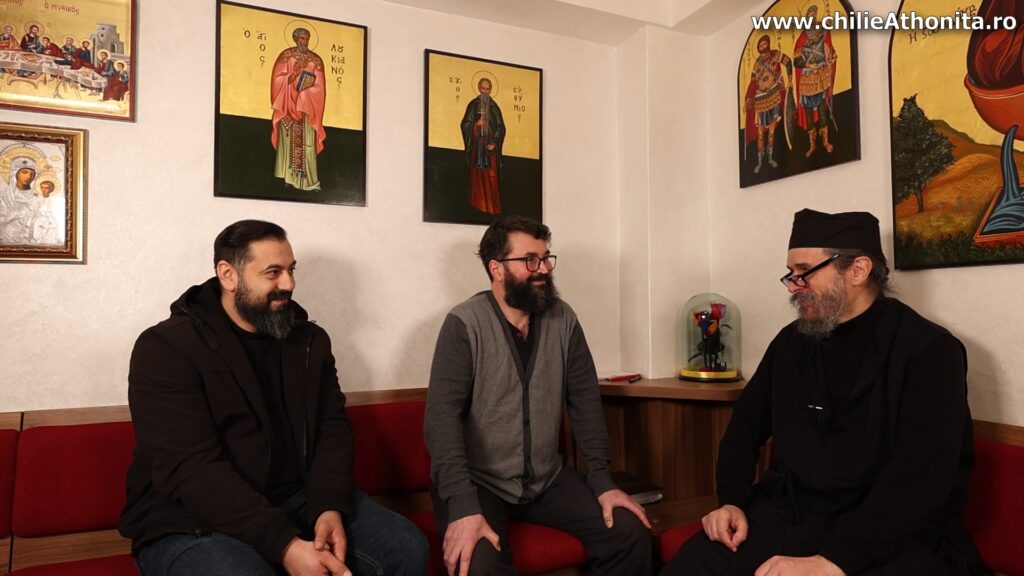
Watch a humble and warm interview with two iconographers—Cezar Ivana and Silviu Ungureanu—in which they reveal part of the inner life of an iconographer, as well as various interesting aspects of the theology of the icon and the art of icon painting in general.
Enjoy!
Fr. Theologos: Glory to the Father, and to the Son, and to the Holy Spirit, now and forever and unto the ages of ages. Amen. Through the prayers of our Holy Fathers, Lord Jesus Christ, Son of God, have mercy on us! Amen.
Dear ones, we are here with two icon painters. We are at the Cell of the Life-Giving Spring, where the two icon painters, namely Cezar Ivana and Silviu Ungureanu – whom I have recently met – are painting the church, it is a work in progress and we wanted to film there, but there is a very strong echo and because of that, we are doing it here, let’s say, in the small guesthouse of the Cell, where it is a much more intimate place and here there are also many icons, as you can see. How many years have they been icon painters?
Cezar Ivana: 27 years.
Silviu Ungureanu: 20.
Fr. T: A lifetime… And we will have a discussion. Actually, they will say a lot, I know very little about icons and what the profession or rather, the vocation means because I don’t know if I can call it a profession, but the vocation of an icon painter. First of all, what is an icon? Who can tell us?
Cezar Ivana: The icon is a continuation of God’s revelation, a continuation of the Epiphany. First, Christ revealed Himself to us. Then He sent the Comforter into the world, Who, working in the souls of the faithful and in the souls of the icon painters as children of the Church, gathering from the arts space existing at that time, this icon materialized—which we have uninterruptedly in the Church with all its trials.
An icon, you can tell, from the first glance, that it is from another world and that is a gateway to the unseen world, a presence of the unseen world and is like a window that takes us beyond – we become co-inhabitants and dwellers with the Savior Christ, with the Mother of God, and with the saints.
Fr. T: So, you’re saying, in fact, that on the one hand we have a technique from this world, and the Holy Spirit comes and spiritualizes this technique through the hearts of people and carries it forward…
Cezar Ivana: Yes… Because, you see, with very slight nuances, it remains the same, it presents itself the same way, and throughout time it has been proven that we, humans, are not capable of this unity. The moment we secularize painting, automatically the perspective changes, what is sought changes, and from one generation to the next, the artistic phenomenon changes, the meaning of the visual sign changes. While in the icon, the stylistic elements remain almost unchanged with small variations and the icon continues to fulfill its liturgical role.
Fr. T: Silviu, what do you say, how do you see it?
Silviu Ungureanu: The icon is like a continuous work; it does not stop with the first icon painters, it is perfected over time. Each painter, perhaps bringing very few new things, the same framework remains, the same foundation, the same spirit, only the work continues.
Fr. T: Yes, what strikes me and impresses me is the fact that indeed both of you, and actually not only you, this is very prominent in the Church, the fact that we are talking about great stability, great consistency here, and this comes from the Holy Spirit, as Cezar also mentioned briefly.
Silviu Ungureanu: And there is also a peace…
Fr. T: Yes, a peace…
Silviu Ungureanu: I mean, when you adhere to certain canons and rules, you feel free, even though many say, “Oh, you’re quite restricted because the icon doesn’t allow you to show your artistic abilities, or you have limitations.” That’s not true.
Fr. T: Oh yes?
Silviu Ungureanu: It is not true.
Fr. T: I don’t know…
Cezar Ivana: Yes, the so-called freedom within the canon, but however we try to approach it or however we make small changes in color, in hue, it remains there. And what I found fascinating, although we are often accused that the faces of the saints look alike, there is a reason for this resemblance because all the saints resemble Christ. They are no longer just some distinct personalities, they have the thoughts of Christ, and so their spiritualized faces surely resemble Christ. It is normal for it to be this way. And yet, what I wanted to say is that I was fascinated by the fact that sitting and working on a certain saint and thinking about them, every time, their face, even though the stylistic signs are the same, resembles that particular saint.
Fr. T: It’s a mystery!
Cezar Ivana: We bring the ingredients, but the result has always seemed beyond our reach. Also, the outcome is transcendent. So, it comes from another world – that unique articulation, our state, the colors we choose, the way we organize the surface… We contribute the craftsmanship, because, of course, God works with what we have labored. The more each of us has gone deeper into the phenomenon, the more aesthetically pleasing the icon may be, but not necessarily spiritually better. Because we see that many of the miracle-working icons…
Fr. T: So, aesthetics is one thing, spirituality is another.
Cezar Ivana: Of course, because God works in those who humble themselves, and that wonderful composition is given by the Lord to whom He wills, and we see that many of the miracle-working icons are naive, but both for their author and for the faith of the people…
Fr. T: So, they are not masterpieces from an artistic point of view?
Cezar Ivana: They are not masterpieces, and precisely by following this path of humility, God works more there, so that we do not take pride in what we have, and He gives to those who have placed less emphasis on aesthetics or even on glorifying God—because if God asks us to be humble, He is humble first.
Fr. T: Ah, so the main trait and quality of a good icon painter is humility, not technique?
Cezar Ivana: Yes. We see that Christ the Savior incarnated in a humble way, lived humbly, and only when He had fulfilled His mission on earth did He reveal a little of His glory. And He never shows us the miracles we want, but lets us walk the humble path and obey Him and fulfill what He said. And this is a miracle: the power to fulfill God’s will!
Fr. T: Yes.
Silviu Ungureanu: And even if we do not humble ourselves, we will be humbled.
Fr. T: Yes, that is right.
Silviu Ungureanu: And only then do you realize God’s presence, that you are being helped – when you are fallen, and as it happens, all people get closer [to God] in critical moments of life.
Fr. T: Have you had an experience? Have you two had an experience?
Silviu Ungureanu: Of course, this happens very often and we are never satisfied with what we do, we always want to make changes, what we do for God is never enough and then you realize how small you are in this world and that you just try to…
Fr. T: So actually, painting icons is a spiritual experience? It is not a technical experience.
Cezar Ivana: It is clearly a spiritual experience, and I have also gone through moments when I was stripped of this power to make them. So, it is only after this power of making is them taken away that you realize how much power you had, how great the gift you were given, how much help you were surrounded by. In order for an icon to materialize, help from above is needed. There is no…
Fr. T: What do you mean? It’s obvious that you won’t forget, but what do you mean you no longer have power?
Cezar I.: The power is taken away from you, literally…
Silviu U.: Let me give you an example.
Fr. T: Yes, yes.
Silviu Ungureanu: When you come very arrogantly, you want to do something, you start, you proceed, but either for technical reasons, or something that is not done, you’ve taken 10 steps backward. Just because you had the arrogance to think that you know, that you control the situation, and then something intervenes.
Fr. T: It won’t turn out, right?
Silviu Ungureanu: It won’t.
Fr. T: Glory to God!
Cezar Ivana: A colleague of mine had a great saying, “You have to enroll in God’s plan even when you make an icon…” Nothing in the Church happens by chance.
Fr. T: Of course.
Cezar Ivana: Everything has a purpose. Even the smallest icon and the smallest reproduction – everything is made because it has a destination.
Silviu Ungureanu: Speaking of that, at the end, many icon painters ruin the icons with varnish.
Fr. T: Really?
Silviu Ungureanu: At the end of the work, when they are very satisfied, they apply a varnish and then they ruin their work.
Fr. T: With that particular lacquer…
Silviu Ungureanu: You can ask all the icon painters, they have experienced it at least once.
Fr. T: Humbling…
Cezar Ivana: I have seen situations where the painting falls, where it turns black, where it molds – these are things that happen instantly, meaning it doesn’t take a few hundred years to degrade. So it happens, and, of course, all these have their own purpose. It’s shaping. Just as we shape surfaces, God shapes us in real time, so that we may be…
Fr. T: Just as you make the icon, God makes His icon, that is, you!
Cezar Ivana: Of course. God is constantly working on us. Somehow, when we say we have temptation, but in fact it is necessary, it’s a… as someone said: God is like a sculptor who works on the Christian through hammer blows and leads them on the right path. And those hammer blows hurt.
Fr. T: Yes, but they bring out the perfection from the boulder that we are.
Cezar Ivana: Exactly, yes.
Fr. T: Glory to God! At one point, you spoke about the canons of painting. What canons? Just a few simple ones.
Cezar Ivana: The canons of painting are made (…) God is order and perfect meaning. The icons are placed in the church, following the path by which God revealed Himself to the world. We start from Pantocrator, from the Almighty, surrounded by angelic hosts…
Fr. T: Oh, so it starts from the dome…
Cezar Ivana: So the spiritual reality of divinity is that God is permanently surrounded by the angelic hosts, and behold, He sends the teaching through the Holy Prophets who are immediately below the angelic hosts, and also among the angelic hosts, in certain forms, appear the Mother of God and Saint John the Baptist – who certainly have risen to the angelic level, and the Mother of God even surpassed it by work. And then it descends towards the Holy Prophets, then towards the Holy Apostles. Where the iconographic program allows, we deal with the 70 Apostolic Fathers – in very spacious areas or where the project is very ambitious.
Then, we also see in the dome, there are versions where immediately below the Pantocrator is the angelic Liturgy to make us aware of the fact that the Liturgy is celebrated in heaven as well, not only on earth. It is first celebrated in heaven and then on earth. Everything we have, first existed in heaven. And matter and man are like a fragile icon of the unseen world. Therefore, this angelic Liturgy is also depicted so that we are aware of this aspect of…
Fr. T: And what is phenomenal, forgive me for interrupting you, don’t forget where you left off – is the fact that in the angelic Liturgy, the Savior also appears on the epitaph, not only the Communion.
Cezar Ivana: Yes, so the Liturgy is served in heaven as well.
Fr. T: Yes. And the fact that, actually, the iconographic program is not read horizontally as we do, as I enter the church uninformed and say “so and so here” and I go to the front…
Silviu Ungureanu: There is both a horizontal and a vertical reading.
Fr. T: Yes, but mainly it is the vertical one which makes much more sense, right.
Cezar Ivana: And then, we see on the pendentives… What are pendentives? A connection between heaven and the world of the saints, and there we see the Holy Evangelists placed, through whose writings we have the life of the Savior on earth.
Fr. T: Stop! For the people, the pendentives, for those who don’t know – it’s about the dome being round and the church’s plan being square. The pendentives are those connecting elements between the round dome and the square plane, if you will.
Silviu Ungureanu: Yes, triangular in shape.
Fr. T: Yes, it’s a triangular shape. In Greek, they are even called round triangles, and you see in the four corners, at the top, where there are also some holes for sound, you see the four Evangelists with their four symbols. Forgive me, go on!
Cezar Ivana: And then, in a simple, essentialized iconographic plan, we enter the Altar where the Queen of Heaven appears on the dome, the Mother of God who became a ladder to heaven, through whom the Savior descended and through whose prayers and intercessions we too can ascend to heaven. And the Altar is dominated by the presence of the Mother of God and the Savior Christ as a baby because the essence of theology is in this icon.
Fr. T: That’s right! It is the Synod par excellence, that is, the cooperation between God and man par excellence – in the icon of the Mother of God with the Child.
Cezar Ivana: Yes, and then, a very interesting icon appears in the Altar, in certain iconographic programs, with the Communion of the Holy Apostles.
Fr. T: How beautiful! Yes.
Cezar Ivana: Which is an icon that comes from tradition, this Communion is not mentioned anywhere, but it is inferred by the institution of the Mystery by the Savior Jesus and through the Last Supper this Communion is deduced and as beginners of the Church – as the first who received the grace of the Holy Spirit – they are also the first Christians who fulfill this ordinance of participation in the Divine Liturgy. Although this Communion probably takes place somewhere after the Descent of the Holy Spirit and after the founding of the Church. Often, what does iconography do? It brings saints – such as Holy Apostle Paul – into historical scenes in which they were not present.
Fr. T: Yes, exactly.
Cezar Ivana: Why? To complete the canonical picture, to complete the unity of Holy Apostle Paul with the Holy Apostles, although he was chosen later, to show this participation in the canons of the Church, in the dogmatics of the Church, of the saints who were not there. And so, it seems to me that this scene of the Apostles’ Communion is also a completion, a dogmatic rounding of the meanings in the Church. Then, of course, the Holy Altar being dedicated to the clergy, the Holy Hierarchs appear, descending beneath these scenes, primarily the Holy Hierarchs of the universal Church, who had a major importance at the first Councils, who wrote the Creed and other teachings of faith and also proved through miracles that Orthodoxy is the only true faith, whose teachings we preserve to this day. And at the same time, alongside the Holy Hierarchs, to the left and right, at the proscomidiary and diaconicon we have scenes that remind us, specifically at the proscomidiary of the Holy Sacrifice – the sacrifice of Abraham or the Three Youths in the fiery furnace of Babylon or…
Fr. T: Or Christ’s Descent into Hades, isn’t it also depicted?
Cezar Ivana: The Descent into Hades is a theme we see in the northern apse. Why? Because there begins the cycle of scenes from the life of the Savior Christ, starting in the southern part with the Nativity of the Lord.
Silviu Ungureanu: That’s the horizontal reading.
Fr. T: Horizontally. Yes.
Cezar Ivana: And then, in the narthex where the vault allows, there are the main feast scenes from the life of the Savior Christ or where the iconographic program is more extensive, there are more scenes arranged in several rows, but they are somehow chronological.
Fr. T: Horizontally, right? And this on the first level or what is it called?
Cezar Ivana: And which culminates with the Resurrection without which our faith is in vain…
Silviu Ungureanu: There are feasts and miracles of the Savior, if space allows.
Fr. T: Yes, yes.
Cezar Ivana: And perhaps the Holy Fathers chose them to be represented in the bosom of the church, there on the sides because these two moments from the life of the Savior Christ are the most beautiful and important moments that remain in the souls of the faithful and give us the strength to move forward on the spiritual path.
Fr. T: Yes, so under the life of the Savior from Birth to Resurrection, on the bands below what do we have?
Silviu Ungureanu: Miracles from the life of the Savior can be placed there or we can continue with certain Great Feasts, which usually are not…
Fr. T: Or down below, can’t saints be placed there?
Silviu Ungureanu: It’s a different level.
Fr. T: That level interests me. What is it?
Cezar Ivana: There are iconographic programs dedicated to a certain saint. Let’s say if the church has Saint Panteleimon as its patron or another saint, then scenes from the life of the saint can be included in the scene registers, but surely we must not omit the supporting points – the Feasts from the life of our Savior Christ, the Baptism, the Transfiguration, the Lord’s Entry into Jerusalem plus the Passions cycle which comes on the other side, in an ideal iconographic program… But if it’s a chapel or something dedicated to a certain saint, it’s not wrong [not to have them], because each saint bears the image of Christ and the grace of the Holy Spirit.
Silviu Ungureanu: In large churches, we have often painted a wall dedicated to a saint.
Fr. T: Yes? Glory to God!
Silviu Ungureanu: And with scenes from the saint’s life. Yes, the church should be spacious…
Fr. T: Yes, of that saint, and it should also fit…
Silviu Ungureanu: To have enough space to develop the subjects…
Fr. T: Yes, yes. You are mainly fresco painters, right?
Cezar Ivana: As for me, I made this choice for monumental painting and I have worked mostly in this space.
Fr. T: For the people, what is fresco, how is fresco different?
Cezar Ivana: Fresco is the only technique among all painting techniques where the color bonds to the wall through a chemical reaction between…
Fr. T: So, it goes into the wall, right?
Cezar Ivana: Yes and no. So, fresco in its still wet composition is calcium hydroxide, and calcium hydroxide reacts with carbon dioxide from the air to form – first on the surface and then throughout the whole mass – an initial film of calcium carbonate and then, it is calcium carbonate; the entire mass of the fresco transforms into calcium carbonate, into chalk.
Fr. T: Chalk, yes.
Cezar Ivana: Chalk that, over time, becomes marbled, so the molecular structure in which the color is embedded is like marble, and marble becomes translucent over hundreds and thousands of years. That is why, somehow, the fresco has this power of ennobling over time, unlike others that adhere to the base through a greasy binder – greasier than the base – and in the presence of ultraviolet rays, that greasy binder loses its molecular bonds and detaches.
Fr. T: So, the fresco is a chemical reaction, whereas the other is…
Cezar Ivana: It somehow, if made under very good technical conditions, forms a mass with the wall, it carbonates in the same layer.
Fr. T: I understand. I have seen on Mount Athos, I have a great and pleasant but also not a very pleasant experience that the frescoes and, in general, the paintings are black. Why are they black and how can they be restored?
Cezar Ivana: Blackness has several sources: candle smoke and stale air which, during the service, through the breathing of the faithful, becomes loaded with microorganisms. Also, there are mold spores in the air – even in dry air – and when they find a favorable environment, in an unventilated and damp corner, fungi immediately develop. So, it can be smoke, it can be fungi, it can be dust.
Silviu Ungureanu: Condensation must be avoided primarily, for ventilation – that would be the first…
Fr. T: So air conditioning should be installed. It helps, right?
Silviu Ungureanu: Not necessarily.
Cezar Ivana: There needs to be an exchange with the outside. So, a healthy building is a well-ventilated building, and this practice isn’t very common. People are afraid of drafts or other things that aren’t necessarily real. They become real the more you believe in them, but if you are calm and not afraid, you have to ventilate the building to keep it in good condition, to allow air masses to circulate, so that there are no unventilated areas where stale air remains and settles on the walls along with its contents: dead skin, dust, dirt, anything…
Silviu Ungureanu: A damp surface acts like glue; everything in the atmosphere sticks to the surface and adheres there.
Fr. T: Yes. How is it cleaned?
Silviu Ungureanu: It’s not complicated, but it’s a lengthy and laborious operation. You have to do tests to see exactly. You don’t know the exact technique there; there are various types of interventions…
Cezar Ivana: There are restoration methods, meaning a specialist needs to be consulted, that’s the first thing.
Fr. T: So it’s possible?
Silviu Ungureanu: Of course.
Cezar Ivana: There is a risk that through an intervention, let’s not call it unauthorized, but through an unconscious or insufficiently well-documented intervention, we could cause damage.
Fr. T: Yes, because I saw that the restorers work very finely, very carefully.
Silviu Ungureanu: Yes, some tests are done, you test some solutions to see how they react…
Cezar Ivana: Yes, there are some solutions that are applied, but there are also simple solutions like… I was at a church many years ago and I was doing a degreasing process: in a container, we mixed clay with baking soda and applied that mixture to the surface, it’s a clay solution, like mud, so to speak, we applied it to the surface, let it dry…
Silviu Ungureanu: Like a dressing that softens the surface…
Cezar Ivana: Like a thin clay film, and then with sponges, water, and vinegar, we cleaned it afterwards. That was the first intervention.
Fr. T: I understand.
Cezar Ivana: And the clay would draw out all the grease from the wall.
Fr. T: Ah, the dirt…
Cezar Ivana: And the baking soda reacts very strongly, meaning the more concentrated the solution, the more aggressively the baking soda acts on the surface, even though it seems completely neutral, it becomes aggressive on the surface, and where there are varnishes, it saponifies. So, you have to know what you are intervening with. If there are varnishes, you intervene with white spirit or… So, there are all kinds of substances like these with which you use a stick and make some tests, and whatever works with that.
Silviu Ungureanu: The moment you see that on that stick there is no dirt, no brownish substance, and you already have a color – a red, a green – it means you have gone too far and reached the painting layer.
Cezar Ivana: But there are restorers who specialize in all kinds of things like these, they even work with lasers, with all sorts of…
Fr. T: Yes, I have seen, yes. So, for the people, the witnesses are small squares in the unimportant areas of the icon where the substance is tested…
Cezar Ivana: Where samples are taken and you have to discover the chemical composition of the painted surface because it might have some varnishes on it…
Silviu Ungureanu: It could be wax, it could be like casein, it could be a lot of things, and then you can’t intervene the same way on the entire surface, which is why it is taken piece by piece.
Fr. T: I understand. I know at least that in the Holy Mountain there are many cases of repainting.
Cezar Ivana: Yes.
Fr. T: That is, we have some very important paintings, well, not only from an artistic point of view, but at least from a historical-cultural perspective, from the Byzantine period that are repainted with… whatever…
Silviu Ungureanu: Well, there was a period when so-called restorers actually repainted the buildings and many monuments were damaged that way.
Cezar Ivana: In the old days, we see Dionysius of Furna presenting some very aggressive methods – before, the icon was dipped into a basin with water and soap, and if it held up, good, if the painting fell off, it was repainted.
Fr. T: Really?
Cezar Ivana: So, something like that…
Fr. T: May the Benevolent and Holy God forbid!
Cezar Ivana: Or the old paintings were smashed with a hammer, with a small axe, or something, and then a fresco was applied over… not much attention was paid to that.
Fr. T: Really? So, with an axe, really with an axe?
Cezar Ivana: Yes, I mean, holes were made every 10 cm, it was hit with a hatchet to create some grip elements and then they were covered. The concept of restoration was introduced very late. Restoration and conservation.
Fr. T: Mother of God!
Cezar Ivana: So, this awareness came very late, made by some French people who said you shouldn’t touch the piece, meaning you only clean it and that’s it, you are not allowed to repaint it. That would be the ideal restoration.
Silviu Ungureanu: There are some very well established principles in restoration now…
Fr. T: It has matured, yes…
Silviu Ungureanu: Which are also found in medicine, meaning you look at it like it’s a patient, you observe it from a distance…
Fr. T: Glory to God!
Silviu Ungureanu: Before intervening on the object, you already have very extensive documentation.
Fr. T: Yes, because I believe… well, at this moment I see that there is indeed a revival in iconographic art, but if we look especially at the centuries when Orthodoxy was struck by the secular spirit, we see a decline in iconographic art, a resemblance to a painting, right?
Cezar Ivana: Yes and no. I mean, there are conservative currents that carry on the tradition, there are semi-innovative currents, but nothing can ever change radically in the Church. For the Catholics, yes, I have seen things go to the extreme where Matisse or Chagall putting their works on various church buildings, which only vaguely reminded one of the holy icons. But in the end, there certainly were choices made in the Catholic Church along with the Humanist and Renaissance periods, where the last Byzantine reminiscences slowly melted away with Giotto, Masaccio, and others… Fra Angelico…
Fr. T: El Greco…
Cezar Ivana: El Greco had already moved [from icon] into religious painting.
Fr. T: Yes, yes. What does religious painting mean? What is the difference between an icon and a religious painting?
Cezar Ivana: Religious painting shifts the focus from the spiritual aspect to the beauty of the human body – this is one of the things that fascinated the Renaissance artists, they tried somehow to revive ancient Greek and Roman art.
Fr. T: Paganism…
Cezar Ivana: And they also – as we discussed earlier – the wealthy of the time, namely Lorenzo de Medici the Magnificent, through the power and wealth he had, brought many artifacts from the Middle East and from all over the world and made them available to artists who, fascinated by their aesthetic beauty, later transposed it into church buildings. Of course, drifting away from this spiritual area and going to an area of obsessive description, of harmony, of beauty of the human body and perspectival discoveries…
Fr. T: Of light…
Cezar Ivana: Yes, a rediscovery with fascination that was certainly supported primarily by the pope and the powerful people of the time.
Fr. T: …by the ideology.
Silviu Ungureanu: You mentioned light, speaking of light, indeed, like my colleague said earlier. In a realistic work, light falls from a certain angle and is painted in that realistic manner. In Byzantine painting, we work layer upon layer and start from a dark layer towards a bright layer, and there is also a theological understanding in this.
Fr. T: What do you mean?
Silviu Ungureanu: We start from darkness and move towards light, to ascend. We keep this concept.
Fr. T: It is very important.
Cezar Ivana: You noticed very well. If we look at the base layer of the portrait, it somehow has an earthy color, which later rises towards a lighting of those areas that are the most…
Fr. T: And in the icon, the light comes out from the front, if I’m not mistaken.
Cezar Ivana: It’s illuminated from within. Also, the gold in icons has this power to capture light even where it is very dim, to bring light into the icon in the dark spaces of the church.
Fr. T: Oh, that’s why it is used…
Cezar Ivana: Gold gives off a mysterious light. So, if you light a single candle in the church where the halos of the saints are gilded, you immediately see that mysterious light everywhere, and it is appropriate for prayer and surely reminds us of the greatness of…
Silviu Ungureanu: That’s why the morning service is so beautiful.
Fr. T: That is right.
Silviu Ungureanu: …by the light of the candles. In the evening, again, the same thing. During the day, there isn’t the same mystery, you no longer have the same experience.
Fr. T: So it seems… I mean, surely art is influenced by the inner experience. What should the inner experience be?
Silviu Ungureanu: Normally, you would be drawn to look at the other or drawn by something else in the church, but as it is, you only look at the saints and you just pray because that’s why you came.
Fr. T: Of course. That is right.
Cezar Ivana: Icons have the same role for us iconographers as they do for the other faithful, in the sense that they help us maintain our focus and path, by contemplating other icons ourselves, preferably icons from the golden age of church painting, and before leaving anything on the surface, we first reflect ourselves in them, we first shape ourselves inwardly, standing face to face with those models, with those prototypes, so to speak. And then, we come to the surface, leaving less room for the personal side in the creation of icons.
Fr. T: Yes, glory to God! Thank you very much!
Cezar Ivana: Thank you very much as well.
Fr. T: May the good God bless you!
Cezar Ivana: We hope it will be useful.
Fr. T: I hope so too – that it will be helpful, because, as I was saying, art is given by spirituality, firstly, and secondly, we see that there are many mysteries and many things that make the icon truly, I believe, the visual emblem of spirituality. Because man need visuals.
Silviu Ungureanu: And our understandings develop over time. That is, at first, we look at an image but do not know exactly how to interpret or reproduce it. At some point, you understand what you see in that image, but you cannot reproduce it. And then the third stage follows, when you both understand and can reproduce it.
Fr. T: Glory to God! It’s a mystery.
Silviu Ungureanu: It’s exactly the same in spiritual matters. There are things you know must be done, you know you have to do them, but you can’t do them until…
Fr. T: Until a certain point when you can understand it and do it.
Cezar Ivana: And let’s not forget the most important aspect or the most important role of the icon, namely that Liturgy without icons is incomplete.
Fr. T: Oh, really? Yes!
Cezar Ivana: So, the icon participates alongside all the other visible elements in the Liturgy.
Fr. T: Yes, because man, unfortunately or fortunately, in his fallen state, is helped by the visual; he needs the visual.
Cezar Ivana: Yes, right, it brings before him the awareness of the unseen world, the presence of our Savior Christ, of the Mother of God, and of the saints. And the icon is the theology of the incarnation.
Silviu Ungureanu: Speaking of which, the lack of faith among people is obvious. I have painted a lot in the diaspora, and one of the requests— from the priests themselves—was to make the painting as airy and open as possible, not too heavy, not too many saints… so the absence of God in their lives is also evident in this.
Fr. T: Unfortunately… It exists, but I think this pressure is a good pressure; I mean, there must be this visual pressure.
Silviu Ungureanu: Yes, if you’re not used to this, it’s exactly like not being used to praying or to…
Fr. T: Of course, to a spiritual life.
Cezar Ivana: There is also this reverse phenomenon, namely, the faithful trying to make the edifice in their own image and not the edifice transforming them, pulling them towards the spiritual image.
Fr. T: That’s true, but I believe that the good God helps.
Cezar Ivana: Of course, in the end, it is the work of God and the necessity of people, because ultimately, the Savior Christ says that “the Sabbath was made for man and not man for the Sabbath.” Everything in this world is made for us, out of God’s love for people, and often God in His love allows these smaller needs of ours to materialize, certain aesthetic desires and certain things like a loving Father who wants to keep us close to Him.
Fr. T: Amen. May the Benevolent God help us! Through the prayers of our Holy Fathers, Lord Jesus Christ, Son of God, have mercy on us! Amen.
Online commemoration lists and donations
May the Lord help us!
Online Commemoration Lists and Donations
May the Lord help us!
If you have a bank card and wish to send commemoration lists and donations online using your card, and/or to support our philanthropic activity, including this site, please fill out the form below to make a small donation. The form is secure – we use Stripe for payment processing – a world leader in this field. We do not collect your personal data.
If you do not have a card, or do not wish to use it, visit the webpage for Online Donations and Commemoration Lists.
We will pray for your loved ones! (Please do not include inessential details like wishes, degree of kinship, introductions etc. JUST the name!)
Especially for recurring commemoration lists, we ask that you please keep them to under 20 names long. If you include a member of the family, we add “and for their families.”