

How We Should Behave in Church – Fr. Pimen Vlad
27 July 2023
The Mother of God, Our Mother – Fr. Pimen Vlad
12 August 2023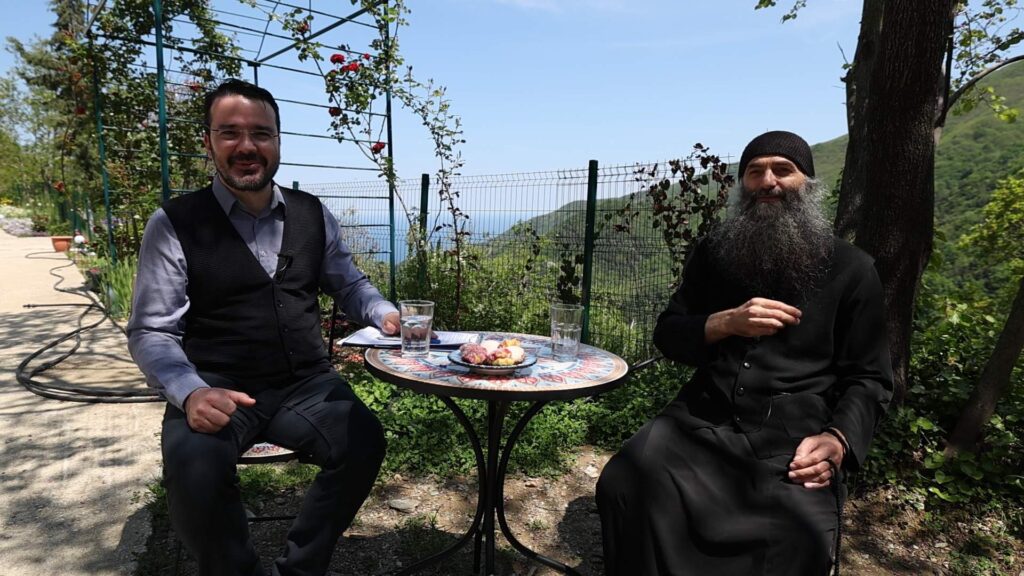
Listen to a comprehensive reflection on fasting by Father Pimen Vlad, who, in a dialogue with Lucian Apopei, presents the various aspects of fasting in the contemporary world.
Enjoy!
L.A: Welcome, folks, to a new edition of your beloved show, “Windows to the Soul.” The good Lord helped us, and we are back on Holy Mount Athos. We are at the Cell of the Entrance of the Theotokos into the Temple, together with Father Abbot Pimen Vlad, to discuss fasting. We live in a world that heavily invests in and insists on this area of consumption. In such a non-fasting, indulgent world, where does fasting fit in? Father, may the Lord help us! Thank you for having us.
Fr. P: Lord, help us! Welcome! May the Mother of God help us!
L.A: Today, we set out to talk about fasting. What are the benefits of fasting in a world that, as I said, invests and insists so much, is so persuasive in this area of consuming as much as possible, and indulging in worldly pleasures, if we may put it that way?
Fr. P: What happens is… It all depends on what we understanding by “fasting.” Because fasting is not just about what I do or don’t put in my mouth.
L.A: That’s right.
Fr. P: Fasting encompasses many aspects. There is also the fast “of the tongue.” For instance, I might say, “I won’t eat until evening!” but I end up badmouthing everyone in the village. “Did you hear what so-and-so did?” and I add to it as well. That is, I make my situation harder, I burden my mind and soul. I see that I refrain from food until evening, I’m angry at everyone, I am judging everyone, and then [I wonder], “I am fasting, why am I not benefiting (receiving grace)? After that… there are a lot of things.
L.A: Could this be a trap? Forgive me for interrupting you, “I don’t upset anyone, I don’t bother anyone, I don’t hurt anyone, but don’t place the burden of fasting on me, ’cause it’s hard,’ ’cause I can’t,’ ’cause I work.'”
Fr. P: It that case, we have to say it differently. To a woman, you say, “Miss, you’ve gained three or four more kilos. Watch out.” Watch how fasting becomes a priority! “What must I do to lose weight?” “Well, eat this and that.” But in doing so, we lose the spiritual reward. The same person, if you tell them to fast, says it’s hard. But if you tell them that they put on some extra kilos, especially women, they immediately find methods to lose them, anything that the dietitian gives them. Or, alright, you say you can’t fast, you went to the doctor, you felt ill and he tells you that you have cancer. But what does cancer mean? If we take it in the spiritual sense, “ca-n-cer” [in Romanian translates to “as-in-heaven”]. Cancer, in fact, prepares you for heaven.
But looking at it in a worldly way, for the person who was suddenly struck [by cancer], he is bluntly told, “It’s serious; you have one month, maybe two, or three.” And what does he do? Then the man is desperate and he asks, “What must I do?” “Well, you have to cut out that, and that, and that…” listing things. “Ok but what am I allowed to eat?” Because if you look at the list, everything is actually cut out. The doctor prescribes you measures that even the strictest fasting fathers in Egypt wouldn’t adhere to. Yet, you are able to then!
L.A: Then see how good bread and water and maybe a boiled potato become!
Fr. P: Yes, that fast you will be able to observe to the letter, and before, when the father advised you to fast a little, for your health, your family, and for 1001 other benefits, [you said] you can’t do it. But when necessity strikes, when you are touched where it hurts, as they say, suddenly you can fast! This shows we are lying to ourselves; we can fast. There’s a common saying, “May God not give you as much as you can bear.” Because we say, “I can’t take it anymore, I can’t bear it.” Or you tell him, “Do this.” “But I can’t.” “You can’t? Seriously?” Lock a man in a room without food and water for a week, then let him out, and you’ll see that he is drags his feet. But release a wolf behind him, and watch him leap over ten fences and run a kilometer without stopping. Suddenly, he finds his strength! The man says he can’t, but no. So, we enter into a state of comfort. We say, “I can’t more than that” [If you tell someone,] “Don’t eat until evening!” [they’ll say], “What, do you want me to die?!” Seriously?
I’ve seen people pulled out from under the rubble in Turkey after 7 days, after 12 days, even more. Imagine being trapped under the rubble for twelve days… You could fast for 12 days and walk around but to stay trapped under the rubble unable to move, in the cold, freezing! Staying there for 12 days, not being able to fulfill your needs, being trapped, yet survive; of course, through the Lord’s mercy. Man says he can’t. You are capable of a lot, but only with God’s help.
You can fast… Here I am referring to the fast itself: eating fasting food, eating a little less. Because fasting is not only about eating fasting foods, it is about eating and not being full, that is the greatest fast. Every time ask yourself, “How much do I need to feel satisfied?” A full bowl. Then, I fill it three-quarters of the way and eat. That too is a form of fasting. Of course, after that, speak less, as the Holy Fathers say, “Silence is golden, speaking the word of God is silver, and the rest is vanity.” What does this mean? It means that silence is also needed for fasting. After that, what do we have left? As I said, this is about restraining the tongue.
For fasting to have value, it needs to be accompanied by good deeds. You give alms, help others, say an extra prayer for someone besides those for yourself, you confess, you Commune. That is, you strengthen your connection with God. You talk to God more often, and then fasting becomes meaningful. It does not mean that it is bad, that if I talk a lot, then I’m not fasting anymore. No, you are fasting, it’s a duty. If you are very ill and cannot fast, that’s a different matter, you consult with your spiritual father, and whatever he allows. But the rest we have to do, little by little, in order to improve. And are we actually doing anyone any good? No. We do good for ourselves. Fasting restores health, clears the mind, enhances clarity of thought, allows for more prayer, and enables you to make a few prostrations, as you are no longer so heavy, and then, you do good deeds according to your strength. In this way, fasting becomes beneficial.
Today, people want fasting food to taste like meat, “Can’t we find some vegan mici [ground meat rolls]? Can’t we find vegan cheese?” And so on. We cling to the same tastes but we call it fasting because the label says, “fasting-friendly.” Even the food that is non-fasting is the same now, it says it has 10% meat, and the rest, there’s everything you want in there, all the powders. They’re about the same. Unwittingly, we harm ourselves.
L.A: Sometimes those choices are unhealthier.
Fr. P.: The temperate man does not fall ill. Sure, he goes through certain things but his life gets more beautiful and purer, because he doesn’t mindlessly eat anytime it strikes him as he passes through the kitchen. Have a meal schedule if possible, and do not get full, avoid fullness and stuffing yourselves. Everything must follow a schedule for the body to remain healthy. Why do you think the Holy Fathers established fasting? It’s not just for spiritual clarity; it’s also to keep the man’s health, benefiting us on all levels. Otherwise, there’s chaos and all that comes with it.
L.A: Father, during fasting periods and beyond, various discussions arise about different ways of fasting, alternative fasting, fasting just with water, these are just two examples. How should we look at these, how do we relate to them? Or asking the question directly, forgive me, is this truly fasting or can it be?
Fr. P: Fasting itself is the fasting set down by the Holy Fathers. So Wednesdays and Fridays, and for those who can, Mondays too. If people understood that Monday’s fast is for the guardian angel, for the well-being of the home, and for peace in the family, many more would be fasting on Mondays. Of course, first of all Wednesday and Friday and the four fasting periods throughout the year. These are the fasts themselves. Moreover, we have Holy Fathers who fasted throughout their whole lives. So, it is not bad in itself. I have met individuals with serious health issues who undertook this water fasting. Their bodies detoxified, and they felt significantly better.
Ultimately, fasting not only cleanses the body but also clears the mind. Let’s be clear, with any food that isn’t heavy, or by simply extending the time between meals, we aid the body in expelling what is harmful, in cleansing, and through fasting, something happens—the mind clarifies. In the first week of Great Lent, as is customary in our monasteries, not just on Athos, the first three days involve no food or water. Each day, you notice your mind is clearer and your state of humility is greater. Something shifts within the human body, your focus during prayer is different, you calm down, and you don’t care about the exterior, material part. So, you begin to draw closer to God. Whether this fasting is with water or not, if you fast for a week, it does clear the mind, and if you add prayer and receive Holy Communion, your benefit greatly. So, it’s not bad!
L.A: How do we make this decision to fast only with water, to fast alternately, or to follow the fasting as ordained by the Good God?
Fr. P.: First and foremost, fasting ordered by the Church is not a matter of pride; it is a duty for every Christian. For many say, “If I’m invited somewhere, how can I tell them I’m fasting?” I tell them, “But why not?” It’s not something extra; it’s a duty. It’s another thing if you choose to fast for a week outside of the designated fasts. Yes, then you avoid others knowing. But on Wednesdays and Fridays, you can meet anyone, even the president, [you say] “It’s Wednesday; I am fasting.” This is the duty of every Christian. The shame should lie with the one who invites you, not to know that it’s Wednesday. It is a duty. So, we should not shy away from this because it’s regarded like a virtue now that we fast on Wednesdays and Fridays. This is the duty of every Christian, this is not a virtue, it’s a duty. A virtue is when you fast all week, besides fasting Wednesdays and Fridays. Yes, and then you say, “I fasted longer than it was written in the law,” as the Savior said, “It is these you should have practiced, without neglecting the others.”
L.A: Father, so it does matter how we fast, but does it also matter how much we eat? Why am I asking this? I recently watched a video of Father Iustin from Petru Vodă, who mentioned there’s a risk during fasting. You may think you’re fasting, yet you find yourself snacking on nuts or breadsticks throughout the day. Does quantity also matter during fasting?
Fr. P.: What is happening with the quantity? Instead of spending all day eating, you should eat at mealtimes—enough to stave off hunger without overindulging, not to say after half an hour, “Whoa, I’m hungry!” meaning enough, but without overeating. And the greatest fast, as the Holy Fathers say, is to refrain from eating between meals. After you eat, don’t touch anything until the next meal, if possible, not even water. That is true fasting, and it’s not difficult. Initially, it may be challenging until you adjust; then your body won’t demand anymore.
Look, I recall reading about an elderly monk from [the Skete of] Saint Anne, he lived alone in a secluded hut, and he had his room, always passing through the kitchen and going outside. He had no set meal times. He would pass through the kitchen, grab a bite, go about his work, he would return and grab another bite then. And he kept praying, he had his little church there, honoring St. George with piety. “St. George, help, St. George, help me!” he would say, tirelessly. “St. George, help me.” Eventually, St. George appears to him, “You keep asking me to help you, but I cannot.” “Why can’t you, St. George?” “Well, if you spend all day eating, you’ve turned your life upside down. Establish some order in this, and then I will help you.” He wanted to make him wiser. Therefore, we must have order.
L.A: Father, is fasting more difficult today? As I mentioned earlier, in a world that urges us to consume more, pizza is just a phone call away…
Fr. P: Nowadays, fasting is the easiest, if you go to the supermarket, half the items are suitable for fasting. Consider that in the past, options were scarce. You would boil the potato, take a slice of bread, make some tea, maybe spread some jam on the bread—that was all.
L.A: So, paradoxically, what seems harder is actually more accessible.
Fr. P: Yes, actually you have all the resources at your disposal. Yet you say, “Lord, I couldn’t do it.” “Why couldn’t you? You yourselves invented so many… there are more fasting-friendly foods in the supermarket than others if you really wanted to.” If you desired a more restrained fast, you would limit yourself to simpler foods. In the end, God accepts the fast even with all those fasting delicacies, as long as you are fasting.
L.A: Father, I present you a challenge; what isn’t fasting? I mean, we think we are fasting, but in reality, we may not be doing it…
Fr. P: Now, to grasp the question, “What isn’t fasting?” what exactly do you mean? So that I understand.
L.A: In the way that, we, more or less, happen ━ depending on one’s spiritual level ━ to think that we fulfilled our duty to fast, but in reality, we are merely gossiping about so-and-so…
Fr. P: So, what is happening? We’ve discussed this before, in another form. But let’s point it out one more time. What is not fasting, that is, we think we are fasting, within the context of observing the food fast, while “eating the flesh of our brother.” I may refrain from food, but I sit around gossiping and judging the other all day. Or you may have a passion, to steal or do other things. This is why, during fasting, it’s said that we should also try to restrain ourselves from actions that provoke God’s displeasure—not that He’s angered, but that He is saddened. There are a lot of things around us, for instance, you might fast from food, but if you struggle with alcohol and drink a liter of spirits at night, can you truly claim, “Lord, I fasted!”? Or consider someone who smokes a cigarette every ten minutes while claiming to fast. I mean, you somehow contradict yourself.
I recall a woman who was fasting diligently. As the fast neared its end, she went to confess to her spiritual father. And she began. For the first five minutes it was good, she spoke about herself. But for the next hour, she spoke of the entire village, linking every sin of hers to the actions of her neighbors. The poor spiritual father wondered what to do. He says to her, “Woman, that’s it, here’s what we’ll do. Go home and bring me a pillow.” The woman lived just three houses from the church. “Is this my penance? The priest has no pillow,” she thought, and she returned with a down pillow, as they used to be. The priest took it up to the bell tower, where the wind blew and at the large windows, he had her open up the pillow and release the feathers. They scattered throughout the village. “Now, for your penance, gather those feathers back.”
“Father, but it’s impossible, haven’t you seen?” Thousands of feathers are strewn across the village!”
“That is your penance.”
“But I can’t, father.”
“These are your words. If you’ve judged the entire village in an hour, it shows how you judge throughout the village, wherever you go and through what you say. These words can destroy families, they can harm others. How do you gather them up? Just like those feathers, once scattered, they cannot be gathered again and they will weigh heavy on your soul.”
That’s why, we must be careful that our fasting does not become covered up by this type of non-fasting. All the value of your struggle to abstain from food until evening can be lost through judgement, first of all because this destroys everything because it usurps God’s authority. And we say, “Lord, step aside; I will set things right!” In doing so, we take God’s right and we rebel against Him. And there is also the commandment that immediately comes with the reward so to speak: “Do not judge in order not be judged.” This means that if we refrain from judgment, God will not judge you either. Yet here we are, quick to cast judgment, trampling over everything.
Another beautiful word reminds us that “God resists the proud, but gives grace to the humble.” To be humble means not to judge anyone. The humble person remains grounded, that’s where he sees himself always, and cannot fall further because there is nothing lower. He always sees the others above him. “All of them are better than me!” because he is low and sees everyone. The moment you elevate yourself and look down, it’s already a problem.
L.A: Dear Father, it’s said there’s a popular saying that for fasting there is no illness. But what about people who, for various reasons, cannot fast? Pregnant women, children, or those with serious illnesses—do they have allowances in this regard?
Fr. P: Do you know what happens? Fasting is meant for the healthy, why? Fasting itself, besides maintaining your health, is for healthy people, to help them practice restraint, pray more, and maintain control over their bodies. And then, in any situation when you see that you are not coping, go to your spiritual father to ask for his blessing and tell him, “Father, look, I have this health problem.” But don’t go seeking excuses for every little discomfort; a sore finger is not a valid reason to abandon fasting. So there must be genuine reasons. You see for old age, people that reach a certain age and can no longer fast. With the blessing of the spiritual father, it is possible. So, it’s not something like, a law, you’re about to die yet you have to fast. No. The spiritual father understands your circumstances and may not permit meat, but may allow an egg or a bit of milk, depending on the situation. So, the spiritual father can, God has granted him to be able to dispense with the rule according to the individual’s needs.
L.A: Father, among the fruits of fasting, which ones would be the most important?
Fr. P: The acquisition of the Holy Spirit, and what does it say? The fruit of the Spirit, is love, joy, peace, and long-suffering. So, what is our purpose in this life? To draw closer to God, who bestows upon us the gift of the Holy Spirit, that is, His grace.
We see it at Saint Seraphim of Sarov when Motovilov witnessed him being in grace, in a little bit of grace, and he saw him and said, “Father, I see you in the midst of the sun.” So that is what it means to be in grace. And we, if we fast for a little while with humility, then the grace of the Holy Spirit comes. And you know what happens then? We cease to judge others; we no longer see evil in anyone. We feel like embracing everyone and we rejoice in all of God’s creation. You see a tiny fly and marvel at it, unable to stop. You gaze at a blooming flower and are awed by its beauty. “How beautiful it is!” What God created… You listen to a bird singing so beautifully, for you are in grace and being in grace, you begin to understand some of all these things that God has created. You begin to see their beauty.
The man who lacks divine grace is attached only to the earth, to matter, to money, he no longer sees any of these. He thinks of how to accumulate, how to make money, how to live better through these goods. It seems to him that happiness resides in material gain, because he feels empty inside. Man without the grace of God is hollow inside, and then, he wants to forget, he seeks to fill this void through this misunderstood matter, wanting it all for himself. So, he no longer cares that one is hungry, that the other endures. He wants to have more and more. If he owns two houses, he craves five more. He has three cars? He thinks two additional ones will surely bring joy! Yet, after acquiring all this, he finds himself lamenting, “Whoa, I’m unhappy.”
Recently I was reading about India’s wealthiest man, a multi-billionaire. Someone asked him in an interview, “Man, are you happy?” “Let me tell you, at first, when I reached a certain level [of wealth], I felt unhappy but my thought had been that if I had those things I would be happy and I saw that I was not fulfilled, I was empty. Then I said, for sure if I do that and that and I acquire that thing and that, I would be happy. I saw that even then I was not happy. Even when I became the richest man in India, I had everything at my feet, I saw that I was still unhappy. [I] said, ‘What is happening?’ Then a friend approached me and asked if I would like to do something good, given my wealth. ‘Sure, what kind of good should I do?’” And he told him, “Look, there’s a place with about 200 disabled children, paralyzed and without proper wheelchairs. You have the means to help each of them get modern wheelchairs. So, they would be able to move, to play.” And then, he said, “Of course, I’ll help. Tell me the price, here’s the money.” “I will order the wheelchairs; you will pay for them, and then you will come with me to give one to each child.”
He said, “When I went there and handed out the wheelchairs, and I saw the joy in the children’s eyes, how they were laughing, rejoicing….” Those kids were not experiencing any of their unhappiness at being paralyzed, with disabilities, they were now embracing each other, racing around in their wheelchairs, playing. He said, “There was one child, when I placed him in his wheelchair, wrapped both arms around me. I tried to pull away, but he wouldn’t let go. Then I leaned over the child, ‘Child do you want anything else from me?’ The child pulled me closer, looked at my face, and said, ‘I want to remember your face well so that when I go to Heaven, I can thank you there again for what you’ve done for us.’ That moment, I felt happy.”
So, when did he feel happy? When he gave, not when he received, even though he was the richest man in India. When he gave, only then was he fulfilled. So, what does that mean? That happiness comes from giving. And let us not forget what love is, and the source of love is Christ. As the Holy Apostle Paul tells us, “Love does not seek its own.” This means it never thinks of itself. It rather considers the well-being of others. Love equals sacrifice. True sacrifice comes from giving your love completely, sacrificing yourself for the other. What did the Savior do? He suffered all the way to the Cross where he embraced everyone and in the final moments he said: “I love you.” So, this is what love means.
We confuse it with selfishness and we call it love. “If you love me, you do this for me, or, I love you, you must do this for me.” That is, as they say, negotiation, trade, it has nothing to do with love. Love is given without expecting anything in return. That’s what it means and this is where true fulfillment begins—spiritual fulfillment, spiritual gratefulness, peace, and tranquility arise from doing good.
If you do good for a hundred people, and each of them prays, “Lord, grant him health,” imagine those 100 heartfelt cries ascending to God: “Lord, give him health.” And then God comes and shakes you awake because He has to make you healthy for those 100 people who have cried out to Him. Consider the grace we receive in that moment! So, grace flows from doing good, from giving, from remaining humble, and from having our connection with God. And through all these, whether through fasting, or a good deed. Combining all that’s possible.
L.A: So, since we have only one minute left, we should understand from your holiness that there is a strong connection between fasting, good deeds, and prayer.
Fr. P: Everything is interconnected. So, every element that leads us to God is like a chain link, one connecting to another, guiding us toward Him. That is why the Holy Fathers made them available to us; for us it is very easy. Consider the early Christians who, in the first centuries after the Holy Apostles, when martyrdom began, many were illiterate and didn’t hear much and perhaps they had only heard one epistle from the Apostles, yet they embraced and lived the faith. For us, the Holy Fathers have laid everything out through councils and countless books. Everything is on a platter. Any confusion we face can be resolved. So, everything was handed to us on a plate. We have everything we need to approach God easily, to walk the right path, but it all depends on us: we must remain within the Church, obey its teachings, partake in confession and Communion, attend the Divine Liturgy, through good deeds, and express daily gratitude to God: “Thank you, Lord, for waking me up today. Thank you, Lord, for bringing me home safely tonight. Thank you, Mother of God, for interceding for me and watching over my family!”
We must always be grateful. As one of the Holy Fathers said, “A prayer of thanksgiving pleases God more than a hundred requests.” It brings God so much joy when we thank Him for what He gives us.
L.A: Dear father, thank you very much!
Fr. P: May the Mother of God help us! Lord, help us!
L.A: Kind people, good wishes from here at Lacu Skete! Remember that in the end these three remain: faith, hope and love, and the greatest of these is love. Lord, help us!
Online commemoration lists and donations
May the Lord help us!
Online Commemoration Lists and Donations
May the Lord help us!
If you have a bank card and wish to send commemoration lists and donations online using your card, and/or to support our philanthropic activity, including this site, please fill out the form below to make a small donation. The form is secure – we use Stripe for payment processing – a world leader in this field. We do not collect your personal data.
If you do not have a card, or do not wish to use it, visit the webpage for Online Donations and Commemoration Lists.
We will pray for your loved ones! (Please do not include inessential details like wishes, degree of kinship, introductions etc. JUST the name!)
Especially for recurring commemoration lists, we ask that you please keep them to under 20 names long. If you include a member of the family, we add “and for their families.”