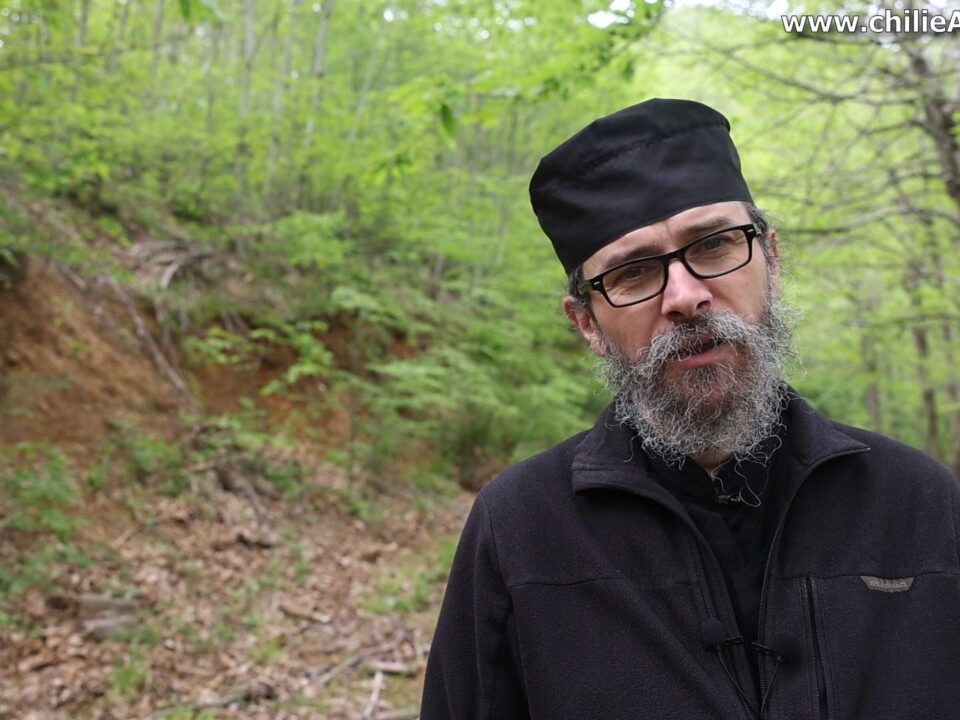


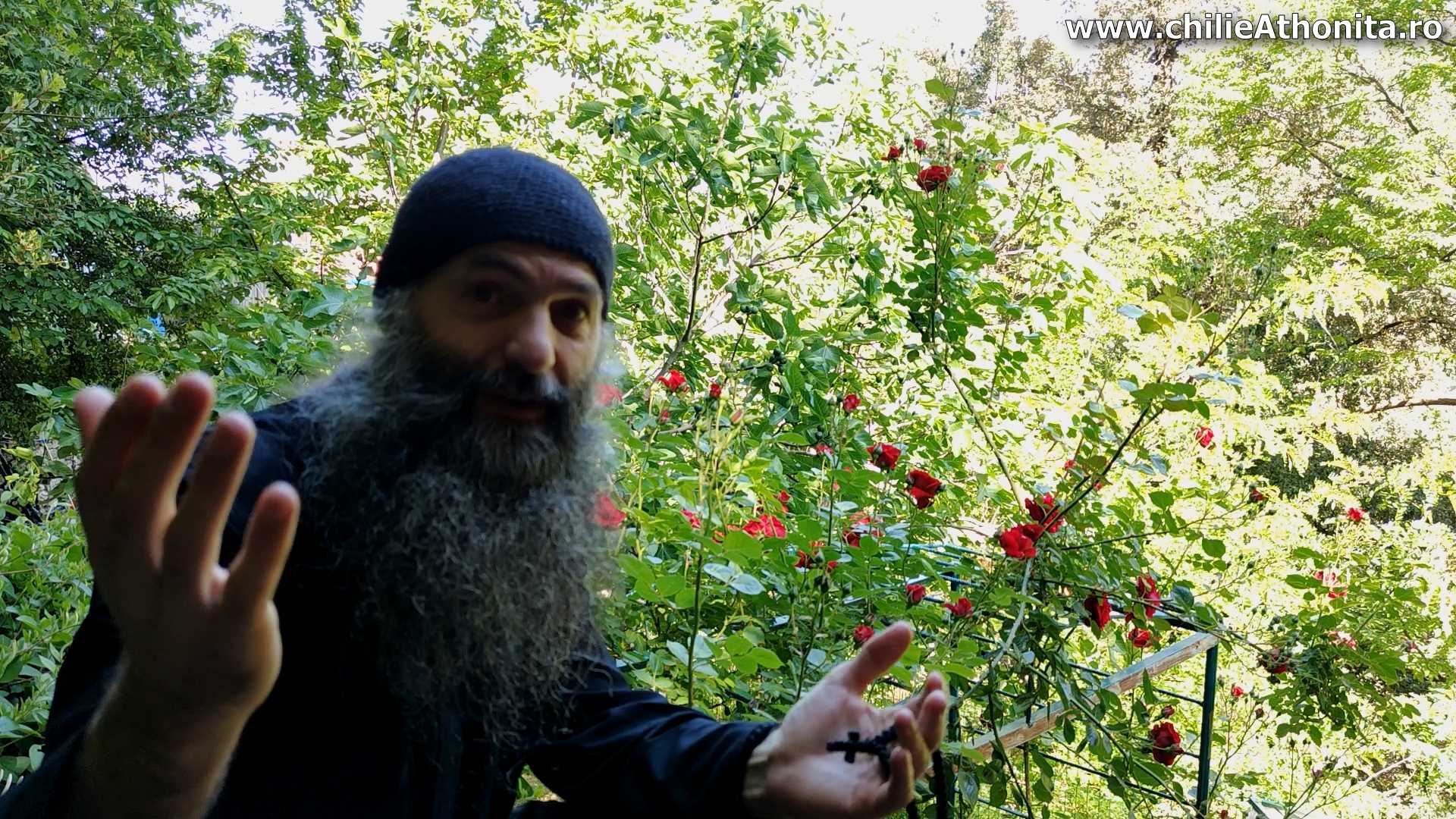
About Temptations and Passions – Fr. Pimen
27 April 2023
The Blessing of Illness – Fr. Pimen
4 May 2023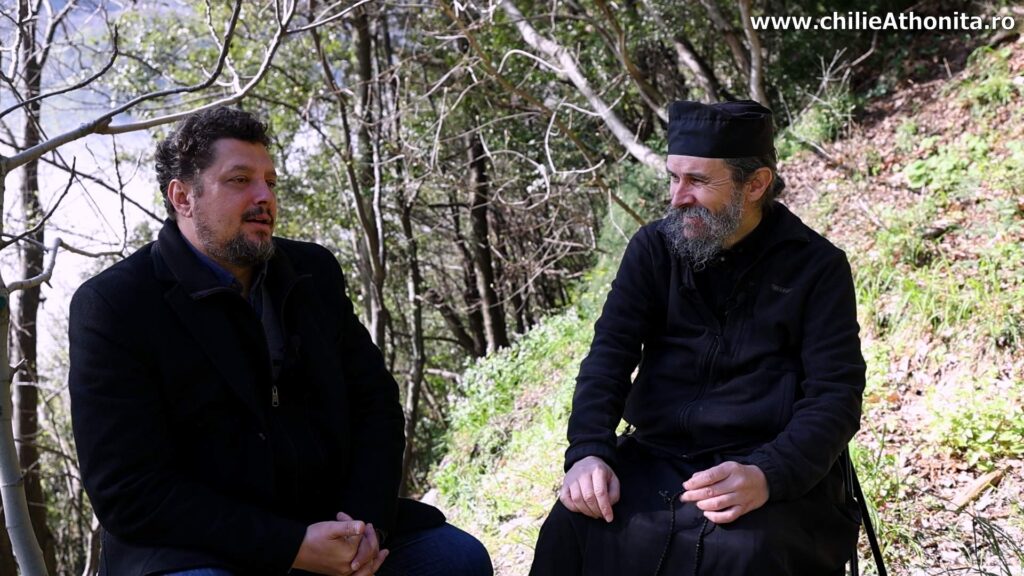
Claudiu Târziu was on a pilgrimage to the Holy Mountain and we tried to find out what the man Claudiu Târziu looks like in his lesser-known activities – beyond his activity as a political figure, an activity that we do not follow.
Enjoy!
Fr. Theologos: Glory to the Father, and to the Son, and to the Holy Spirit, now and ever and unto ages of ages. Amen. Through the prayers of our Holy Fathers, O Lord Jesus Christ, Son of God, have mercy on us! Amen.
We are filming this on the feast day of Saint Claudius the Martyr, Claudius the Tribune, and we are with Claudiu Târziu—perhaps you know him as a politician, a cultural figure, and also as a theologian. I repeat, as I said in the podcast with Sorin Lavric, I don’t know much about politics and I won’t ask political questions; maybe you expect us to ask political questions – maybe one or two, I don’t know… In any case, I respect Claudiu very much and I love him greatly for his spiritual and cultural-spiritual work, if you will, because he has an association: Rost (Purpose) or… Yes, that’s it.. and I would like to talk more about this topic, about spirituality, about our people, our heritage, about culture. Rost (Purpose). Does it still have purpose?
Claudiu Târziu: Yes, we started from this thought: that the worst thing for a person is not to have a purpose in the world, and if we somehow can help the Romanian people to rediscover the purpose lost during communism – as we considered – that they lost it to the force of the enemy who ruled these lands of ours for 45 years, then we must do it, we are obliged to do it. And why did we believe that we were the ones called to do it and not others?
Firstly, because we had a tremendous opportunity; providence allowed us to meet former political prisoners who have considerably grown spiritually in prison, sanctified through prayer and through the hardships endured in prison, through the tortures they were subjected to, and through the extermination regime which they nevertheless survived. Those former political prisoners gave us the essential guidelines to follow, and we wanted to turn them into a path for the entire nation, not just for those of us who had the privilege of meeting these wonderful elders—among whom perhaps the first for us, those from Rost, was Father Gheorghe Calciu Dumitreasa, who served 21 years in prison, including five years during Ceaușescu’s regime.
Since I keep hearing this nonsense that there were no political prisoners during Ceaușescu’s time! There were! There was Goma and Father Calciu and many others. Father Calciu, who was imprisoned for the second time for his opposition, was the only one who opposed the demolition of churches in Bucharest. From the pulpit. And when he was no longer allowed to preach in the church at the Radu Vodă Monastery in Bucharest, where the seminary where he taught was located, he then spoke from the steps of the church and continued to confess fearlessly, wholeheartedly, and with full responsibility for the younger generation. In fact, in his famous sermons—The Seven Homilies to the Youth—he addressed young people in particular because he knew that if there was anything left to save, it was the youth who could be saved, not those who had already been shaped in one way or another, or rather, deformed by the regime in which they had lived. Therefore, our role is that of guides not because we are better than others, but because we have learned from the best what path we must follow as a nation.
And this path has, of course, two essential landmarks, in my opinion: love for one’s people and love for God, or love for God and love for one’s people. It must be equally about love. You cannot accomplish absolutely anything in whatever you set out to do – whether it is culture, agriculture, engineering, aeronautics, or politics. Nothing will succeed if you do not do it with love. You must have love for your profession, love for others in order to give from what you know and can do. This thought is the starting point. Do we have love? Do we still have love? I believe that this is the problem of today’s world: it suffers from a lack of love. Hence, wars, all the evils, diseases that strike us, and everything else. And nature rebels against us because we no longer have love and treat it without love, and so it responds to us as we deserve.
Rost is an association that, at the time—in the early 2000s— was mainly made up of young people, but now we are not so young anymore… It is an educational and cultural association that has many activities and a publishing house, and it also had its own magazine that was in print for 10 years, from 2002 to 2012. Now it survives only through the online platform – rostonline. Rost Publishing House, the publishing house that bears the association’s name, and, above all, we have a cultural and educational center called “Casa cu rost” (House with Purpose), which was initiated, conceived, and managed to this day by my wife, Adela Ioana. What do we try to do there? To accustom people, especially the younger ones, but also the adults, to natural life, to normality. Well, yes, this is the state we have reached as a people and as a world in general, having to relearn normality so that we can return to the natural order. By the way, we have adopted a sort of slogan for the publishing house which may seem odd, but it is very true in its essence: “The exceptional natural.”
Fr. T: Yes, sadly!
C.T.: Yes, today what is natural is exceptional. It is no longer something normal.
Fr. T: That is true.
C.T.: And we try to make it normal. Where from, where to? So, from learning traditional crafts such as carving, pottery, sewing traditional blouses, and so on, to healthy eating and Christian thinking—because there is also a way of thinking in the Christian spirit. We, Christians, are not brainless as many of those who passionately hate us imagine. We think, not just feel. We also think about God and we also talk to Him. Sometimes He even answers us. We must learn to think in Christian terms. If we believe that everything boils down to fulfilling some formalities, a ritual, that is good, it’s a start, but it is not everything. We must go so far as to be able to think Christianly and, ultimately, to be able to feel Christianly. Of course, there are people gifted by God who suddenly feel.
As Țuțea said: “Between a scholar devoid of God and a poor old woman who is faithful and sheds tears before the icon of the Mother of God, it is she who truly feels, and who is…”
Fr. T: Human. And the scholar is a ferret.
C.T.: Exactly.
Fr. T: That was Țuțea’s statement.
C.T.: Exactly like that. Right. Well, that’s where we need to get! And we try to do that through Rost as well. It’s good that you asked me this question about Rost because people now imagine that before I entered politics, three years ago, I didn’t exist, that I was born directly into politics and deserve all the tomatoes and eggs thrown at me by my opponents because, isn’t that so? I resemble all the political beasts before me, before I entered this fight. Well, it’s not so! Glory to God that I had… both the spiritual strength and the help of those around me to profess, for almost 30 years, the same values that I placed with my own hand on the flag of the Alliance for the Union of Romanians (AUR), namely: faith, family, nation, and freedom. I served them in every way I could— from cultural events to street protests, from memoranda to politicians to scathing articles against politicians. That is, in every way possible, I have tried to serve what I believed in.
And yes, unlike other politicians, I and Sorin Lavric, George Simion and many others at the top of our party can say that we have done something in line with what has been declared today, long before we ourselves knew that we would be entering a political project. That’s why, yes, we can get credit. Until proven otherwise, if we come to power and do not do what we have said, then we certainly deserve to be sanctioned, but until then we can be taken at our word. Why? Because we have a past that can be easily verified. Now everything is on the internet, and we are actually very open people, and I personally have a website where I have posted all my writings. I was a journalist for 28 years, I have also published some books, I have posted videos with various personalities with whom I have had discussions, and so on. So I can be easily verified and you can believe me or…
Fr. T: Yes, yes…
C.T.: But based on what you see I’ve already done. You may think that once I entered politics, I became corrupt, but let me prove to you that this is not the case.
Fr. T: Right. Regarding Rost, how can someone join, get in touch with you? Because I understood, at least I understood very well, that Rost has a formative, very formative activity. So, if a young person, if someone wants to join, get in touch with you, and so on, how can they do that?
C.T.: It’s very simple because now we use all communication channels, including Facebook, WhatsApp, Instagram, and TikTok. We use all of them because these are the times we live in, and we need to reach the people who need us, to let them know that we exist and what we do. And we organize dozens of workshops weekly.
Fr. T: Really? Glory to God!
C.T.: Dozens of workshops with teachers who are highly skilled in their area of expertise, and they teach different things. Each person chooses something. Some people are interested in healthy eating and learn how to make sourdough bread or raw-vegan sweets or all kinds of things like that, which today seem like eccentricities, seem like proof that we are pretentious or something. No. These were once ordinary things in people’s lives.
Fr. T: Yes, something normal.
C.T.: No one questioned it… We even laughed about it with friends: “Did the Romanian peasant say this is organic tomato, this is organic potato?” There was no such thing! Because everything was natural, including the diet. Not only must the food come from natural sources, but the way you grow it, the way you nourish yourself, ultimately, must be natural as well. There is much to discuss here, but perhaps people are most interested in this aspect of Christian psychotherapy that we have developed very well, especially since my wife is also a psychotherapist. She primarily works with children because that’s where there is a major issue today…
Fr. T: It’s a big issue!
C.T.: And very few psychotherapists work with children. It is difficult, it is a great responsibility, but if you have love—once again, if you have love— you can do good things there as well.
Fr. T: Okay, let’s go back! First of all, I would like to make a small digression— regarding orthodox psychotherapy. Brethren, please, there is a book, it is called just that: “Orthodox Psychotherapy” written by His Eminence Hierotheos Vlachos when he was an archimandrite. Search for Hierotheos Vlahos, Metropolitan of Nafpaktos, today. I warmly recommend it, get it, read it! Closing the parenthesis, we return to the love. What is love? What is God and what is the people?
C.T.: I believe that love does not exist in the absence of action. I can’t say: “yes, I love you,” but I’m not making any effort. That is, I make no concessions to you, I show you no understanding, I make no sacrifice for you, but I say I love you. Well, how is that? Love is constantly proven by deeds, and it resides in deeds. The moment you give up your piece of bread – which might be the last one for someone who needs it more – you have shown that you have love. The moment you spare no effort, giving your last drop of energy for a cause greater than yourself – and if it is greater than you, it is above the belly – then you demonstrate love for your people, your family, your local community, or depending on how great that cause is. When you obey God’s commandments, you show your love for God. Without this, you can only say it with your mouth, you can perform some rituals, and that’s it. But what do you do to prove this love? Everyone is asking: Well, but why should I give alms? Why should I go to church on Sunday? Why, why, why? Well, how else do you demonstrate your love for God? Or do you want only God to love you, and to help you every time you call on Him, but you do nothing?
Fr. T: Abstract.
C.T.: You’re like one of those spoiled kids who expects their parents to give them everything, but you don’t listen to them, and inevitably, in the end, this disobedience, which is a lack of love, will lead you astray. You asked me about love…
Fr. T: God and the people.
C.T.: I’ve covered them all, I think, they’re all there. In my opinion, there is no true service. That is, you cannot be a patriot, a nationalist in the best sense of the word, without love. And I have explained this many times. True nationalists don’t hate other peoples.
Fr. T: Obviously.
C.T.: They love their own people and, of course, they defend, protect, try to strengthen, promote, and make it better.
Fr. T: They don’t defend it against other people, but against other ideologies.
C.T.: Against ideologies in general. The neo-Marxist ideology is a deadly scourge for everyone, wreaking havoc especially in the West, but sadly it has also entered our country, including through legislative means, with the majority vote because that’s what it is… And there are many who declare themselves patriots and Christians. Brothers, but why did you vote for that? Didn’t you know that it’s not good for your people, that it’s not good from a Christian point of view? “I am also a Christian, brother, and I am also a patriot, but they have the money.” Well, brother, if you think like that, better go home because you confuse people and also commit sins, just leave it like that! God… people…
Fr. T: How do you see God, what is God like for you? Well, I’m not asking for a dogmatic answer.
C.T.: No, I wouldn’t even be able to give a dogmatic answer, but for me God is very tangible. That is, for me He is not an abstraction, He is not someone I do not know. He is Someone I constantly feel near me and Whose help I have felt many times, sometimes even without asking for it. Because I was so troubled that I was not able to ask for God’s help, but God knows that I need Him and knew that if He reached out His hand to me, I could wake up from that turmoil and resume my path, and He helped me. And after going through these experiences, I also shared them with some former political prisoners, trying to learn more from them, and I did find out more.
For example, Father Gheorghe Calciu used to tell me: “Well, you’re the one saying that? Yes, I’m glad you have also lived such experiences, but I have lived through a terrible one.” And then he told me about his experience in Pitești, which was a disaster. Perhaps the people watching us know or do not know, but for two years, in the Pitești prison, where mainly students were detained—in order to destroy the future elite of the country—during communism in the 1950s, a horrific experiment was conducted: they put a group of former prisoners who wanted to be released quickly because they had shorter sentences and had no faith or love, to beat the others to such an extent that they too became torturers. And so that even some among the good ones became torturers, so that more and more of the good ones became torturers until they all had to become torturers and beat each other to death. That was the communist thinking—just so you understand how good communism was, dear ones, who still say that it was good!
Fr. T: Yes… that Ceaușescu was good, yes, yes…
C.T.: Oh no, I can’t stand the nostalgics anymore… In the end, Father Calciu, having been beaten to a pulp many times, fell. Those watching us need to know what that means. It got to the point where he no longer had buttocks. They beat him until the flesh fell off his buttocks, and he had none left until he died. That’s how hard they beat him! And he fell. But he couldn’t beat someone. He was also small in stature, not the type to necessarily use force, but he probably retained a form of lucidity and love, and he never hit anyone. However, it is said that he had an elephant’s memory and remembered what those who criticized themselves after the beatings said. And when it wasn’t true, he would say, “Look, it’s not true.” Well, when this group was put on trial under Western interventions and so on, they looked for scapegoats, one of whom was Father Calciu, and he said: “Look, I didn’t care about anything anymore because I was so bewildered by the tortures I had been subjected to that I no longer believed in anything, I didn’t even have the strength to pray anymore, and so I no longer cared about anything. Anything could happen to me.” Probably many of those who entered the trial were in this state, and that is why most of them followed the scenario fabricated by the communist authorities, the secret police, and the communist party. They told them: “Say that you are guilty, that you alone took this initiative at the urging of your political leaders from abroad and that the authorities had no involvement whatsoever…”
Fr. T: And that the party is out of the picture, has nothing to do with it.
C.T.: “You got into a fight…” As if you could do anything in prison, on your own, just like that.
Fr. T: Yes…
C.T.: Everyone said this, led by Eugen Țurcanu, who commanded these troops of torturers, and they were all sentenced to death. Only one said it wasn’t true and overturned the trial, and that was Father Calciu. At that time, he was a political prisoner, a former medical student. He had completed three years of medical school. And he got out and lived until 2006. But God – because this is where we started – God intervened and brought him back when he could no longer pray. He restored his soul and said, “Look, you are a good man; you made a mistake not because there was evil in you, not because you lacked love, but because others brought you to a state of being inhuman.”
Fr. T: Yes, “you couldn’t anymore.”
C.T.: “Look, now I’m helping you!” And He helped him, and afterward, the father did so many good things, that he redeemed his guilt a hundredfold…
Fr. T: His fall…
C.T.: Yes, and among the good things, I believe he also did one good thing that concerns me, which is that he guided me on the right path. I wrote a book, I’ll give it to you when we’re done here. „Cei 13 care m-au salvat” (The 13 who saved me). They are 13 former political prisoners, including Father Calciu, Bishop Bartolomeu Anania, Ion Gavrilă Ogoranu, and several others who have guided me on this spiritual path and in the struggle for our nation. I look up to them, I am indebted to them, and if I ever falter, I ask their forgiveness first and foremost. The others are merely beneficiaries of their work. If I do something right, it’s not me they should thank, but them. That is why I wrote this book, and everything Father Calciu also said is in there. In this book, you will also find a very interesting opinion regarding the Church. Why should the Church engage in politics, and how should it do so? Not in a partisan manner because the Church covers everyone, but to prepare people from the Church…
Fr. T: So that they have enlightened minds to be able to do politics themselves…
C.T.: Yes, strong, faithful, devoted, full of love and sacrifice…
Fr. T: Pillars…
C.T.: For them to engage in the kind of politics that the country needs. And what a tremendous responsibility the Church has!
Fr. T: Obviously.
C.T.: We don’t have a political class that we love, that’s for sure, but we all have a responsibility here, including the Church. Well, where is the Church? Why doesn’t it raise such people? I went, I tell you honestly, I went to priests, hierarchs, and I asked them: recommend good people you know, Romanian Christians who want to get involved in politics! Don’t expect us to solve everything. We are a few people who have raised a flag, but that does not mean that we are the best, nor that we are the only ones in Romania. There are many more who are good, and better than us. Come on, let’s bring them along too, because only together can we do what we have to do! Romania is in a deplorable situation in many respects, and the moral crisis is perhaps the greatest crisis of all. Not the economic one, not the financial one. The moral crisis! And where? In a Christian country. Look, here we are at Athos, in the garden of the Mother of God. We say that Romania is also the garden of the Mother of God. Well, yes, but we don’t really behave as if we were in the Garden of the Mother of God, with all the sins we constantly commit. Well, we must change this, so that Romania truly becomes the Garden of the Mother of God, because it would be good for us as a people, and through us, perhaps other peoples might also be saved. We don’t know. Because I don’t think it’s for nothing, you see, I keep switching from one thing to another, talking a lot because I know we have little time.
Fr. T: Speak, speak, it doesn’t matter. I’ll cut you off.
C.T.: I don’t believe that God allowed this fantastic exodus, unprecedented in our history, without reason. There are 8 million Romanians living outside the country. Over 6 million documented by state institutions, I tell you this for sure. 5 million with residence permits, over 1 million with domicile abroad, but many more who are not registered or who are seasonal workers and come and go, and so on. Plus the other Romanians from historical communities, from Bessarabia, who also work and live in the West. But Romanians, being who they are—as I said that we are no longer in the garden of the Mother of God —nevertheless, they took their church upon their backs. Wherever they are, whether in Italy, Spain, the United Kingdom, Germany, France, wherever they went, they built a little church. If they didn’t have money to build a small church, they rented one from the Roman Catholics, from other denominations that no longer use those establishments because they no longer believe – there are entire peoples who no longer believe. The Czechs, for example, or the Belgians.
Fr. T: Yes, the poor ones…
C.T.: They have nothing to do with it. I have seen their monuments…
Fr. T: Yes, phenomenal.
C.T.: Some extraordinary churches that were no longer in use were given to our Romanian and Orthodox communities, who take care of them, maintain them, serve in them, and have brought priests from home. Well, I think God said, “These Romanians, even though they have fallen, still have a bit of love for Me, a bit of humility, and a bit of endeavour to do good, so I’ll take them to some places where they can influence others.” Maybe this is our spiritual imperialism. We have never conquered any nation with weapons, because that was never our aim, but behold, with the spirit, we can conquer them in the name of Christ our God so that they may be saved.
Fr. T: That is right.
C.T.: I find this scenario very plausible and extraordinarily beautiful.
Fr. T: Beautiful and very important. There is a great responsibility upon us, upon you, upon all of us to help this scenario succeed, because this scenario is therapeutic, it is salvific, it is redemptive. This is not about choice, meaning yes, okay, I am with this, you are with that, and so on. No. It is about human salvation, that is, about human happiness, joy, and the capacity for love.
C.T.: You should know that – forgive me! – they bear fruit.
Fr. T: Obviously.
C.T.: Among other things, I am the chairman of the Romanian Senate’s Commission for Romanians Everywhere, and in this capacity, I have made many visits both to the historical Romanian communities around the borders and to the communities of economic exile – as I call it – it’s not really a diaspora, we have not spread out as if we had no borders, no national hearth. We simply spread out to be able to live somewhat better than the politicians in Romania allowed us. Well, I went to them and saw how annually, dozens, hundreds, perhaps even thousands – in some Romanian communities – of foreigners convert to Orthodoxy, because they see that here is the true mystical thrill, they feel the services differently, and if they truly seek God, they come. I even met a Dutch priest in the Netherlands who, having no reference point, left home as a young man to search for meaning in life and traveled all over the world. He visited countless neo-Protestants of all kinds, but they didn’t convince him, and ultimately, he came across Father Calciu, who was exiled in America. After his last period of imprisonment, the communists kicked him out, saying, “Come on, the Americans intervened for you, so, leave this place!” And he went to America and started from zero at the age of 60 and built a church there in a town called Alexandria near Washington, where he performed miracles. What can I say? He brought many people to faith, of all nations, including this Dutchman who now serves as an Orthodox priest in a city in the Netherlands, where Orthodoxy has taken root.
Fr. T: Glory to God!
C.T.: So, here are the fruits of this spiritual imperialism I was talking about! Plus, I’m telling you, almost no kind of organization like this—non-governmental, cultural association, or whatever, embassy programs to unite Romanians abroad—works. But the church unites them. Around the church, everyone is there. If I want to go to a Romanian community anywhere, I look for the church. Thank God that the fathers have got me taped, so they welcome me!
Fr. T: How beautiful! You said that the main crisis today is the moral crisis.
C.T.: Yes.
Fr. T: How does the main illness manifest concretely? Or the main illnesses?
C.T.: Well, this is what I think. The moral crisis stems from a lack of love. When you do not love, first of all, you no longer respect God’s commandments. First, you suddenly fall. After that, if you do not love, you also fall from a human perspective. That is, if you don’t truly love your wife, you’re cheating on her. If you don’t truly love your child, you don’t guide them down a healthy path, you don’t care how they develop, how they shape themselves as a person, as a future adult, and you neglect them. Well, all these things ultimately affect society because we are practically dealing with a world that has been torn from its natural and deep roots. A world that no longer relates to the past with reverence. We no longer care about the sacrifices our ancestors made so that we could have a country. We no longer care about the saints who pray for us, for example, we no longer care that there are many mass graves or tombs of people who suffered for their faith in communist prisons and who were sanctified through suffering in those communist prisons, who also pray for us, and through whose prayers God still keeps us and has not wiped us off the face of the earth. We do not care about this… We do not care to live according to some moral benchmarks, be they even of a secular nature.
Fr. T: Ethical…
C.T.: Ethical, right. Good wording, I was looking for that word.
Fr. T: Please forgive me!
C.T.: Yes, we no longer care. That is to say, what does it matter if I lie, cheat, steal, harm my neighbor, or, whatever— let’s call them the Romanian next to me, as I don’t call them neighbor since that actually has a spiritual connotation.
Fr. T: The neighbor no longer exists…
C.T.: Yes, it’s “the distant one.” “What does it matter?! After all, this world is one in which I must take everything, with fury, with the belief that I deserve everything and others deserve nothing. I have to climb on their shoulders as high as possible, solve my problems for myself and—possibly— my relatives up to the seventh generation for generations to come, and I don’t care about others.”
Fr. T: Egoism actually means war; it means loneliness.
C.T.: Well, it is first an inner war, because many of these people come to realize, especially those who, through God’s love, eventually return along the path to what is true, to the truth that is God. These people realize that no matter how much wealth they accumulate, no matter how much political or any kind of power they have, no matter how much they indulge in every luxury in the world, they still feel a void in their souls, and then they no longer understand. Hey, brother, what am I doing here? What else do I need to do to be satisfied? And some of them realize that they have not taken the path that leads to contentment, but a path that enlarges the emptiness inside them and ultimately makes them a living dead. Because you are no longer alive in Christ, no longer spiritually alive; you are a shell that you stuff with everything and carry proudly through the world, but which no longer has any practical impact. If you do everything only for yourself and do not give to others, if you do not plant love, you ultimately have no impact on them. At least, you become disgraceful and…
Fr. T: Yes, a bunch of cells…
C.T.: Yes, that’s why, as you see, we are here at the Holy Mountain, and one of the recent, or rather more recent, benefactors is Mr. George Becali. He once told me in a conversation: “Look, I have wealth, I have money, I have everything, and I thought – I can’t just leave it here to rust; I can’t leave it here in anyone’s hands! I take it with me to heaven.” Well, how do you do that? “Here’s how I do it: I give it away. I give it to others, to the poor, to the sick, to the Church, and I take it with me to heaven.” And I said: “Look, if more people who have financial potential, who have great wealth, but also smaller amounts, could reach this awareness, it would be wonderful because this good done in the world, if multiplied, ultimately softens the people.”
Fr. T: Obviously. It softens their hearts.
C.T.: People are also mean due to the fact that they are deprived of many things, then they become more selfish, more unsympathetic, less loving. And here I have counterexamples, since I am like the lawyer Istrate Micescu who could defend or accuse someone in the same trial. It depended on which side they were on… I have a case that I recalled just recently. A prominent businessman in Romania was an unbeliever, and tragedy struck his family: one of his children died.
Fr. T: May God forgive him!
C.T.: And that man who was unbelieving, mind you, was only interested in money and was involved in all kinds of shady, perhaps even strange, business dealings— because that’s how you make money quickly, you can only grow fast by doing such things. Well, what do you think? He turned to God.
Fr. T: Glory to God!
C.T.: He became a believer and practices charity and does extraordinary things; he has made an impact not only in the Romanian sphere but beyond, as he also does at Athos…
Fr. T: May God help him!
C.T.: With this love, an overflow of love that overwhelmed him, how? Through a tragedy. It was then that he truly understood the purpose of life. Others struck by such an event might have become even bitter against God, more devoid of love, harsher. No! You see, it can happen this way too. We must take into account that every person is an individual; we should not judge anyone, and if we cover them with love, in the end there is a great chance that they will respond with love to us and to people in general.
Fr. T: How do you see the youth and the future?
C.T.: I am optimistic, but I have a kind of eschatological optimism.
Fr. T: I understand…
C.T.: That is to say, in the end, Judgment will come and we will find peace. So that is my optimism—that things will become clear by the end. But regarding what happens until then, of course, we cannot envision the future of a nation without its youth, and we cannot envision the future of a nation without two major components that have been systematically undermined, eroded, and deprived in the 33 years since the fall of communism. And I’m talking about education and health, or health and education. If we do not have a healthy people, and that starts from the grassroots level, from prevention, from healthy nutrition, sports, and so on, and an equally educated people – we cannot hope for our survival as a people. Only from here on do all the others come. And again, in my humble opinion, I believe our nation has a future all the more so if it manages to reunify. Only when our people will be within the borders of the same state, by reclaiming our brothers who were torn from our bosom by force, so to speak, by the will of the two great bloody dictators, Stalin and Hitler, and who are separated from us to this day. So until we bring these brothers home, we cannot be a whole people in spirit, first and foremost.
Fr. T: Yes, yes…
C.T.: That is also why our party is called the Alliance for the Union of Romanians. I named it, and I am proud of that, because it does not only aim for a geographical, political, or territorial union, but first and foremost, a spiritual union, a union in what we feel, in what we think, and what we accomplish together. This is what makes a nation strong: what it manages to do well together. And so, you must take care of this. First of all, it must be well established spiritually. Secondly, it must be healthy physically. Thirdly, it must be well educated. If you have these things, no one can stand in your way, and we will truly be a saving people for many others. Let others not fear us, thinking that if we grow, they will suffer. It will be good for them. We will be a role model and a source of support for them, for everyone. That is what I believe, and that is what the new generations must do, but in order for the new generations to achieve these, they must have living role models. Just as we had the chance to meet living role models— living martyrs and saints—who explained to us what this world is about and helped us take our first steps on a healthy path. We, too, must be role models for the young generation. It’s difficult. That is, we should not ask of them first…
Fr. T: If we are not…
C.T.: If we don’t offer. I mean, let’s be the good ones, the loving ones, the doers, the ones that sacrifice themselves, and then, the young people will see in us that what we say and think, we also do, and that we speak with love, we turn to them with love, not with hatred, not with quarrels, not with scandal. “What do these people say? That they want to do this together. What do these people say? That they want to give up their own things for us. And do they do it? They do! Well, if they do, then maybe we should follow them.” That’s how I saw it with the elderly former political prisoners. When I met them, I was a mess, astray… Yes, I did not understand the purpose of life because I… Not that I no longer believed in God… I always believed in God, but I was confused and did not really know where to start this relationship with God. And I was around 20 years old, a rocker, a postmodernist poet, one of those…
Fr. T: Classic…
C.T.: Well, these people enlightened me. But how did they enlightened me? Not that they took me by the hand and brought me to church, but simply through this model they offered me. When I went on the first trips with them to places of commemoration for comrades who had fallen there, in the name of the people and for Christ, and I saw how they behaved with each other, how they spoke to each other, how they gave each other the best piece of food, how they were tolerant, how they had patience with one another, I said: “Hey, man, what kind of education did these people get? I want to attend that school too!” So, by setting an example, you provide a model that can be formative. It’s not enough to tell the child, “It’s not good to do this, it’s good to do that.” If they see that you tell them it is not good to do something, but you do that very thing yourself, they will copy what you do, not what you tell them. It’s trivial, it’s basic…
Fr. T: They also accuse you of hypocrisy.
C.T.: Yes, and I come back and say: let’s not doubt the younger generation! This generation has its own qualities and capabilities, and I am convinced that it can achieve great things, but it needs to be helped. First of all, you must provide a conducive environment. Give them a country where they can be well educated, well cared for, and where they can put their knowledge to good use, earn the money they deserve, and not be forced to take the path of exile. And then, you will see how many things the youth will accomplish. I have great confidence in Romania’s young people that they will succeed, but there’s only one condition: those of us who are a bit more mature must help them!
Fr. T: One last message for Romanians!
C.T.: One last message… I say what I have said my whole life: no one is coming to do our work for us, no one will save us if we do not do it ourselves. That is, as long as we do not act, as long as we do not get involved – even through that vote we must go cast. As the father said: let us pray before we vote so that our minds may be enlightened. Even through small acts of goodwill and generosity toward those around us. Well, until we do something, however small, we have nothing to ask of others and nothing to hope for from others. So, dear ones, brethren, you do it first and then wait for the good deed to return to you, and it will surely return, for God does not remain indebted.
Fr. T: May Good God help us! Brethren, let us be the change we wish to see happen! And may God help us so! Through the prayers of our Holy Fathers, O Lord Jesus Christ, Son of God, have mercy on us! Amen.
Online commemoration lists and donations
May the Lord help us!
Online Commemoration Lists and Donations
May the Lord help us!
If you have a bank card and wish to send commemoration lists and donations online using your card, and/or to support our philanthropic activity, including this site, please fill out the form below to make a small donation. The form is secure – we use Stripe for payment processing – a world leader in this field. We do not collect your personal data.
If you do not have a card, or do not wish to use it, visit the webpage for Online Donations and Commemoration Lists.
We will pray for your loved ones! (Please do not include inessential details like wishes, degree of kinship, introductions etc. JUST the name!)
Especially for recurring commemoration lists, we ask that you please keep them to under 20 names long. If you include a member of the family, we add “and for their families.”