

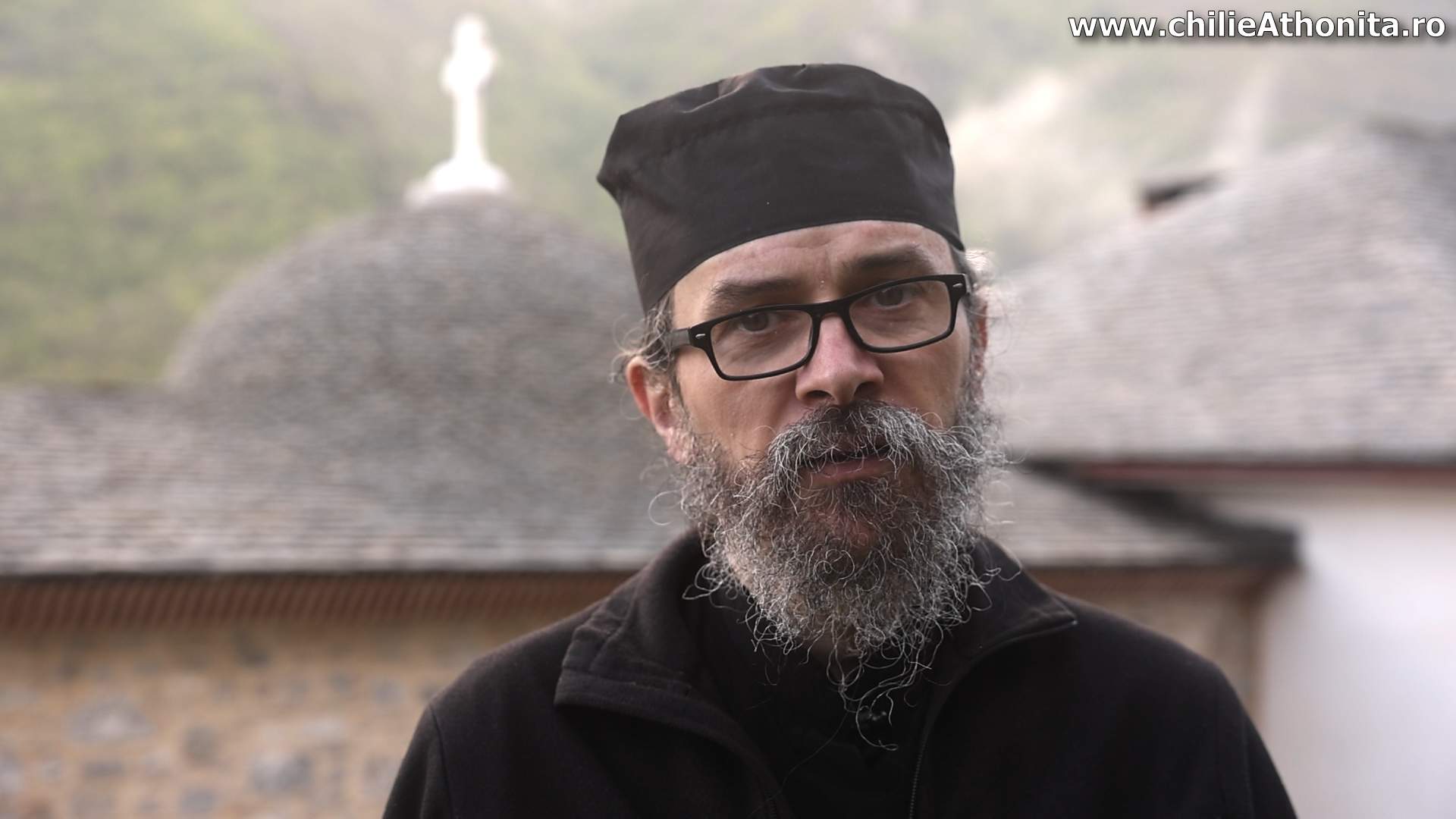
The Ascension of the Lord: The complete victory – Fr. Theologos
15 July 2026
Blind Science and the Blind Man That Sees – Fr. Theologos
29 July 2026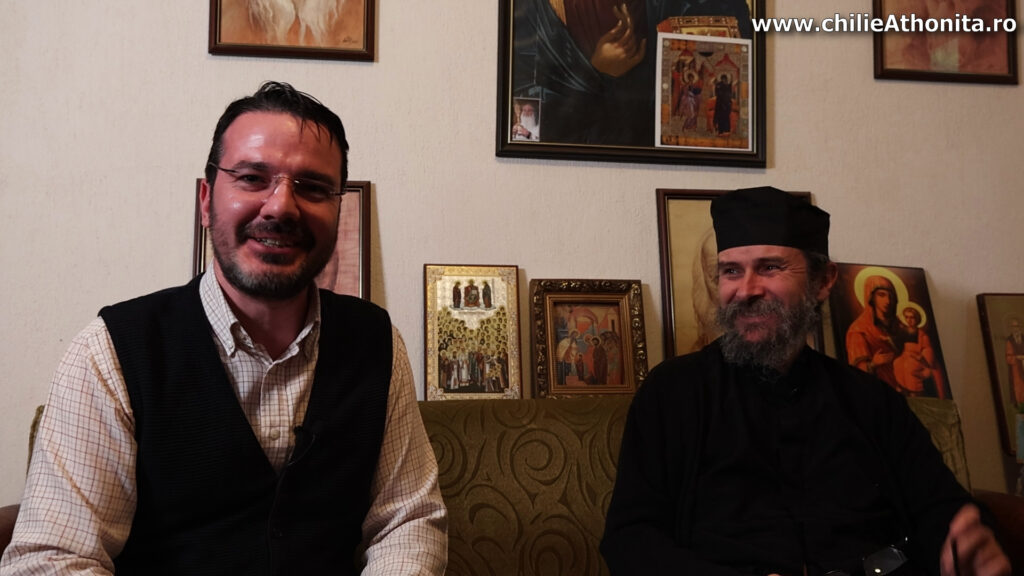
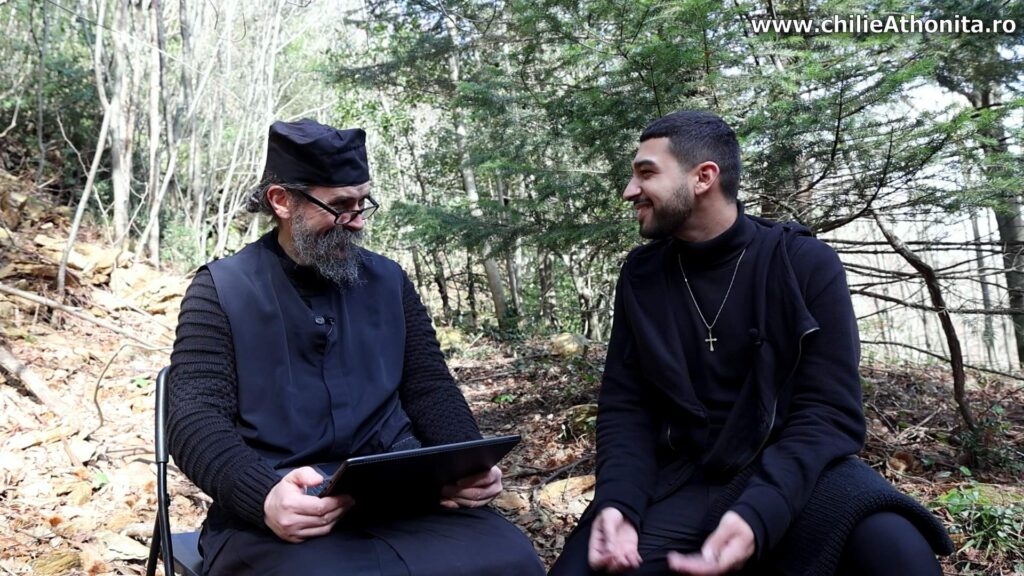
What young people should we promote? Father Theologos from the Romanian Hermitage Lacu tries to answer this question in a dialogue with Lucian Apopei, the communication director of the Archdiocese of Iași. The discussion is prompted by the running of the fundraising campaign between May 15 and June 15, 2023 to provide 100 scholarships for young people from the Metropolitanate of Moldova and Bukovina.
Very practical examples are offered from the field of computer science and not only, examples analyzed from a spiritual point of view to see who are the young people we need to promote.
Enjoy watching!
Lucian Apopei: Father, you spoke about meaning. What does a meaningful youth mean?
Fr. Theologos: A happy youth! And the awareness of it, the experience of the fact that I am eternal… I mean, yes, I am telling the truth because I am eternal, and the Truth is a Person Who takes care of me.
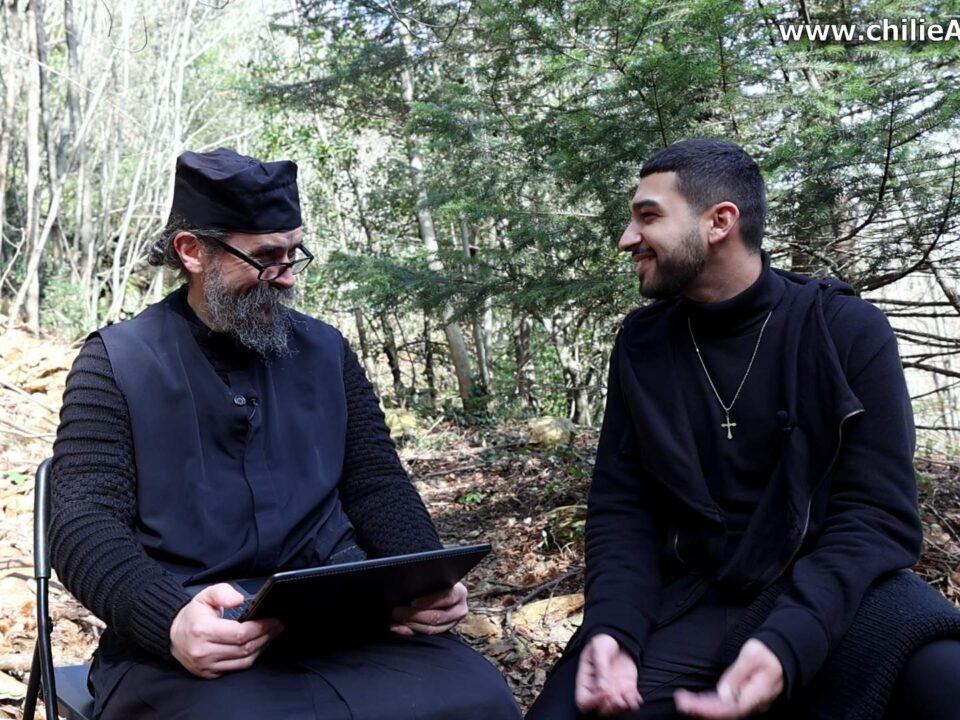
L.A.: Welcome, folks, to a new edition of your beloved program, “Windows to the Soul.” Good God has helped us to make it here again this year to Mount Athos, to the Romanian Skete of Lacu, the Cell of the Entry of the Mother of God into the Temple. You have probably heard of the scholarship program offered by the big-hearted Pro Vita department, under the coordination of father Radu Brînză, which awards scholarships to deserving young people—young people who dream of becoming architects, painters, athletes, police officers, teachers… Well, on this journey, Mount Athos has been and continues to be a source of help to us in supporting these young people from the Archdiocese of Iași. But what is the path—or what should the path be—from dreams and aspirations to fulfillment? We are here with Father Teologos to find out and to consult with one another. Father, thank you for welcoming us back here!
Fr. T.: Glory to God!
L.A.: Not only for this reason, but also because you are supporting this special program, through which these deserving young people from the Archdiocese of Iași receive this encouragement— which, while not particularly significant in material terms, is of immense importance in giving them the courage they need to fulfill their calling.
Fr. T.: It is very important that the young person does not feel alone. Right now, there really is a pandemic— it has been declared a pandemic— of loneliness in the U.S. In an Orthodox country like Romania, things are better, but not as they should be. And for this reason, it is very important that young people do not feel alone; and especially those young people who have been blessed by God—who possess certain gifts from God—must be supported out of respect for that gift. And of course, out of respect for them— and for all people—but when God affirms someone, we must respect God’s choice and affirm that young person. Unfortunately, however, we cannot assess the character of these young people; that is the responsibility of father Radu from Pro Vita. He’s here with us; you just can’t see him in the frame. It is their iresponsibility to look for character, and they should promote people— especially young people—with characters above all else. Because skills can be acquired, but character is much harder to refine. And that’s why I think it’s the largest firm—it’s called Investment Angel—the biggest investor in Silicon Valley. The company is called Anderson Horovic. The Anderson brand is a titan of Silicon Valley. It has created the first—let’s just say— the first famous browser, Netscape, and, as I was saying, it’s now the largest investment firm there, one of the largest, and certainly the most famous. And their rule of thumb is this: If the character is less than stellar, than avoid, avoid, avoid. In other words, if a person’s character isn’t exactly exceptional, so to speak, steer clear, steer clear, steer clear. So we, as the Holy Mountain, we try to promote good people, not gifted people, because it is good people who make for a good society, a good company, or a good community—not gifted people. Gifted people make a gifted company or make a gifted society, which sounds somewhat ironic; not even from the standpoint of syntax, of the Romanian language, does it sound good. So we must always seek goodness, and this goodness comes from God. The good one is not the dull one, but the one who is truly alive and filled with God’s grace.
L.A.: Can this kindness be amplified, sustained, and nurtured?
Fr. T.: Obviously.
L.A.: Also through a program like the one run by the Pro Vita department, with its 100 scholarships?
Fr. T.: Of course, of course, because man is fallen, we are fallen, we are far from God. So, theoretically, we should do everything for God, and we should allow ourselves to be crucified for God and sacrifice ourselves for God and for eternal life—that is clear, no question about it. We can’t do that; we are fallen, as I said. We need incentives, so the moment people see that they’re getting a tangible reward— even money— although it doesn’t help to offer money. Through attention, the time they devote, and the support they offer—and I would even ask father Radu and managers, for example, in companies: they must reward their good people and those with good character. Yes, through money too, but there’s a problem there. Especially through a smile, a handshake, or a word of encouragement. “Yes, good job, you’re doing great!” This matter is very important. That is very, very important. And that’s why we’re doing our best to encourage them. And that’s why these programs— like the ones they used to have with Olympiad winners in high schools and so on—I don’t know, I think they still exist today, I hope, I don’t know…
L.A.: They do, they do indeed.
Fr. T.: That’s great; it motivates young people, and not only does it motivate them, but it also serves as a form of selection, allowing them to enter a certain environment which is much more competitive. At one point, we were having a discussion—it was with some professors from Cambridge or Harvard, I can’t quite remember which—but in any case, from some top universities in England, and the issue that came up was that what’s done at these universities is pretty much the same as what’s done at any university in the world. So what’s the difference? And they say the difference lies in two things: first, in the teaching style—that is, in the teachers’ personalities— and second, in the students’ personalities. In other words, you’re in a highly competitive environment, which of course can have negative effects in this regard, even going so far as to damage your nervous system due to excessive competition. But if you find yourself in a competitive environment— an environment that’s on a whole different level—then you step up your game and develop a new way of thinking. I mean, of course the selection helps. It really helps you move forward and say, “Hey, yeah, it’s worth it.” Of course you do; you end up at the other extreme— one of excessive technology, a lack of love, toxicity, overwork, burnout, and so on.
L.A.: Father, you mentioned the West, you mentioned Silicon Valley; I don’t think we should hide from our viewers the fact that you were active in those circles. How did you overcome those challenges? Both those typical of that age and those encountered at that time?
Fr. T.: With spirituality!
L.A.: Does it matter that this scholarship program comes from this particular branch of the Church? So are these things somehow connected?
Fr. T.: It is essential. Let me tell you something. For young people… I’ve had a computer since I was a very young child—let me tell you the whole story… That computer was a really good one for its time! My family—God bless my mom and dad—so we weren’t exactly poor, but we weren’t rich either. I had a friend who was an electrician; he went to West Germany back in the days of communism, and he sent us a really good computer from there, and suddenly we had a computer on our table. We were looking at it, it was looking at us, and my parents told me we had to find a computer science teacher to teach their little one—that is, me— how to use this computer. Well, there wasn’t a computer science teacher at the time, so after much effort, they managed to find a hacker. So, someone who worked at the computing center. His name is Francisc, may God truly bless him! And the key point is that he came to my house and said the following: “I’m not a computer science teacher; I’m a hacker, so I can’t teach you computer science—I’m going to teach you how I think.” I think, first of all, it is essential for young people to learn to think. And thanks to Francisc— may God truly bless him—I hope he’s still alive… I’ve learned how a machine thinks. I worked, well, in assembly language—for those in the know, that’s a whole other story. After many years, I also worked somewhere else in the world, at an institution—it doesn’t matter where. In any case, I ended up at the monastery, and there I developed the computer system tailored to the monastery’s needs, using a programming language that was the world’s leading one at the time, and the company behind it was the world’s leading one. The company is called Borland. The problem wasn’t that they were number one in the world and the best team, but that they knew it and were proud of it. In other words, a spiritual issue. I had already written a great deal of code in that language; I couldn’t afford to rewrite it, and these were applications that were critical to the monastery, so with the blessing of my abbot at the time, I started a blog. I was anonymous, and God enlightened me; I thank the Mother of God, for she enlightened me, and I realized that the problem facing that company—which, as I said, was number one in the world at the time—was not a programming problem but a spiritual one, and the greatest problems are always spiritual ones. And in fact, the blog was focused on human factors in software development— that is, the human element in the development of software and programs. And in fact, I was speaking in spiritual terms, drawing on Orthodox teachings from the Holy Fathers without naming them, and I tried—and in the end, with the help of the Mother of God, I managed to resolve most of the problems, and that company didn’t end up closing. It all came to an end a long time after that—a whole story. But then things settled down because the issue was a spiritual one. It is always a spiritual issue. A person may be very competent professionally, but they shouldn’t rely on their skills— such as their expertise in computer science, mathematics, or physics, or their ability to play an instrument, and so on—because that creates a very toxic atmosphere, as happened back then, and the company ends up paying the price. And again, at another company where I was once again part of the Autodesk team—it’s the world leader in architecture and so on, as well as in 3D software. So all these things you see—Hollywood special effects and so on—are mainly created using Autodesk software like Maya and 3ds Max. The main thing I discussed with them there—as a monk—wasn’t 3D modeling algorithms, but the flexibility of humility; that’s what I discussed with them. Because the main priority was… they realized it themselves after losing a few billion; I think they realized that spirituality is always the main priority, always. And if a person is not humble and becomes stubborn, they destroy their company’s greatest asset—which is not money, but its good reputation and the love and cohesion within the team, as well as the bond with the community it serves. And then the company goes downhill. So if people aren’t paying attention to spirituality— and even Westerners have realized this— but unfortunately, they’re in a “tarpit”— there’s a famous computer science book that talks about the “tarpit”— that is, in a pit of tar—they don’t know what to do to get out of there and are just groping around. Orthodoxy solves their problems, and as I was saying, in Borland’s case, Orthodoxy solved the problems at Autodesk as well; on the company’s internal forums, I would post quotes from the Holy Fathers, but I didn’t name them. Why? Because they, having been exposed to a distorted image of Christ due to the heresies they hold, are steeped in misinformation. To them, Christ is a Christ of the Crusades, of legalism, of money if you will, and so on. So if you talk to them about Orthodox therapeutics, it works. Believe me, brethren, it works— at least in the case of Borland, which had I don’t know how many millions of programmers in its community, or in the case of Autodesk, where, well, their CEO earns… pfff, just the CEO alone. And they have I don’t know how many programs. The team I was working on at Inventor—$800 million in revenue per year, net income back then, I don’t know how many years ago, not that long ago. So even though the numbers were astronomical, humility was always the top priority, because if you don’t prioritize it, God forbid what might happen.
L.A.: Is there a danger that young people might idealize their company, turning the company where they work, the one they plan to join, or even the career they are pursuing into an idol?
Fr. T.: Yes, of course, because they have dreams—and their dream is to work at the “King of the Day,” as it’s called, the coolest and biggest company I can imagine—so they sacrifice everything for that, and, what’s most painful, they sacrifice their relationships for it: their friendships, their marriage, their romantic relationships, and their relationships with their parents. And as I was saying, some of them end up feeling unfulfilled, some become aggressive, they create this toxic atmosphere, and only the Church saves them. It’s really only the Church that saves them. Brethren, it’s not like that, believe me! So let me tell you, I’ve worked in companies too, and I know that if you take these things too far, it all falls apart. Come on, let me give an example so they don’t think I’m just talking…
L.A.: Please!
Fr. T.: Arian 4 or I don’t know… In any case, one of the rockets from the ESA—the European Space Agency—they were very proud— by the way, what does pride do?— they were very proud that they had built the Ariane 5, if I’m not mistaken, it doesn’t matter, and they were so full of themselves… so the moment they launched the rocket, the rocket exploded I don’t know how long after… 30 seconds after takeoff, 20 seconds. Why? Because of pride. Because the on-board computer’s navigation software was written in a very robust and secure programming language—called ADA, which is even used by the U.S. Department of Defense—and even though it was a very robust and secure language, out of pride they disabled the checks and safety measures in the program, and at one point, the program they had created performed a division by zero, the onboard computer reset, and it was all over. 300 billion went up in smoke. It was shattered to pieces – both the rocket and the satellite.
L.A.: Out of pride.
Fr. T.: Out of pride. So, once again, it’s not a matter of programming— that I chose some language or did something specific—it’s the best language: it’s the language used in the military, the language used in aerospace, and so on. They actually did it out of pride—they said, “No, we don’t need that; let’s just move on,” and they went ahead and turned it off themselves. So, brethren, don’t you dare think you’re some kind of… programmers, street sweepers, psalmists, or whatever— dust will be all that remains! The time will come when you’ll hit your head— and you’ll hit it really hard. The greater the pride, the greater the humility that follows.
L.A.: How do you envision healthy development for young people in a world that, in many ways, seems quite unhealthy?
Fr. T.: Yes. Again… well, now I remember my relations with the United States and the Western world, and I ask you to forgive me! I love the Romanian language very much, and I can’t say that I hate English, but I don’t like English because it lacks expressive power; whereas in computer science, it does have expressive power, but it’s a wooden language. Coming back, how? Only in the Church. Only the Church provides young people with the balance they need to avoid developing nervous disorders. Only the Church gives them meaning, only the Church gives them optimism, because, you see, the Church doesn’t just keep telling you to be brave, be brave, be brave—it gives you a reason to be brave! I mean, brother, even death has been conquered! You just have to dare! Just be bold enough to take this path: that is, to read the Holy Fathers, to apply the Holy Fathers’ teachings, and to have this courage—this drive, as the words come to me in English— this boldness to move forward. Yes, I will, forward with faith— Good God help us! We’ll do this, then! Do you understand? And—speaking of Autodesk—if we happen to make a mistake, let’s have the humility to pivot, to say, “Yes, I was wrong. Okay, I’ll backtrack.” Because that’s what it was. So at Autodesk, the best programmers weren’t the ones writing code; they were on the so-called customer success team— the team responsible for user success. The moment they saw—I mean, we were working on 20 million lines of code, which is a massive undertaking— and the moment they saw that something wasn’t going well in the community—that is, the community didn’t agree with something—we had to humble ourselves and pivot immediately, saying, “Yes, we were wrong; we’ll change that.” Not to say that we’re number one in the world—because we were. But to say, “Yes, okay, we made a mistake.” This should be applied not only in leading industries, but also within the family. I mean, if I say something to my wife and then realize I was wrong, I tell her, “Yes, love, please forgive me, I was wrong.” Of course, if she starts to say more, you have to humble yourself, adopt a submissive posture, and let it pass. We must humble ourselves; we simply cannot help but humble ourselves. Because if we don’t, we’ll lose. Well, the Americans have lost what matters most to them—money and fame—but we are losing God’s grace, which is eternal. Forever. And all these things—humbling oneself—man cannot humble himself. It is only in Church that they learn to humble themselves. Unless a person is aware of a loving God, of his own eternity, and of the fact that He is the King-Man, he cannot humble himself.
L.A.: Father, you spoke about meaning. What does a meaningful youth mean?
Fr. T.: A happy youth! And the awareness of it, the experience of the fact that I am eternal… I mean, yes, I am telling the truth because I am eternal, and the Truth is a Person Who takes care of me.
L.A.: I was watching the videos made by my colleagues in the Pro Vita department—they’re available on Pro Vita Iași’s website and social media pages—and my attention was caught by a young man or woman, I can’t remember which, who said with such maturity that “I want to grow, I want to be smart so I don’t become a puppet of society.” Do our knowledge and strong character help us weather these passing storms?
Fr. T.: That’s exactly how he’ll end up as a puppet. If a person relies too much on themselves, they will end up becoming a puppet. The person who trusts in God will ultimately be free. Only obedience to the perfect, all-powerful, perfectly free, and loving Being ensures man’s freedom. So I’m going to take on the whole world, and I think I am… Who are you, anyway?! I don’t know what field that young lady was in, but I have the utmost respect for her—please forgive me! Okay, let me speak in my area of expertise. You’re not the best programmer or the best photographer. There are always far more of them, and they’re far better than you. There’s always someone better than you—always. There’s no such thing. I mean, who are you? God on Earth?
L.A.: Other times, this situation leads to complacency, and you can’t get past that point.
Fr. T.: Yes, pride comes before a fall, that’s for sure. That’s dogma; you can take it as dogma. Saint Mark the Ascetic says: Do you see a thought that promises you greatness? It is the thought that makes you feel ashamed, that brings shame upon you. That is the dogma of the Ecumenical Council.
L.A.: Father, as we wrap up our conversation, what should the joys of youth be? Beyond this development…
Fr. T.: Love, love… I mean, there should be true friendship—not friendship based on physical attraction, but friendship based on true spiritual love. Because that’s terrible: if I say that Gigel is friends with Maria, they immediately jump to the wrong thought, you know. No! There needs to be true friendship among young people, a unity of souls, a sense of community… I don’t like that word because it sounds cold. A friendship, a shared life—and that happens only in the Church. Otherwise, the young person has no reason to overcome his hatred, and above all, he doesn’t know how to overcome his hatred toward others and his self-interest.
L.A.: Dear father, thank you so much for welcoming us here!
Fr. T.: God bless you!
L.A.: And because you support this project—which we may not be able to discuss in detail, or perhaps it’s not appropriate to do so—we must admit that your support goes beyond these broadcasts…
Fr. T.: Well, time has passed, yes…
L.A.: Thank you!
Fr. T.: May Good God help us!
L.A.: Friends, that was today’s episode of the show, and I urge you all—from here on Mount Athos—to support the dreams of these 100 young people. They are the doctors, police officers, and athletes of tomorrow…
Fr. T.: And the good people of tomorrow!
L.A.: And the good people of tomorrow. May the Lord help us!
Fr. T.: May Good God help us!
Online commemoration lists and donations
May the Lord help us!
Online Commemoration Lists and Donations
May the Lord help us!
If you have a bank card and wish to send commemoration lists and donations online using your card, and/or to support our philanthropic activity, including this site, please fill out the form below to make a small donation. The form is secure – we use Stripe for payment processing – a world leader in this field. We do not collect your personal data.
If you do not have a card, or do not wish to use it, visit the webpage for Online Donations and Commemoration Lists.
We will pray for your loved ones! (Please do not include inessential details like wishes, degree of kinship, introductions etc. JUST the name!)
Especially for recurring commemoration lists, we ask that you please keep them to under 20 names long. If you include a member of the family, we add “and for their families.”