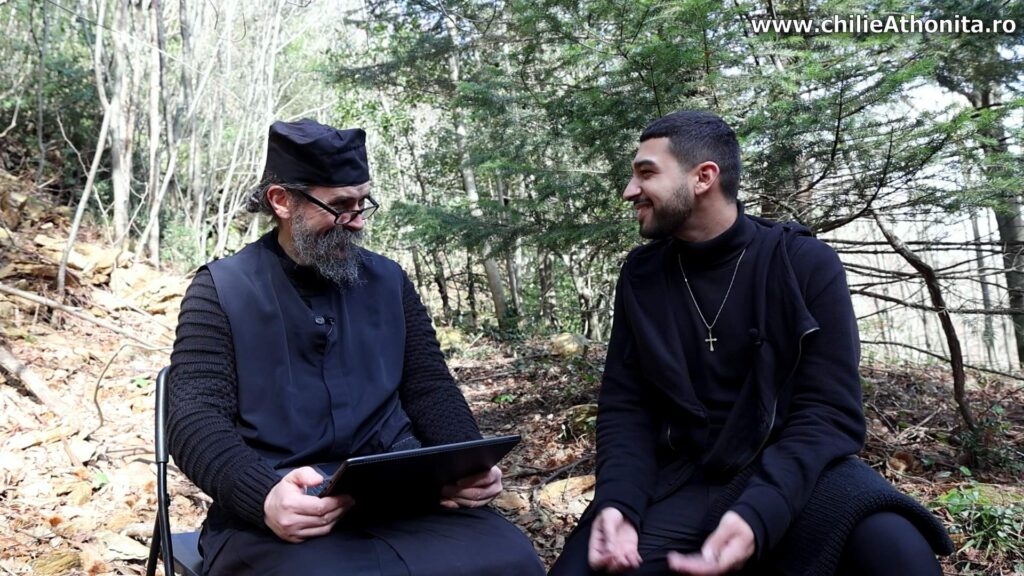



Family, Children, Books, Education – Fr. Pimen Vlad
26 August 2026
The Goal of Humanity: The Holy Spirit – Father Theologos
9 September 2026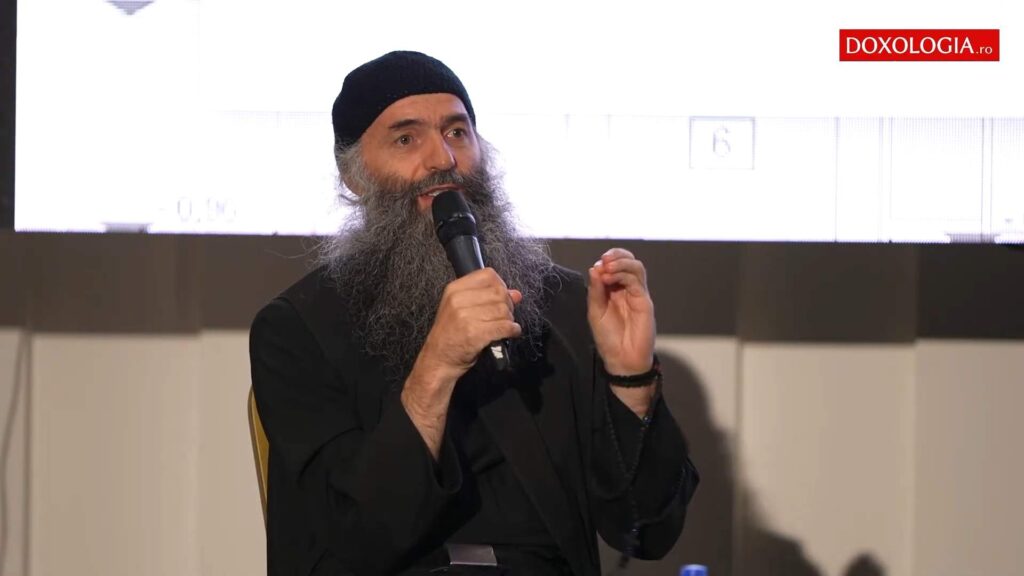
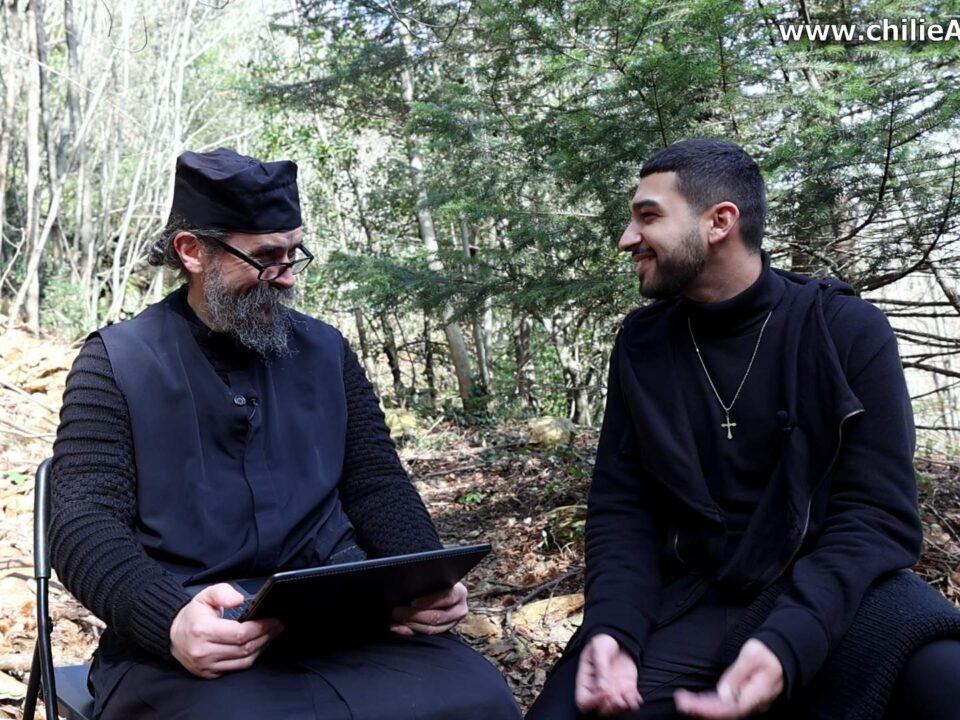
Listen to part of the question-and-answer session held by Fr. Pimen at the conference organized by the “Pro Vita” Association in Iași. The questions in this section concern true love, problems that arise in the family, abortions, illnesses, and the will of God.
Enjoy!
Fr. Pimen: And so that I don’t ramble on too much here, talking to myself, I’ll now let you ask a few questions, since I understand you have plenty.
Lucian Apopei: Yes, when I came to you on Mount Athos, I was the producer, the cameraman, and everything else. I’m a little confused here because I have at least 2,000 producers, and the people who message me here come from all walks of life. I don’t think it’s possible to answer them all. That is why I ask for your patience, but we will begin.
Fr. P.: Try a few. And if I can, I answer; if not, we move on. I’ll just say— as the saying goes— “Next question,” and we’ll move on.
L. A.: Yes, there are also questions from the topic proposed for this evening, obviously there are also many personal concerns, there are testimonies. Speaking of what you were talking about—hope, and the challenges people can face in life. I was here with someone who had suffered from a condition that doctors said was terminal and that the person had no chance of survival. Well, that person is here in the room today, many years after those moments. We have also received similar testimonies from other people. But someone— a good friend—asked me a question before the event began and said, “Please ask Fr. Pimen if he has ever come close to death and how he reacted.”
Fr. P.: Close to death… Now, you know how it is? It depends on how each person looks at things.
L. A.: You smiled at death.
Fr. P.: Do you know how [I react]? I smile at death. When I reach the limit, that’s when I start joking around. About ten years ago, I was somewhere near Galați, and I’d been feeling sick for about a week—getting worse and worse. I went to see a father there, and even though I had told him I wasn’t feeling well, he said, “Come with me to bless water!” My legs were shaking as I followed him. And he said to me, “Until we get to the water blessing, let’s take a quick walk through the market so you can see the city!”
And that 5-minute walk took an hour… he kept blessing every store and kept on walking. My legs were shaking, but I kept walking behind him until we reached the place where the water was blessed. On our way home, he had a habit: whenever he asked me a question, he would stop right in his tracks and wait for my answer, without moving. Once we were done, we kept going for a few more steps… so that walk took another hour. My legs were getting weaker and weaker; I had reached the point where I couldn’t go on. And just as we were about to get to his place, finally, at the entrance to the building, he said to me, “Father, I just remembered—someone in the neighboring building asked me to tell you to stop by their place if you come over!” I said, “Father, I can’t go on!” but he insisted, “Just for a little bit!” So, we went there.
When we finally got to his place, it was 30°C—really hot— and I started shivering; I was shaking all over. I lay down in bed, pulled two blankets over me, and was completely shivering. Around eleven o’clock that evening, a couple of his acquaintances dropped by, and the father still wanted us to talk a bit more. I was shaking all over, but he didn’t seem to notice. The two visitors kept looking at him, then at me, and asked, “Father, can’t you see he’s dying?” because they could tell I was losing my train of thought. At a certain point, I could no longer see them or hear them; I just gazed at the icon of the Mother of God and spoke with her. They were talking and chatting, and I had established this connection because he had an icon on the wall, and somehow I was talking to the Mother of God: “Mother of God, as you know, if the time has come, so be it! If you allow me to return, as you wish!”
Of course, those people eventually picked me up and took me to the emergency room, because, as they said, I was done for. They took me to the emergency room, of course, supported by two people— my legs were shaking… I got to the doctor there and I told her, “I just came here to die!” The doctor told me that nobody dies in her office. They took me to a bed in the emergency room, in a ward with about ten beds, each with a seriously ill patient and a doctor by their side. I walked in there, looked at them, and said, “Do you have room for one more person who’s come here to die?” At that moment, they all turned to look at me with such fierce stares that I just shrank. I said, “Wait, I can’t joke around here!” It was as if everyone was dying there, and I had come to die too. And then I curled up and went to my bed.
So I was at the limit, but whenever I reach the limit, I get into a good mood, and then I start joking around, and others realize… This whole thing ended in the end, I survived with a bagful of antibiotic until they figured out what was wrong with me, and after about three weeks I was back on my feet.
But I was once in Kareia, the capital of Mount Athos, at a doctor’s office, with some pretty serious health issues. But I was joking with him, and he said, “Come on, father, be serious—you don’t have those kinds of problems; looking at you, not even close…” When I was talking to him about this, he couldn’t accept the idea that I was having those problems. He said, “No way, you look too good, you’re in such a good mood—if you had this, you’d already be bedridden!”
So, that’s how I’ve always reacted when I’ve found myself in serious situations. Once I even ended up in Bucharest, at the hospital, and the doctors said, “Man, it’s sepsis! Whether he lives or he goes, we still don’t know!” that’s how the situation was. I never get into that state of panic. At one point, while they were drawing my blood, I started seeing stars, so I just told them that I also have heart problems. So, of course, two of them had me hanging upside down by my feet, and a couple of others were pricking my fingers—I mean, I was at my limit. They told me, “We almost lost you!” I was really on the verge—the stars were already looking beautiful—but I recovered; the Mother of God didn’t allow it.
That’s why, whenever I’ve found myself in a situation like that, I’ve never panicked. I always tried to get in touch with the Mother of God in those moments. I knew that if it came to that, I would speak to the Mother of God: “Mother of God, as you know! If you know it’s time, just take me in your arms and don’t let go!” That is, for her to take care of me, and so, if you have the Mother of God as your mother, no matter what the situation, there’s no reason to be afraid at that moment.
L. A.: I can confirm what you said. Just a little story, if you will, for the sensitive soul who has come from Iași, to Mount Athos. Well, it’s a situation that doesn’t really warrant a detailed description. I was with Fr. Theologos and I said, “Father, what if something happens?” and he replied, “Don’t worry, because if you die, you’ll die on Mount Athos. You’re here, that’s good. Where would you rather die than here, on Mount Athos?”
Someone else asks the same question: “Between pain and amen, how much pain is required for a saving ‘amen’?”
Fr. P.: Between pain and amen?
L. A.: Yes! I think that is the title of a movie or a book. So he asks: How much pain must we endure for a saving “amen”?
Fr. P.: In other words, does a saving “amen” mean a salvific ending?
L. A.: Yes.
Fr. P.: Or that the human suffering would come to an end? There are two meanings here…
L. A.: Yes, I think he explains it very well toward the end of the message, where he says: “Which is more important, physical suffering or spiritual suffering?”
Fr. P.: So, more important… We can’t say that one form of suffering is important and another isn’t. For example, there could be a spiritual suffering we inflict on ourselves: let’s say you have something that’s tormenting you and, in fact, isn’t helping you—it’s destroying you. Or perhaps it is a suffering that is for the good of the soul. So, let’s be clear: not all sufferings or torments are salvific! The ones we do to ourselves knowingly, when we hurt ourselves— those aren’t salvific. They are salvific if you’ve fallen ill without [for example] having drunk so much that you’ve passed out under the table and developed cirrhosis, and then you say “I have received a salvific illness!” That is not salvific—it’s from your own foolishness!
So, if you mind your family peacefully and work and so on, and God allows you an illness, and you endure it, that is salvific. As for the other one, you have to repent because you got sick from your own foolishness. So, there is a difference between these things. That is why I say that even these trials—whether spiritual or physical—are salvific if they come upon us without us seeking them out or harming ourselves. That’s when they are salvific. And they last as long as God allows. Sometimes we may need to go through them so that certain things can be erased, and then we may go through them for a longer time.
But if God knows that we truly repent for what we have done, we humble ourselves before God, we all make peace with one another and ask for forgiveness, then that torment can be shortened and we can be well going forward. But it’s all up to us. If we cling to our wickedness and pride, our suffering may last a long time and not be salvific. That is why, whenever you are suffering, you should always seek to humble yourselves before God, go to confession, receive Communion, ask for forgiveness from those around you, and be kind— do not harbor hatred toward anyone—and then that suffering will be shortened and will even become beneficial.
L. A.: Yes. The questions are very, very varied. Various concerns that people have. Many of them remind me of what you said: “Next question!” In fact, it also reminded me of an incident from college, when I asked a Father Professor a question, and at the end of it he looked at me and said, “Make me God so I can answer you!” I ask you now: why is it that women who want children cannot have them, while those who do not want them give birth to many or have abortions?
Fr. P.: You gave the answer a little earlier—the professor’s answer… Because there are situations we can’t possibly know about. For each person… we say she wants children, but we don’t know what that person’s life was like up until then. Maybe they had abortions, or maybe they’ve helped others get abortions, or done other things that eventually lead to consequences you have to deal with when you realize that, at a certain age, you want children too. Or maybe that’s not it.
We find an example with Saint Porphyrios. A husband came and said to him, “Father, we want children so badly, but we can’t have any!” and the Saint replied, “God isn’t giving you any because your wife is very irritable; she has a problem. She’s always angry and agitated. If God were to give you a child, she would ruin him, through her condition, that is why He does not allow you to have a child.”
There are situations we don’t understand, but God has a reason for not allowing certain things to happen. Sometimes that might not be the issue, but there may be orphaned children who need a family, and God might not give you children of your own so that you can adopt one, two, or three who need a family. So, everything is from God’s ordinance, which somehow we don’t know, it’s beyond us.
L. A.: You should know that a great many questions—I’d estimate, at first glance, about 70–80%—are related to family problems or family matters. I don’t think it’s a coincidence that Pro Vita is organizing this event; there is some connection between them. There are many personal questions that I’m not sure we should be the ones to answer, and there are many concerns that I don’t think we should address—not in this context— but I would like to ask a question that is less personal. I would ask the following question: “Love is the most beautiful virtue; we all desire it, but how can we understand it, how can we grow in love, when love is intertwined with the cross, with suffering? Why with suffering?” the person asks, saying that when you love, you hurt for the loved one.
Fr. P.: So, if you don’t taste the bitter, you don’t know what the sweet tastes like. So, it’s the same with love. If you don’t suffer, you don’t feel like you’re experiencing love. You say you love, but you don’t sacrifice anything for that love. And in order to prove your love, God allows certain things through which you suffer. Perhaps the person you love, in order to test your love, doesn’t reciprocate it the way you expect. And only then can you truly test yourself to see if it’s real love. Because if you get upset that they don’t repay you because you love them, because you’ve done this and that, then it’s not love. As I said before, love only does good. The love a mother has for her children is the closest thing to God’s love. It’s a sacrificial love. And why do I say that?
For example, if her child falls into the water or somewhere where he is in mortal danger, she doesn’t think twice—even if she doesn’t know how to swim, she jumps into the water to save him. She’ll do anything to save him; it doesn’t matter; if there is a bullet in front of him, she’ll step in front of him and sacrifices herself. The question arises: why isn’t a father’s love as great? Because he didn’t carry the child in his womb. If he has to jump into the water to save his child, the first thing he does is take off his Rolex, take off his shoes, and he wonders if he knows how to swim. So, he thinks first. That is why a man will never be able to match the self-sacrificing love a mother has for her children. The mother experiences these feelings much more deeply because she carried the child in her womb and has a much stronger bond.
That’s why they say love requires sacrifice, and it’s only then that we see for ourselves whether we love someone— whether we have the strength to put up with that person day after day, even if they’re difficult, even if they have certain issues—to be patient day after day, to be patient with them, and to stand by them, always, no matter what—even if, say, they cursed at you yesterday, today when they need you, to quickly rush to embrace them, to have that strength, to overcome everything. Only then do you realize that your love is [truly] love and that it has value, because God will eventually set everything right, even if it’s hard at first. After you surpass a limit, God will help you!
I remember—I’ve mentioned this before—a particular case. A woman wrote me a letter. She got married, had two children, and when the children were little, her husband left her. He went off to live his life. For 20 years, he didn’t come home or help them in any way. She was alone, never remarried, and raised her children. He changed several women, had fun, he had money, until he got sick and became very ill. Of course, all the women who had been with him just for the money left him, and he was left alone, poor, penniless, and bedridden with worms eating away at him.
This woman found out about him, went to her spiritual father, and said, “Father, I feel pity for him. Look at the situation he’s in. Should I take him in and take care of him?” The spiritual father told her, “I’m not asking you to do this, but if you know you have the strength to do this, I bless you—though I’m not asking you to do it because, humanly speaking, it’s impossible. The man who left you and lived his own life for 20 years—and now when he has a need, to take him in and care for him…”
He was bedridden, riddled with worms, and the woman said, “I’ll take him in.” And for two years she cared for him, washing him as if he were a child, until the time came for him to go to the Lord. Can you imagine? That’s what true love is— when she completely put herself aside and cared for him like a child until he passed away, without ever reproaching him for anything. I say, as the Savior did: “Do the same, and in this way prove that you have love.”
If you can’t put up with one another just because someone said something to you or bothered you with something, how can you prove your love? You say you got married for love, but after two or three years, you’re at each other’s throats. Where is the love, then? No! Love requires sacrifice; the two are inseparable. So, love requires sacrifice, but it also brings a lot of joy, just so you know. If you are patient, you will truly come to experience love and rejoice at it.
I see you’ve received a few more gifts there…
L. A.: Yeah, it makes me laugh—I don’t encourage people to spend time on the phone.
Fr. P.: Well, that’s exactly why I said from the start—that it’s better this way than on the phone.
L. A.: Alright… Fr. Nicodim, Fr. Radu, you have work to do! So, there are a lot of questions related to family and, in particular, about this organization, Pro Vita. I think you need to hire more people.
Can abortions be forgiven?
Fr. P.: So, whatever sin we commit, if we confess it, if we repent of it for the rest of our lives, and if we do not repeat it, God forgives it. But I read somewhere that we still have one more hurdle to overcome. It said that, even though they are aborted, those children are not lost. Don’t think that’s it— they were just thrown away somewhere and are now lost. Because they have a soul that comes from God and returns to God. And every soul that leaves this world and returns to God—even if it departed at a young age—will reach the age of the Savior, 33 years old. So, you’ll find those aborted children in Heaven at that age, and they’ll be the prosecutors: “Lord, they wouldn’t let us rejoice in this life on earth!” They’ll somehow seek justice from God. That is why it takes a great deal of repentance for God to wipe away these sins and forgive us.
So, don’t think that just because you’ve confessed them, that’s it, they’re forgiven. There must also be repentance, because it’s quite a serious sin. Do you know what category it falls under? Think about it, as a mother, where God has placed the child. In his mother’s womb, [for her] to protect him—even with her hands if possible—to take care of him. We could call it premeditated murder because the mother thinks it through and makes plans on how to go and kill them. So, even though the word sounds harsh, that’s what it is. And think about how these acts are punished on earth. Even though they’re neatly legalized, nicely dressed up, called “pregnancy termination”… But let’s be clear, sin remains sin!
All the powers of the world may legitimize it, but sin remains sin, and we are accountable for it before God. So, as I told you, any sin is forgiven if there is confession and repentance for it, and if we do not repeat it.
L. A.: There are also people who don’t ask you anything; they just wish you good health and ask you to pray. They ask that you keep them in your prayers there on Mount Athos, and I pass this on to you all as well, do not doubt this, Father Pimen is praying for all of us.
“How can we know what God’s will is for us? Even though I pray and I never miss the Divine Liturgy on Sundays, I still don’t know how to make wise choices. And here I’m referring to choosing a life partner.” Here is yet another question regarding family and not only that.
Fr. P.: What happens? What is our mistake when it comes to this choice? Two people meet, they like each other, they fall in love, and they want to consummate this as soon as possible. That’s it, after three days, in love: “That’s it, should I move in with you, or are you moving in with me?”
Just think about how beautiful it used to be before. You met someone you liked… How long did it take you just to tell them that? You tried every possible way to get closer, to make a gesture, to offer her a flower from a distance, to let her know [how you felt]. Do you remember the movie “Liceenii” [High Schoolers]? What it was like back then… It was a movie from the ’70s, when it was made. So, everything was exactly—as the saying goes—like grass growing, everything in its own time. Nothing was rushed or turned upside down.
You’d write a letter and wait a month for a reply. Now you send ten messages a day, and if an hour goes by and he hasn’t replied, you get angry and block him [saying]: “What do you mean, an hour has gone by and he hasn’t replied?!” So, everyone is in a hurry. Things should just be allowed to take their natural course. If you’ve met the right person, that doesn’t mean that if you rush over, throw your arms around them, and ask, “Which bed should we go to?”, it’s all sorted! No! Let things happen in their own time; don’t rush things. Because if they’re the right person, they’ll accept this and be patient to get to know each other better, without rushing to move in together.
And if you truly love and are loved, [say], “Let’s meet each other’s parents! Let’s not wait years and years—we want to be together and see this through to the end, then let’s go ahead and get married.” Oh, as they say these days, “Wait, we won’t have a venue for another year!” or something like that—no problem at all! You go ahead and get married, and after a year or so, you can throw a reception at the venue and invite all your guests if you want. What does the wedding service have to do with the venue not being available for another year?
You move in together, live together for a year, and then, with just a month to go before you’re supposed to have your wedding at the venue, a fight breaks out and it’s all over—everything falls apart. We confuse the wedding with having fun, and that’s where we usually turn things upside down. So, let things flow in their own time, but make sure it’s done under God’s blessing first. Because many people say, “Father, but if I turn him down, he’ll just go to someone else!” Really? So, you mean to say he loves you if he goes to someone else? Then that relationship will never work out! No!
If he really loves you, then he’ll be patient! And if he really is in a hurry and you truly love him too, go before the Holy Altar and get married, and then you’ll be together. But if he turns that down and says, “Wait, let’s get to know each other!” or something like that, then he’s just looking to have some fun. He tells you he loves you, you’ll live together for a year, a month, or God knows how long, and then he’ll pack up and move on, and you’ll say it was a failed relationship. But why? Because things got started on the wrong foot right from the beginning! Never rush things; just be patient a little longer, and you’ll see that once you’ve gotten off to the right start, the relationship will last until the end. You don’t go through ten relationships in ten years!
Online commemoration lists and donations
May the Lord help us!
Online Commemoration Lists and Donations
May the Lord help us!
If you have a bank card and wish to send commemoration lists and donations online using your card, and/or to support our philanthropic activity, including this site, please fill out the form below to make a small donation. The form is secure – we use Stripe for payment processing – a world leader in this field. We do not collect your personal data.
If you do not have a card, or do not wish to use it, visit the webpage for Online Donations and Commemoration Lists.
We will pray for your loved ones! (Please do not include inessential details like wishes, degree of kinship, introductions etc. JUST the name!)
Especially for recurring commemoration lists, we ask that you please keep them to under 20 names long. If you include a member of the family, we add “and for their families.”