

People’s Reverence, St. Paraskeva – Fr. Pimen Vlad
19 August 2026
Love, Family, Abortions, God’s Will – Fr. Pimen Vlad
2 September 2026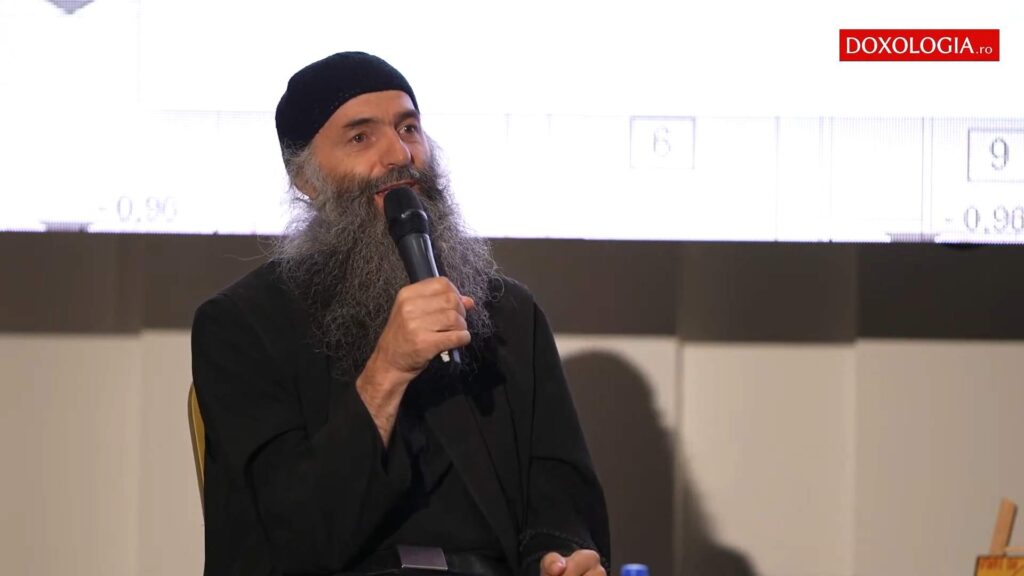
Listen to Father Pimen Vlad as he answers a series of questions from the faithful concerning family issues, especially those related to children and methods of learning to become better.
Enjoy!
Lucian Apopei: Father, here’s a question for another evening spiritual meeting— short but profound: “What is the meaning of life?”
Fr. Pimen: The meaning of life? Where did we come from? We came from God, and we return to God. God has allowed us to be here on earth so that we may prepare for the life beyond, not so that we may attach ourselves completely to this world. And that is why He constantly allows us to see people around us departing, and not only to see them departing, but to participate in so many funerals and to clearly see that they all leave with empty hands. No one takes anything, maybe they were even dressed by their relatives–no matter how rich or poor they were–with those cardboard shoes, so nothing more expensive would go to waste, because it costs a lot. And maybe that man struggled all his life, and in the end, he takes nothing with him—only what he sent ahead.
So, our purpose here on earth is to prepare for eternity, because life here is short. Does it seem long to us? No, life here is very short, but God has allowed us, during our time here, through the patience we practice, through the love we show toward others, through our kindness, through everything we do here on earth, to prepare ourselves for eternity; because when we depart for eternity, it says: Just as we lived here on earth, that is, with the aim of doing good, of being good, of praying, all of this continues in eternity on a different level. If our goal is merely amusements and misdeeds, when we depart to the other side we will face torment, and we will experience this desire of our passions to a much greater degree—yet it will remain unfulfilled forever, meaning it will become a torment for us. And that’s why it’s good to always be prepared, but not to stand there scared. Our life should be beautiful, in a continuous preparation for eternity because, in fact, that’s our purpose, and we are only passing through here, on earth.
Here I will tell a little story: there was a great nobleman who went hunting and ended up in a cave, where he met a hermit who had nothing: just a bundle of straw on the floor and a little bit of dried bread. The rich man marveled, “Man, how do you even live here? I see you don’t have any closets, clothes…,” all the things he knew he had in his palaces. “How do you live here?” The hermit said to him, “But where are your things? I see you have nothing but your horse and your bow. Where are your things?” “Well, father, I’m just passing through.” And [the hermit] said: “I’m just passing through too—so why bother collecting anything if I’m just passing through?” So, actually, our life is like crossing a bridge to get to the other side. So, our goal is to reach eternity, God, where we need to be, and depending on how we prepare ourselves, that is what we will find on the other side.
L.A.: There are, well, quite a few questions; I’ve tried to group them together in some way, all related to prayer. Several faithful in the audience are wondering how to remove thoughts, the worries of life, that appear during prayer and distract from it.
Fr. P.: I recall that someone came by, a young man, and [he said]: “Father, I’d also like to ask you about the prayer of the heart.” I had seen him there in church; when the priest was handing out the antidoron, he was standing there, staring—he didn’t even know how to take antidoron. So, I took him aside and said to him: “Have you ever been to church before?” “Well, I remember when I was little; I think my grandmother took me a couple of times.” Even the sign of the cross, he was struggling to do it, in his own way, to make the cross. I asked him a few more questions and realized that he hadn’t had any contact, but he, too, had met someone who told him he needed to pray with the prayer of the heart. And I told him: “Man, our life must be a prayer. How? Through what we do.” We see what the Savior did: He gave us a very important prayer, the Lord’s Prayer, which says: “And forgive us our trespasses, as we forgive those who trespass against us.” So, we set a condition for God: “Lord, forgive me on the condition that I forgive others as well.” There is actually one condition: “Lord, forgive us, as we forgive others.” If we do not forgive, may You not forgive us, Lord. All day long we say the Lord’s Prayer and also “I never want to see that one,” “I won’t forgive that one even at their grave.”
So, prayer must be part of our lives. First of all, to be connected to God, besides at home, through the Mysteries of the Church; let us attend the Divine Liturgy or, whenever we have to opportunity, go to church, to confess, to receive Holy Communion, and do everything well to the best of our ability. And all of this turns into a prayer. That is why Holy Apostle Paul said, “Pray without ceasing!” and he said this to everyone. And many ask, “But how can I pray all the time?” You can turn your life into a prayer through what I’ve said—even by smiling at someone, wishing them a good day, greeting someone, helping out, singing a song, rejoicing, glorifying God—all of these things become a prayer. You don’t have to sit there all alone in a corner and say: “Get out of here—I’m praying!” No! The person who prays only when they pray is never really praying. That is what a holy father used to say. That is, saying, “That’s it, I’ve set aside 15 minutes to pray and that’s the prayer.” No.
Our life must become a prayer, and in this way we draw near to God little by little, and we won’t even realize when our minds become clear and when prayer begins to work within us through what I have said, glorifying God, rejoicing all the time, helping those around us, and constantly asking for God’s help and thanking Him! Because we often forget to thank Him. And we must struggle with all these. Because these things are not easy, but we struggle.
And as we say that our minds wander during prayer… Usually, when you read a prayer, your mind wanders. That’s why I recommend that everyone take a bit of time—10 minutes, or a quarter of an hour— to pray in their own words, to talk with God and the Mother of God. You go in your corner and talk, telling Him your troubles and your joys, and then the mind does not wander because you’re talking to God.
L.A.: Still on the subject of prayer, someone asks when prayer is best received. In solitude, like Saint Theodora of Sihla, or in church together with other faithful, with more people?
Fr. P.: So, we see that there are various examples, but those from the desert are few, not many. There have been a few cases of people who withdrew and lived that life. Many people look to Saint Mary of Egypt or Saint Theodora as an example, as if it were a rule. No, these are cases that, as they say, have attained holiness, through God’s grace, but not everyone can follow them. That is why, in the Church, as they say, earth and heaven are united, the Church Militant with the Church Triumphant, and all of heaven descends to earth. When you pray at home, that is good too, but you are praying alone, whereas at church the entire community which prays together becomes like a torch of fire rising to Heaven, and God’s grace—which descends especially during the Divine Liturgy— fills the entire church.
If you go, say, to a perfume shop and spend fifteen minutes there looking at the perfumes but don’t buy anything, when you leave, everyone asks you what perfume you’re wearing. You took some of that fragrance. It is the same in church: even if you sometimes feel sleepy, even if your mind wanders at times, you were overshadowed by God’s grace, which descends upon the church during the Divine Liturgy and the prayers that are offered, and you find that you leave the church feeling more at peace. So, praying together is always the most helpful, especially during the Divine Liturgy. That is why you should try not to miss the Divine Liturgy, for there you receive abundant grace, which helps you, strengthens you, and even heals you of many illnesses, since God’s grace is healing and brings peace and stillness to the soul.
L.A.: Father, here’s a question from an eighth-grader—we can call him a child—and I’m glad he has this kind of concern. “How can I put my phone down? I’m trying to quit, but I can’t.”
Fr. P.: It’s simple: if you see that you can’t manage it anymore, hand it over to your parents. When you really want to, you say to them: “Dad, mom, take the phone—and today I don’t want you to give it back to me, even if you see me screaming.” So, when you really want this and see that you can’t—because on your own, even if you put it away in a drawer or somewhere else, it still tempts you, but the moment you hand it over to them and tell them: “Now, do not give it to me today, no matter what I do!” then, you can do this if you really want to. That’s so I don’t say to lock it in a drawer and throw the key down the well, because then you’d jump in after it to look for it.
But the fact is, parents always have their child’s best interests at heart and truly want them to not be addicted to their phone. You can entrust it to them, if you truly want that and are sincere in this. And you tell them: “Don’t give it to me for two hours…, three hours…, a day.” Try to fight it, because phones are truly addictive—the more time you spend on them, the more it creates this addiction to spend even more time on them. There are so many things on there that you just can’t put it down. Hours go by, and you just can’t get rid of it. So, you have to take this route if you can’t set it aside on your own.
L.A.: We will keep going! This young man has several questions, and we’re glad there are these concerns. “How can I develop a desire to learn? I find it very difficult.”
Fr. P.: The desire to learn…
L. A.: And he also says, to tie the questions together: “I’m in 8th grade. What can I do to succeed at the National Evaluation?” So, he has concerns in this direction.
Fr. P.: So, first of all, pray to God to give you strength and to give you the will, and to the Mother of God to help you, so that you can do this. After that, you have to want to learn, because if you don’t have the desire, [saying], “I want a good grade too,” but you don’t even open the book… So, you have to overcome yourself a little if you want to become good at what you want to do in life. Whether you want to be a doctor or something else… you need to have knowledge about that thing.
You have to learn to be useful; if not, there’s also a need for people to do manual labor. If you really don’t want to, tell your parents: “Buy me 10 cows, a few sheep, because I want to be useful to society too,” if you don’t want anything else. You have to struggle, but you also have to learn, and to ask God for help that you may receive His help, because it’s true… to do it seems hard. But [say], “Lord, help me, enlighten me; I want to learn, but my mind won’t grasp it, I lack the zeal.” And you cry out to God there and do your best to learn, but always ask for God’s help, because God will help you if you ask! If not, it’s harder.
L.A.: And speaking of reading, studying, and learning. I know you’ve written several books. This is a question that’s been on my mind, since the organizers have been writing for me to remind [everyone] that some of your books are here, at the stands by the exit. I want to ask, where did this urge to write come from, for you? I know you’ve been really busy [in Athos], building two Cells and shoveling and hauling stone so much that only your back knows how you managed.
Fr. P.: At least my life hasn’t been in vain!
L.A.: Yes, but where does this desire to write come from?
Fr. P.: So, what happens? I wasn’t particularly good at school. I actually found my 10th-grade report card; my grade point average was a 7. I said: “Good thing it wasn’t five; I thought it was less. That’s good.” And I only completed 10 grades. Not much, but what happened? I’ve loved reading ever since I was a child. I know I was just a kid, and one of my sisters had received a book as a prize at school: “The Șoimărești Clan. The Sign of Cancer, or the Time of the Duke-Prince.” I was a child; I was in my early school years. And I liked this book so much that I started reading ever since. I had gotten to the point where I was reading a book, 200-pages, a day. So, I was, as they say, addicted to reading. I would even go work the field with my family, I would ask my mother to hold my hoe—I went hoeing since I was 7, I would herd the cow, the sheep, pretty much ever since I could walk…
I recall how whenever the cow would get bit by a horsefly and take of running, it was just like a cartoon: if I held onto the rope, I’d fly through the air after it until I would let go, and she would go on her way. She would go right into the middle of the cornfield—or whatever field it was— stop there, settle down, and I would quietly go around her [saying], “Joiana, Joiana!” so I could grab her by the rope, pull her out, and bring her home.
So, I liked reading. I read and read, and when I would finish reading—whether I was with the cows or the sheep and there were children around me—and I would have nothing else to read, they would all gather around me and I would tell them stories. It was God’s will at that moment that, whenever I read a book, I would know almost the entire text in the author’s own words. My memory was so good back then. And I loved telling them stories, and they would all sit in a circle, wide-eyed, because they were children who didn’t read. To them, the things I told them were new: fairy tales, Scheherazade, everything—and they just sat there, as if I were introducing them to another world. I was around 10, 12, or 14 years old back then. Until I was about 16, I read constantly for several years. Well, that really opens your mind.
Back then, this technology didn’t exist, and church books didn’t exist either. I remember meeting a deacon, Father Băbuț from Oradea, at Sihăstria Monastery when I was around 15 or 16 years old. He was doing missionary work, typing up manuscripts, and had written a book: “The Romanian Pilgrim.” With mistakes, with whatever you want, but he wrote it and would type it himself. You’d order the book from him. I paid him double the price to send me a book, and when he did, it felt like the greatest treasure. There weren’t books like there are today; you wouldn’t find a single book on spiritual matters to buy—they weren’t around in that period, until 1989. You would beg someone or pay to find a book.
But I read everything I could get my hands on, as I told you. There was someone in the village who had always loved to read and had suitcases full of books. Like I said, with fairytales, with swordsmen—with whatever you wanted. Well, I devoured them all. That gradually opened my mind. Even after I arrived in Athos later on, I still liked to read. People had started coming to Athos; they asked me about Athos and the monasteries, and I just kept talking and talking until I would lose my voice.
At one point, I decided that I had to put everything I’d learned on Mount Athos into a book. And I wrote my first book: “Holy Mount Athos – The Garden of the Mother of God,” but of course, [I wrote it as] someone with only a 10th-grade education who never learned a thing about grammar or anything else. After I wrote the book, I thought: I’ll give it to a father there who has a university degree—someone well-educated. And I hand him the notebook and say: “Take a look at it—maybe you can fix it up a bit so I don’t have to send it to a publisher in this state.” He took it, and three days later he came back and tossed it on my desk: “Get this out of here! Go learn some grammar first—stop boring me with this!” The man was in despair over the way the book was written, but someone— a father from [Romania], also from Sihăstria, where I had been —meeting with me, I told him about it, [and] he said: “Bring it here, I’ll take care of it.” And he worked on that book and today, 20 years later, that book is the most widely read book on Mount Athos. It was printed continuously by the thousands every year, so much so that I no longer know how many copies, and five years ago I updated it to be more in line with what is currently happening in Athos. “The Holy Mount Athos – The Garden of the Mother of God.”
That book, which was the most maligned at first, ended up being the most widely read and appreciated by everyone— and by all the taxis in Athos, since out of every 20 taxis, 15 are driven by Romanians, all of whom have that book and have always used it as their guide on Mount Athos.
After writing this book, I found a book in Greek so I could learn the language. At first, I studied a little and started reading in Greek. I’ve read about 70 books in Greek—the easier ones, spiritual books, with teachings and the lives of saints, but easy ones, so I could learn Greek. The more I read, the more I enjoyed it, and eventually I came across a book about a holy abbot, Elder Iakovos Tsalikis. And when I read it, I liked it so much that even though I didn’t master Greek, I took the book and, going to my spiritual father, I said this, “Mother of God, if it is your will that I translate this book into Romanian, let my spiritual father tell me three times to translate it.” I went to see Father Iulian, the elder who passed away recently, and said, “Father, I found a beautiful book—a beautiful account of the life of Elder Iakovos Tsalikis— and I’d like to translate it, but my Greek isn’t very good.” And he said to me three times, “Translate it, translate it, translate it!” He repeated it three times. I said, “That’s it, I’m not even going to discuss it anymore!”
The next day, I went straight to the monastery in Greece that had published it. It was the monastery where the Elder Iakovos Tsalikis labored as a monk. I went to see the abbot, spoke with him, and he gave me his full blessing. The translation went so smoothly, as if someone were whispering to me, everything went without a hitch. That was the first book I translated from Greek. After that, I translated about five more and wrote a total of about 15 books. Among them is a collection of poems; since I read a lot, I was also a romantic, and at some point, I kept writing poems and gathered many pages. However, I chose just a few of them and put them in a booklet. That’s pretty much how it was with writing.
L.A.: It isn’t just the students who came—their teachers came too. Someone asked a question, and I’m going to ask you this one, asking your forgiveness because you asked us beforehand not to request personal advice, but I think this question is of a general nature: What advice do you think a teacher who is just starting out should know?
Fr. P.: As a teacher, you should know one thing: many parents are always dissatisfied with teachers, claiming they aren’t educating their children properly, but I’ve met some very good teachers. In fact, it’s the parents who aren’t raising them properly at home. For seven years, they’ve been setting what is perhaps the worst possible example: only quarrels, drunkenness, beatings at home—and then they expect the teacher to bring home little angels. You should know this: the child who was raised well those seven years at home—you know what I mean by that—will also be a good child at school. They may be more energetic, but the foundation comes from home, and teachers have their own very important role: to have a lot of love for the children.
You should know that if the teacher has the vocation to be a teacher, they fulfill their duty with love, with patience…, because when you take this path, to become a teacher, you must arm yourself with patience. You no longer have just one child, two, four, five, or however many you have at home—you have twenty or thirty in a single class, and if you repeat with other classes, you need a lot of patience. That is why I say that a teacher who is truly called to this vocation arms themselves with patience and love and strives to shape good people for society—that is, to teach them to be good people, not just what is written in books.
As a teacher, you should always give the children a brief introduction before starting the lesson. Prepare at home a quote for the children every day, one that will help them become good people. Just for a couple of minutes, and then you can start the lesson—that’s when you’ll be able to capture the children’s attention and win them over. Someone told me in Athens – a Romanian family – one of the children said he had a teacher who was so good and loved by the children, he knew how to work with them so that whatever he said, the children took it as law, and at one point—he taught them very good, practical things—he told them: “Hey, I see you come to school with chips and these are bad for you! Let me show you something!” and he took a chip and set it on fire and it melted like plastic. He said, “Look at what you are eating!” and from that moment on, the whole class stopped eating chips.
So, the teacher had won their hearts, and they trusted him—they believed that what he said was indeed true. But he treated them with great love and patience. If you are a teacher, look for Paulin Lecca’s book “From Death to Life.” I read it many years ago. Take, for example, what he says about the time he went to Transnistria on a mission—since there were no teachers in the schools there. He went there and the school principal told him that in the class he was given, he should be careful as there was a child due to whom all the teachers who had been there had left beaten, since the child threw stones at the teachers.
When Paulin Lecca went there, he was dirt poor; he had been given an abandoned house, he had nothing to eat, would wander through the gardens, find a beet or a leftover potato, eat those, he also said he was full of lice, and then go teach the children. But he started with so much love. He says he started by doing the roll call, and he had been told which child was bad; and he saw that the child was intelligent, so he began to pay attention to him, to call him to the blackboard, to help him, and praise him in front of the class: “Look at this model student!” That’s how he gradually won over the children.
At that time, he taught religion in school and he recalls that he spoke to them about the Savior, but in a way they could understand: “Think about the Mother of God who went there, cast out, in a manger, with a tiny Child and she had nothing to wrap Him in, and it was cold and He was crying.” As he spoke to them so warmly, all the children in the class were crying. In other words, he made all these into a story for them. He goes on to say that when the year was over and he had to leave—since he’d been doing this for a year— “all the children cried for me and threw things at me, but not stones; instead, they all threw flowers at me as I left.” So, from a class where all the teachers came out beaten, he managed to make them all cry. That means reaching children’s hearts, because children haven’t yet been tainted by the ways of the world; so, if you know how to go about it, you can reach their hearts, have them listen to you, and you give society good people. That’s up to you, but always have God with you.
If you have God, before you go into the classroom, make the sign of the cross, ask God to enlighten you, and teach the children to pray as well. And I come back to this: a Greek teacher in Athens told me that whenever there was a sick child in the class, he would have all the children pray for them. And do you know how many miracles have happened? When he said: “Look, your classmate couldn’t come today—they are seriously ill—let’s all say a prayer!” They would all pray together. And that child would recover; there are plenty of cases like that. So, he taught the children to pray.
L.A.: Father, we’re staying in the classroom because we have one more child who asks us this—I’ll read it verbatim: “Bless me, Father! I have a classmate who picks on me. How do I explain to him that I don’t like what he’s doing?”
Fr. P.: You don’t have to explain it to him. Try to be kind to that child; speak to him gently. When you go to school, if you have an extra piece of chocolate, give him some too. No matter how he acts, you’ll see that, in time, you’ll win him over. Don’t resort to violence—it never solves anything. Everything works out with patience and love. Speak to him kindly, and eventually he’ll understand.
L.A.: “How can we avoid living alone in a marriage?” We are going back to the family. “What advice can you offer if things have come to this point?” Yes, there are families where everyone lives alone, in their own little corner.
Fr. P.: So, what happens? Now there are two options [to] “living alone.” [One is] to be together in the marriage, but they sleep, as someone once said, one facing one wall and the other facing the opposite wall. Or maybe it means they’ve gotten a divorce and are separated. What’s going on? I’ve come across certain situations where people shirk responsibility: one of them shuts themselves off, goes their own way, and somehow feels that’s just fine. They don’t resolve their issues within the family; if the other person just sits quietly in their corner, they’re happy that the other person isn’t saying anything to them.
I was actually talking to a woman whose husband used to have his lapses and his mistakes. She was very patient at home, waiting for him to leave the others and come back home as he should. And the time came, through her patience, after about two years, that was resolved. But now that her husband had returned home, and after that he also returned to God… there was an extreme there: that is, he thought he had to be in a certain way regarding this… he started neglecting her—who had been so patient for so long—by finding excuses not to be home saying he had things to do somewhere and so on.
If, to show her displeasure, she would turn her back to the wall and cry in bed at night, it was a joy for him that he could go to sleep peacefully and sleep—”How nice that she’s leaving me alone!” So, he had somehow solved the problem by running away. Instead of talking about this: “Hey, you’ve put up with me for so long, and I can see you’re unhappy. Let’s find a way!” Instead, he said, “I pray, I don’t need anything else. I live in prayer!” In other words, he went to the other extreme.
From the moment God brought you together and you got married, you must never take anything to extremes. Be kind and patient with one another, and show one another tolerance. It even says very beautifully in the Holy Scripture: when you want, for certain periods, to live separately for prayer, for certain things, it should be with understanding and acceptance from both. When one person wants it and the other doesn’t, and the one who doesn’t want it takes it to extremes—saying that they would like to pray—they may push the other person into doing other things for which they then become responsible.
So, any problem in a marriage is solved by talking it out with each other: “Hey, what do you expect from me? What do you want? I can tell you’re unhappy. Let’s see what we can change, what we can fix!” Don’t run away from problems; solve them, because otherwise they’ll linger and cause damage.
Pomelnice online și donații
Doamne ajută!
Dacă aveți un card și doriți să trimiteți pomelnice online și donații folosind cardul dumneavoastră, sau/și să susțineți activitatea noastră filantropică, inclusiv acest site, vă rugăm să introduceți datele necesare mai jos pentru a face o mică donație. Forma este sigură – procesatorul de carduri este Stripe – leader mondial în acest domeniu. Nu colectăm datele dvs. personale.
Dacă nu aveți card sau nu doriți să-l folosiți, accesați Pagina de donații și Pomelnice online .
Ne rugăm pentru cei dragi ai dumneavoastră! (vă rugăm nu introduceți detalii neesențiale precum dorințe, grade de rudenie, introduceri etc. Treceți DOAR numele!). Stripe limitează lungimea textelor și din cauza asta vă rugăm să fiți scurți. Dacă puneți un membru al familiei, noi adăugăm „și familiile lor”.
Dumnezeu să vă răsplătească dragostea!