

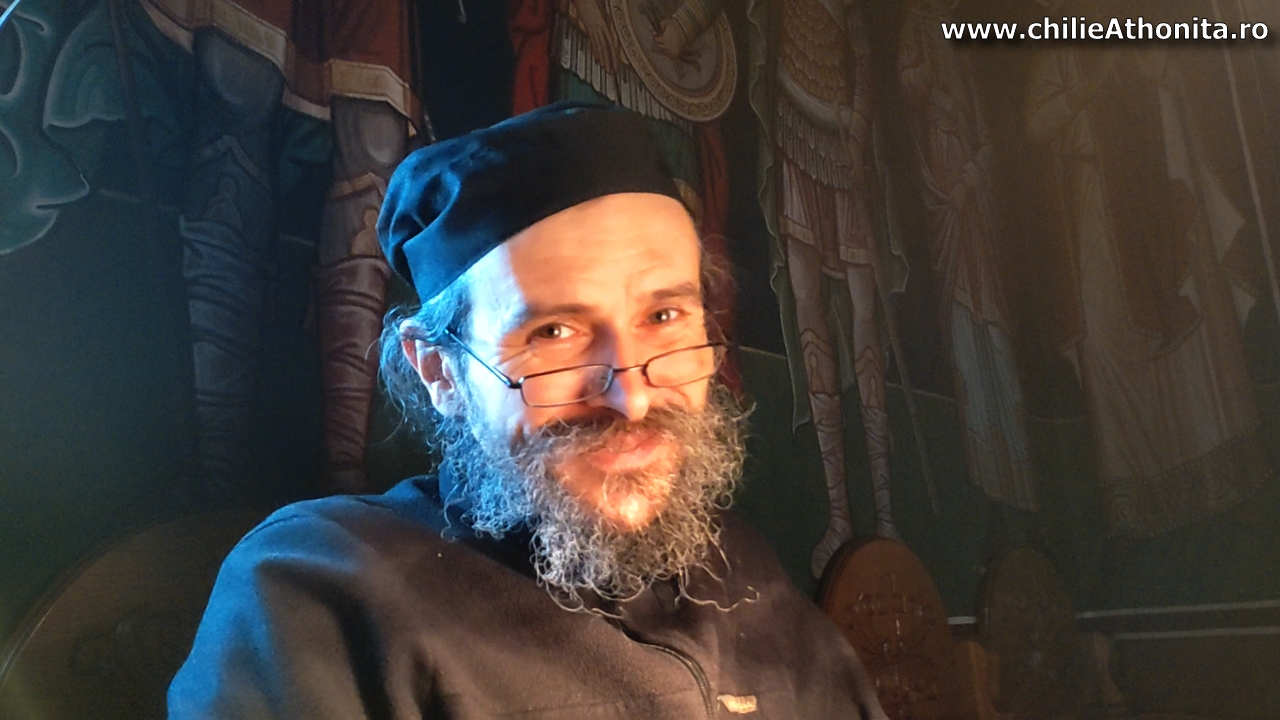
Interview – Father Theologos, the Former IT Programmer Who Found His Answers in Faith
22 April 2023
About Temptations and Passions – Fr. Pimen
27 April 2023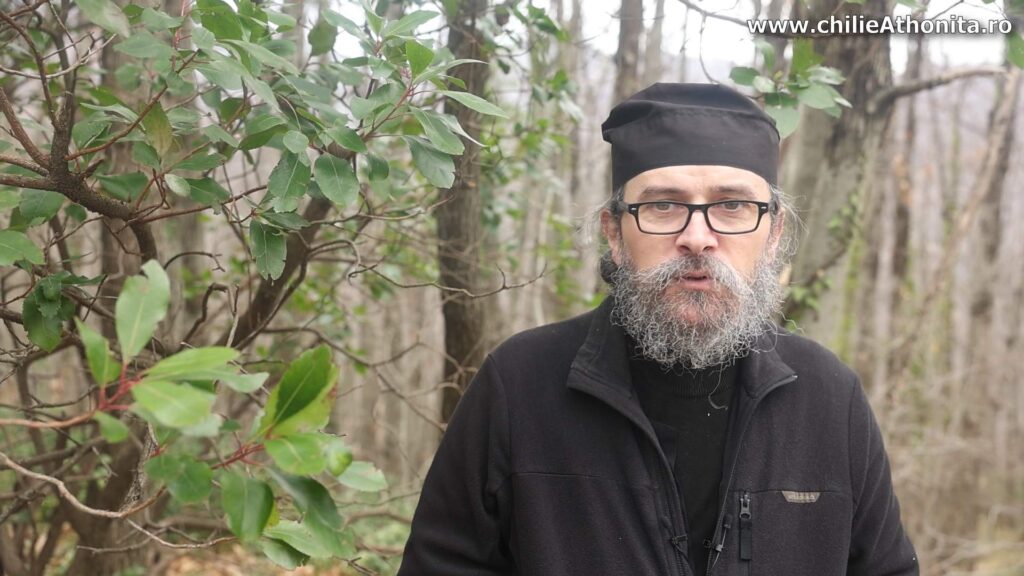
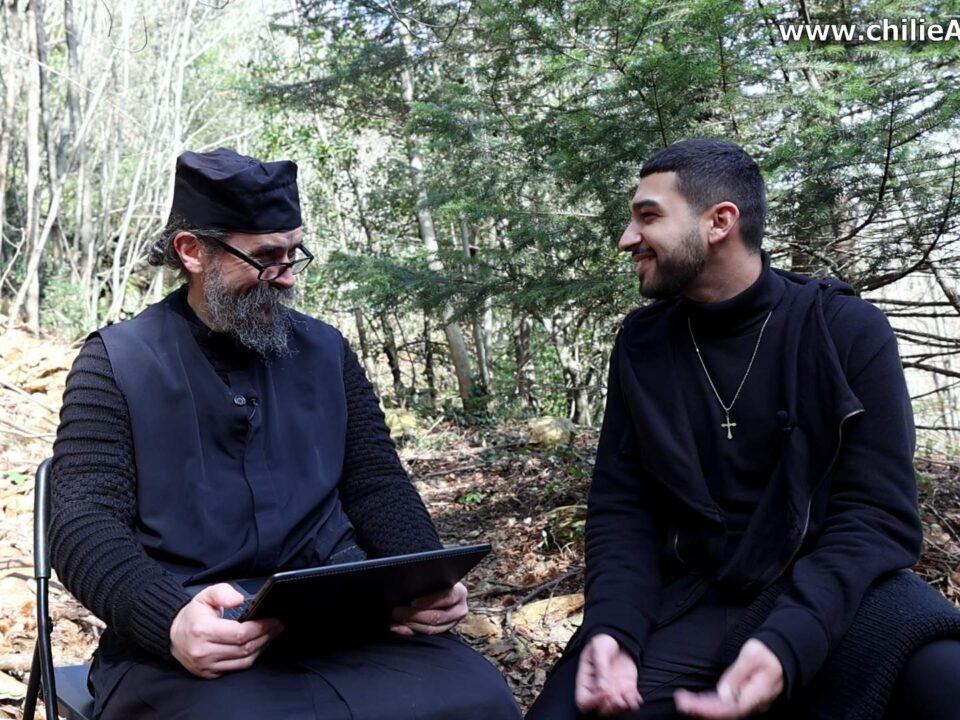
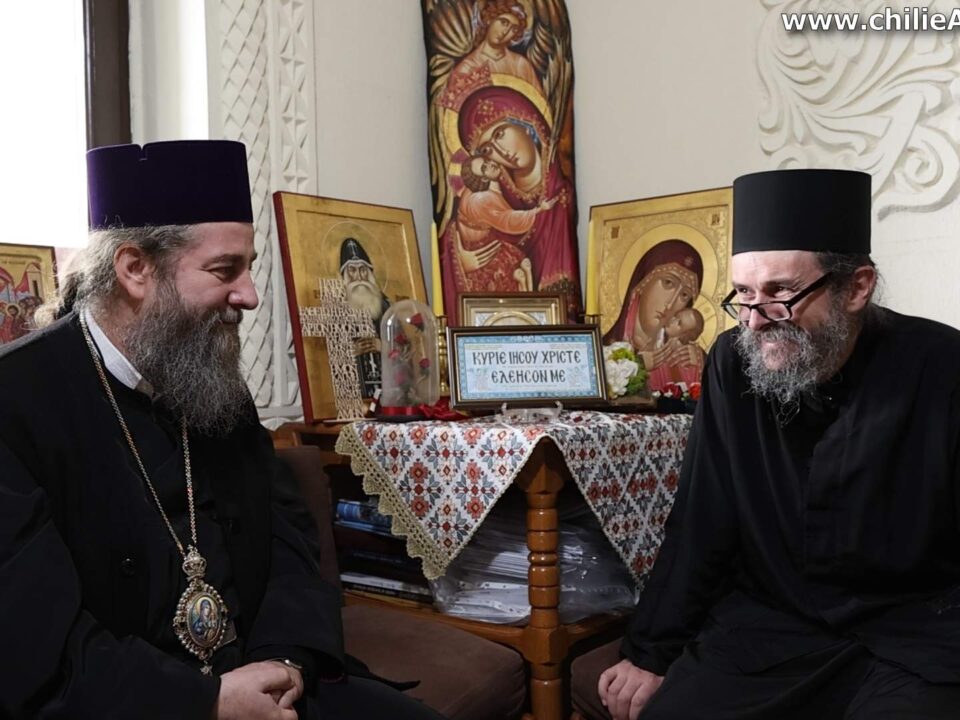
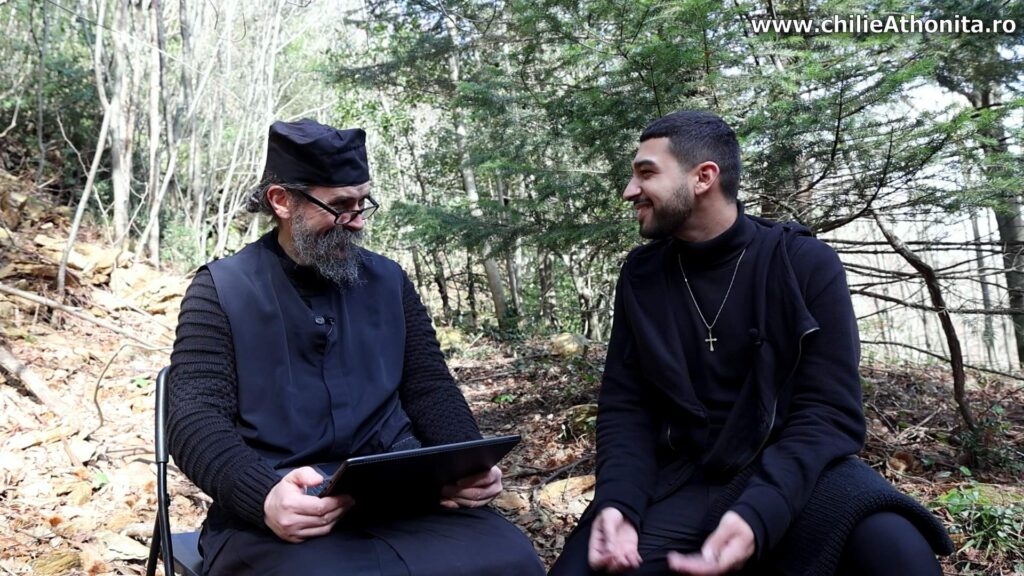
Is there faith at the entrepreneurial level? Do the saints also help in our professional lives? How can we truly succeed in business? Watch a discussion between Ionuț Nistor, owner of MaxiMove Translations (https://maximovetranslations.com/), and Fr. Theologos on these topics.
Enjoy!
Fr. T.: Glory to the Father, and to the Son, and to the Holy Spirit, now and forever and unto the ages of ages. Amen. Through the prayers of our Holy Fathers, Lord Jesus Christ, Son of God, have mercy on us! Amen.
Dear ones, we are here with Ionuț Nistor, who is the unseen face of the English version of our website. I don’t know if you know, I know that some of you follow the English version, it is a quite popular version where we post the articles, the videos in fact, from the Romanian version and someone translates them. The main translator, or rather, the backbone of the translations for the English edition of the videos is Ionuț Nistor. More precisely, his company. It is called MaxiMove Translations and it also has a very nice website, which I think we will put on the banner.
And today we will discuss with Ionuț not so much the process of translating clips from Romanian into English, but the process of translating a person from a sinful man into a spiritual man, that is, the relationship between entrepreneurship and spiritual life, because he is the director of the company. First of all, speaking of the spiritual life, how can there be an atmosphere, a spiritual life, within a company? Or rather, from your point of view?
I.N.: First of all, thank you for the invitation.
Fr. T.: God bless you!
I.N.: And what can I say? We have had the company for about three years now; we just celebrated three years of activity this February. We have somehow tried to combine both spiritual life and entrepreneurship to maintain our balance, so to speak, in the long term and many of the principles we have applied were taken from the elders of Mount Athos or from other Romanian or foreign fathers, who helped us organize our activity from both perspectives. To start with a few ideas, for example, we aim to help one another, we have a policy of serving our neighbor, and not necessarily leading him or…
Fr. T.: Fleecing him…
I.N.: Fleecing him, right. I mean, starting from the leadership of the company, we should try to help each other, to have the disposition to serve, to sacrifice ourselves for one another.
Fr. T.: To be a family, right?
I.N.: Right. It’s somehow a family business. My wife and I are the shareholders, and we have many collaborators, both Romanian and from abroad, because translations are generally done by natives. So, if we do a translation into English or German, we work with a native from that country. That is why we have over 8,000 collaborators all over the world.
Fr. T.: Glory to God!
I.N.: From every country on earth, I think…
Fr. T.: Mother of God!
I.N.: And we work constantly with a few hundred, so to speak…
Fr. T.: Brethren, so, an army of translators, glory to God!
I.N.: Yes, that’s roughly how it works in the field and we have adapted as well. Yes, then prayer for each other helps a lot. Somehow that helps us overcome many problems, to always manage to cultivate the good thought when difficulties arise, to try not to focus too much on making money. I mean, from the beginning it was a big struggle to understand how to apply this word: “But seek first the kingdom of God […], and all these things shall be added to you.” Okay, I seek the Kingdom of God at the company, but how will we be given the resources, money, all these…
Fr. T.: Yes, yes, all the others…
I.N.: Solutions, all of that. And indeed, it works.
Fr. T.: Yes?
I.N.: So, we tested it and somehow that was a challenge: “Come on, let’s see! Look, we have so many spiritual teachings, come on, let’s apply them and test them!” The company and our activity were like a kind of laboratory for us. We wanted to test and see if we could apply them in everyday life. And it worked.
Fr. T.: Yes, so, actually, you made a leap of faith, didn’t you? Because logically this doesn’t work, but you made a leap of faith and it worked.
I.N.: Yes, a father even told us, “Money should be your very last concern. You have many problems to solve before you get to money. When you have solved all the problems, then you think about what you do, how to obtain the money, or what concerns you have regarding money.”
Fr. T.: That’s right, because money is always a side effect of your professionalism. That’s how it should be! So, money should always be the reward that a person gives you because you have given them rest, because you have given them a little corner of heaven. Because every person seeks heaven and we must offer the other person heaven. Of course, from your point of view of the services and so on, that is, you have to rest the person, let him feel your love and then the person will give money in return.
The same applies to us… of course, we, you see, mainly monasticism, but also the Church, does not seek money, because whenever you seek money directly, trauma and scandals arise, and the company does not last, the company effectively does not last. But always, if you seek first, as I said, paradise—that is, spirituality and love— money comes as a side effect. That is, the person submits a commemoration list, something or other, and that always comes when the person knows very well that yes, okay, the other person is helping me. And I know cases of companies that went down the path of money and were utterly destroyed. Companies that collapsed because of money—I remember now a very large and very famous IT company from a long time ago.
What did these guys do? Back then, they had created by far the best programming language – it was called Turbo Pascal, Turbo C++, maybe the older ones know what I’m talking about.
I.N.: Yes, I learned it in high school.
Fr. T.: Back when we were young, yes. So, this company, called Borland, whom I collaborated with and thus knew the whole story, they found out that in Russia, the software – well, also in Romania, but especially in Russia – was massively pirated. And instead of suing and seeking material damages and so on, what did they do? They printed manuals. They printed manuals for it, and then they had a very large base of people who knew that language, and from there on, they also chose employees and collaborations for the future, and people started buying licenses.
So, the moment you help people, God will help you. When that same company, Borland, after many years, focused on money and turned its back on the community’s needs – I know from the inside – that company went downhill, and especially in a very, very ugly way. All the founders who were for the community left, and the company, from a shining star that changed and revolutionized the entire programming language market, ended up in dust and ashes. Why? Because the company fell into the hands of proud people, of those who did not focus on what the community wanted, but rather focused on making money, squeezing money out. May the Good and Holy God forbid!
I.N.: Yes, there are many examples like this.
Fr. T.: Yes, exactly, there are numerous examples. Well, so this, as you can see, if a person turns away from God and turns toward mammon, God does not help them. Do you have any examples, or how do you see God’s help in your company? Clear examples of the help of grace?
I.N.: Yes, there are every day, let’s say, I mean all the problems related to deadlines, budgets, quality, anything that can arise in a company, human resources – we work with people and where there are people there are also problems – God solves them. I mean, we put our hope in God. We try. We cannot manage, especially since we work with people from different cultures, especially…
Fr. T.: Yes, hundreds and thousands of people…
I.N.: It is impossible to know the culture of every country, to adapt to it, and then only God can find solutions. When we see that we can no longer manage, we go in front of the icon and say, “Lord help us!”
Fr. T.: “Lord, help us find a translator!”
I.N.: Yes, yes, in this matter we try not to stress too much. We give God the letter with the request and then say, “Lord, may Your will be done! If You want us to solve the problem, we will solve it. If not, we will see, something will happen somehow.”
Fr. T.: That is true.
I.N.: Yes, we also have a coordinator, so to speak, who guides us in our work. It is Saint John Maximovitch.
Fr. T.: Oh, yes? Glory to God!
I.N.: The patron of our company.
Fr. T.: Details.
I.N.: That’s where the name comes from.
Fr. T.: Oh, MaxiMove from Saint John Maximovitch. Mother of God! I thought it was something like maxi-taxi, God forbid… may the Saint forgive me! Yes, any details?
I.N.: Saint John Maximovitch has taken care of us from the beginning.
Fr. T.: Seriously?
I.N.: He is a saint who traveled extensively, knows many cultures, foreign languages, was even a translator, translated many books…
Fr. T.: Really?
I.N.: And then God gave us this patron.
Fr. T.: Well, you should have the icon! I believe you have icons and vigil lamps and such…
I.N.: Glory to God! We do.
Fr. T.: And something concrete—how has the Saint helped you? Or, I don’t know… A big contract or something…
I.N.: Yes, there are both bigger and smaller projects. For example, we have miracles like “You need money on this date”, a month or two in advance, projects come exactly for the amount you need in a month or two, and you wonder how, from where? I mean, we haven’t planned anything, we haven’t… It’s difficult – since we’re only two people handling management and sales – to have a sales effort sufficient to cover certain larger needs. And then, God and Saint John Maximovitch arrange everything so that at the right moment the money is exactly what is needed for the problem that is crying out, so to speak.
Fr. T.: Glory to God! Yes. A great saint!
I.N.: I found this word of St. Paisios and I said, let’s test it!
Fr. T.: Let’s see, does it work, is the Saint right?
I.N.: St. Paisios, if it doesn’t work…
Fr. T.: You are responsible! Yes, yes. Glory to God! This is very, very good. Why? Because we see Orthodoxy applied. So, we see that indeed this “makeshift structure” works. You see, Orthodoxy is a supra-logical way of life, meaning it is not normal, and I also saw a situation like this, where you say “Lord help me!” and suddenly, bam, it appears.
For example, I know that in photography there is the Holy Spirit [helping] – for photographers, definitely the Holy Spirit – take note; for translators, St. John Maximovitch, and for photographers, there is also St. Eudokimos and the Mother of God! St. Eudokimos of Vatopedi.
So, someone came to Vatopedi – I had a very old camera – and someone came to Vatopedi and said to me: “I would like…” I don’t even remember exactly. I think he asked me for, or I gave him, in any case, he had some photos from a feast day and the man was very impressed by those photographs, by the grace of the Mother of God, and he said, “Tell me how much money you want so you can buy a camera.” And I always have the principle that I never ask if there is no urgent need and, especially, if the camera is not suitable for the needs. First of all, the man worked for money, not me, so I don’t exploit the man, let’s be serious. And I said, “I don’t need it,” and indeed I didn’t need it then. Well, I don’t know how many years passed until the camera I really needed appeared, because in the case of monasticism there are very special conditions, low light conditions, the fathers are dressed in black, they move, so a very complex and very good autofocus system is needed.
And exactly on the feast day of St. Eudokimos of Vatopedi, exactly on the feast day, the camera I needed was announced. Okay, but in the meantime, that person kept telling me, “Should I get you a camera? Should I get you a camera? Should I get you a camera?” and I kept saying, “No, no, no, no,” until the person stopped because it was also getting embarrassing you know. And I said, “Well, if it’s from God, I won’t start the conversation with this person; let him somehow do it.” Well, the next day, on the feast day of St. Eudokimos, suddenly this person appeared out of nowhere and stood alone in front of the hierarch’s throne after the service, in front of the hierarchal throne which, well, at Vatopedi is there, and he came to me out of the blue, from nowhere, and said, “Do you still want a camera?” And I said, “Yes.” And he deposited the money into our bank account, and the fathers asked, “Where did this come from?” And I told them the whole story.
And believe me, from St. Eudokimos’ day, that is from October 7th or October 5th, when is it, I don’t even remember exactly, I struggled, I did everything possible for the camera to arrive, but it was not possible. Emails, people sent, phone calls, everything. Nothing! So, no. I wanted it to come by Christmas, it couldn’t come for Christmas, I wanted it to come by Easter, it couldn’t come for Easter, and, ultimately, when everything seemed lost, I was kind of, not to say despondent, because that’s too much, but deflated and I was also very tired, on the feast of the Annunciation, which is the main feast at Vatopedi, of the Mother of God, I was at the gate, standing at the gate like this, and someone came with a package and said, “Here, this is for you!” And he put it in my hands and left. I found myself with the camera in my hands. So, the saints help us!
I.N.: Yes, and all the saints, when problems arise, we do not rely only on St. John Maximovitch…
Fr. T.: Yes, yes, yes.
I.N.: We try to bring as many [saints] as possible into the team… according to the scale of the problem, so to speak.
Fr. T.: Yes, yes, of course, and you see that, first of all, the Saint tries to humble you, to solve your spiritual problem, and then they also help you on the material level. Well, that is the good part. Any temptations, struggles?
I.N.: Yes, there are temptations. You can imagine that when you work with people from different cultures, different religions, with different ways of thinking, temptations arise that are more internal than external, because in this field there is a certain politeness, so to speak, a custom used in communication, so that it is very rare to resort to harsh words or so. But the inner temptations are quite strong, and it’s a struggle, so to speak.
Fr. T.: And St. John Maximovitch…
I.N.: …That is, with the Christian tools of battle. I liked a word [of wisdom], I think I heard it from an Athonite father as well. It was about serving pilgrims on Mount Athos: we have one foot in hesychasm and one foot in serving the pilgrims. And somehow that is how we thought as well.
Fr. T.: That’s right!
I.N.: We are with one foot in hesychasm and one foot in the company’s activity, so that we can overcome all these temptations…
Fr. T.: Yes, because otherwise it is not possible, otherwise you get disturbed, traumas arise, schisms appear. We are not talking about theological schisms here, but about ruptures between people. All kinds of things like that. This is absolutely necessary. Speaking of which, do you now manage your time with your family, with your wife?
I.N.: Yes, since it’s a family business, we somehow have a flexibility that helps us to also solve family problems and take care of the three children we have, to be able to take them to school, to organize ourselves…
Fr. T.: May they live long!
I.N.: I mean, God arranges moments of respite when we can take care of things and rejoice together, and other moments when we have to work and focus on work. Yes, but solutions are found, meaning if you somehow do everything at the right time, so to speak, then things settle and both the children and the company get sorted out…
Fr. T.: Oh, so with peace, like that.
I.N.: It is a balance and a harmony, so to speak, in this whole system because it is a family business and we are all involved, from children to parents…
Fr. T.: From children!
I.N.: The children are not necessarily involved in the practical activity, but their presence still has an impact on the activity.
Fr. T.: Yes, I realize that. All our love to the children and the wife.
I.N.: Thank you!
Fr. T.: May good God help you! Yes, you said you work a lot with people from abroad, even more, if I’m not mistaken, than with those from Romania. Can you see the difference between – and I don’t necessarily mean biologically, but rather spiritually, in terms of the way of thinking – how do you see it?
I.N.: Yes, there are quite big differences, you can imagine. I told you that there are people from almost all countries, we work with them. There are differences in culture, differences in religion, in approach. We are somehow united by the field since we generally work with companies of the same profile, so to speak, like ours, some larger, others smaller. But we try to overcome the differences…
Fr. T.: A few traits?
I.N.: To overcome them with a smile on our faces, to have patience, even if sometimes some things upset us or we upset others, we ask for forgiveness. We try to seek peace more than justice.
Fr. T.: Yes, yes, yes, by the way, as Fr. Arsenie Papacioc used to say…
I.N.: Yes, and everything is overcome…
Fr. T.: This is very important because, usually, you see in companies that are distant from God that they somehow try by force, but it seems that it does not work like that.
I.N.: Yes, anyway, we do not approach sensitive topics; we try to focus on professional activity without seeking conflicts and so on.
Fr. T.: Yes. Glory to God! For me, it is very encouraging to see a company or someone – there are other examples as well – that can succeed with God. We know this, but when you see it concretely, it somehow gives you great courage.
I.N.: Yes, we found that the Orthodox treasure has not been exploited enough in the field of entrepreneurship, and that is why I said, “Let’s test it, let’s see!” I was aware that solutions can be found in Orthodox spirituality for almost any personal, professional, or other problem, but they had not been tested; I couldn’t find anywhere someone saying, “Look, if you want to succeed in business, use these principles!” I said, let’s implement them ourselves and test them firsthand, so to speak.
Fr. T.: Yes, yes, yes.
I.N.: And indeed, this aspect proved to be a success, considering that it helps you maintain your balance. Not to exaggerate in either direction. That is, not to be only with prayer and leave everything else aside, but also not to be buried in activity and forget about yourself and all the things around you.
Fr. T.: Yes, and to become overworked and all that.
I.N.: Yes, and at some point, you break anyway. The field is very demanding, very dynamic, and if you don’t have a measure in your activity, you can’t last long. Someone even said that anyone can enter this field, but not many can last. That’s what they say about those in the industry, in the guild, yes. I attended a few conferences and heard their discourse: anyone can enter the translation field, it’s no problem, you are all welcome, but not many can last.
Fr. T.: Why? Forgive me! So, firstly, because they do not have Orthodoxy as a generator of balance and a generator of strength. Another reason?
I.N.: Yes, this attraction to extremes – either you are drawn by money and fight for money and lose something else from another perspective, or you seek as much activity as possible, still ultimately for money, and you give in psychologically or physically or from other points of view. Similarly, many problems arise with contracts. That is, translations apply to documents, to all kinds of content that is sensitive, so to speak, confidential, and other complications can arise here as well. There are traps everywhere in this field, so to speak, and then, if you don’t have some “eyes in the sky” to guide you…
Fr. T.: You won’t hold out…
I.N.: It’s very hard to hold out, yes.
Fr. T.: You give me a very strong impression that even the Westerners – whom I love very much, but we must admit they are far from God – so even they realize that not many can endure, meaning there is a need for spiritual support.
I.N.: Yes! I was wondering myself, well, not many hold out, but what do those who do hold out do? I was wondering, but I didn’t find out.
Fr. T.: Oh, you didn’t find out. You found out now!
I.N.: Or to find my own way. If it works, it works, if it doesn’t, it doesn’t. And then I put…
Fr. T.: Yes, and I can testify to this topic. I can actually give many testimonies. For example, I remember at Autodesk – where there was a business where I collaborated on Inventor, which is a program that brings in a net income of 800 million per year – at one point, 800 million dollars – the main thing discussed there was not the 3D modeling algorithms.
So, Inventor is a 3D modeling program. But it was the flexibility of humility. That is, they said, “Yes, okay, we are Autodesk,” meaning those who made, I don’t know… The Panama Canal, “…but if we get rigid, we generate a very toxic atmosphere both within the company among ourselves and also in the community, and we destroy ourselves.” That’s why Borland collapsed, the former company, as I was saying. If, however, we have this flexibility of humility and humble ourselves, that is, we have a soft heart, a gentle heart, and so on, then we succeed. And even their quality assurance director, with whom I had very close relations – Chris Mitchell – God bless him! He used to tell me that he greatly appreciated spirituality. He said he was from England and greatly valued spirituality and the fact that we, the monks, had dedicated ourselves to God and that they very much needed us exactly to ensure balance in the company.
So that’s what I was doing there, I wasn’t writing code, I was kind of… It doesn’t matter what my position was there, but I was helping them maintain balance and keep a certain enlightenment as much as possible…
I.N.: A kind of lightning rod.
Fr. T.: Yes, yes, a kind of lightning rod and not only that. Avoiding extremes because extremes always come from the devil. Because this theme arises. I think it also appears in translations. It is called over-engineering in computer science, meaning working more than necessary on something, in a field that is not that important. Here, freedom from passions, that is, righteousness, ensures success. And you see that, indeed, Orthodoxy is a successful teaching of faith.
I.N.: Yes, it is tested.
Fr. T.: It is tested. Glory to God! How do you see the future?
I.N.: Yes, I hope that more and more people will adopt this way of approaching business, and I believe there are many examples in our country of individuals who are involved in the spiritual life, live a spiritual life, and are successful in business. Some are more visible, others less so – somewhat more discreetly. But I think in the future, more and more people will be open to entrepreneurship because it is very much promoted in our country through all kinds of projects, and if you don’t have a solution that ensures long-term success, in fact, you have no solution at all. If you only manage to endure until the weeding and not until the end, then…
Fr. T.: You no longer have the corn…
I.N.: It is a daily struggle, and if you don’t have the necessary tools, you won’t last very long, that’s the way it is.
Fr. T.: And I think you won’t last, first of all, within yourself, then within your family, then in your relationship with the state, in your relationship with clients, in your relationship with no one, actually.
I.N.: Yes.
Fr. T.: That is very important. So, glory to God that we have God, and I am very glad that you have hope.
I.N.: May the Lord help us!
Fr. T.: Because many have no hope. Folks, have hope! Have hope that the good Lord helps! Through the prayers of our Holy Fathers, Lord Jesus Christ, Son of God, have mercy on us! Amen.
Online commemoration lists and donations
May the Lord help us!
Online Commemoration Lists and Donations
May the Lord help us!
If you have a bank card and wish to send commemoration lists and donations online using your card, and/or to support our philanthropic activity, including this site, please fill out the form below to make a small donation. The form is secure – we use Stripe for payment processing – a world leader in this field. We do not collect your personal data.
If you do not have a card, or do not wish to use it, visit the webpage for Online Donations and Commemoration Lists.
We will pray for your loved ones! (Please do not include inessential details like wishes, degree of kinship, introductions etc. JUST the name!)
Especially for recurring commemoration lists, we ask that you please keep them to under 20 names long. If you include a member of the family, we add “and for their families.”