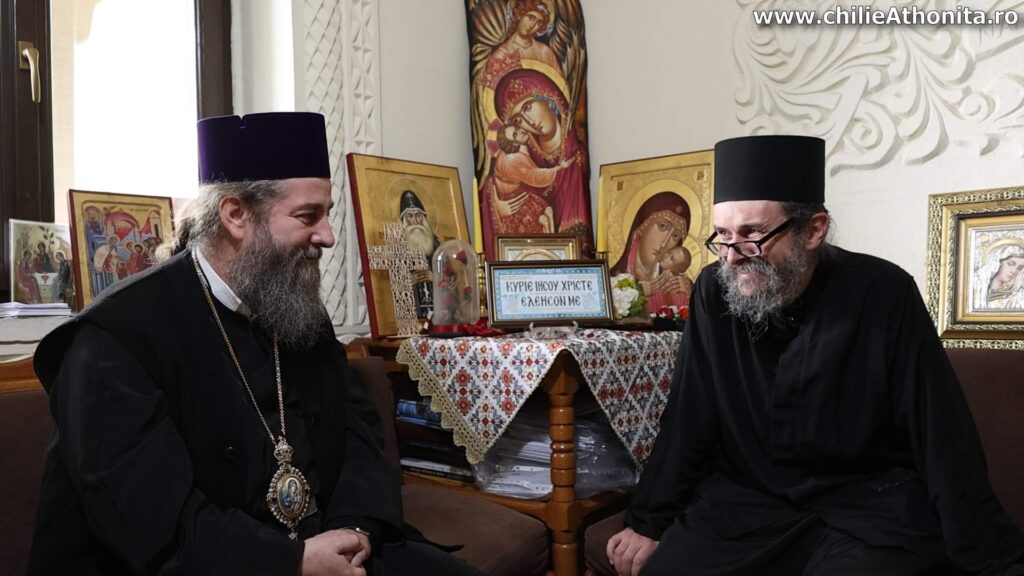


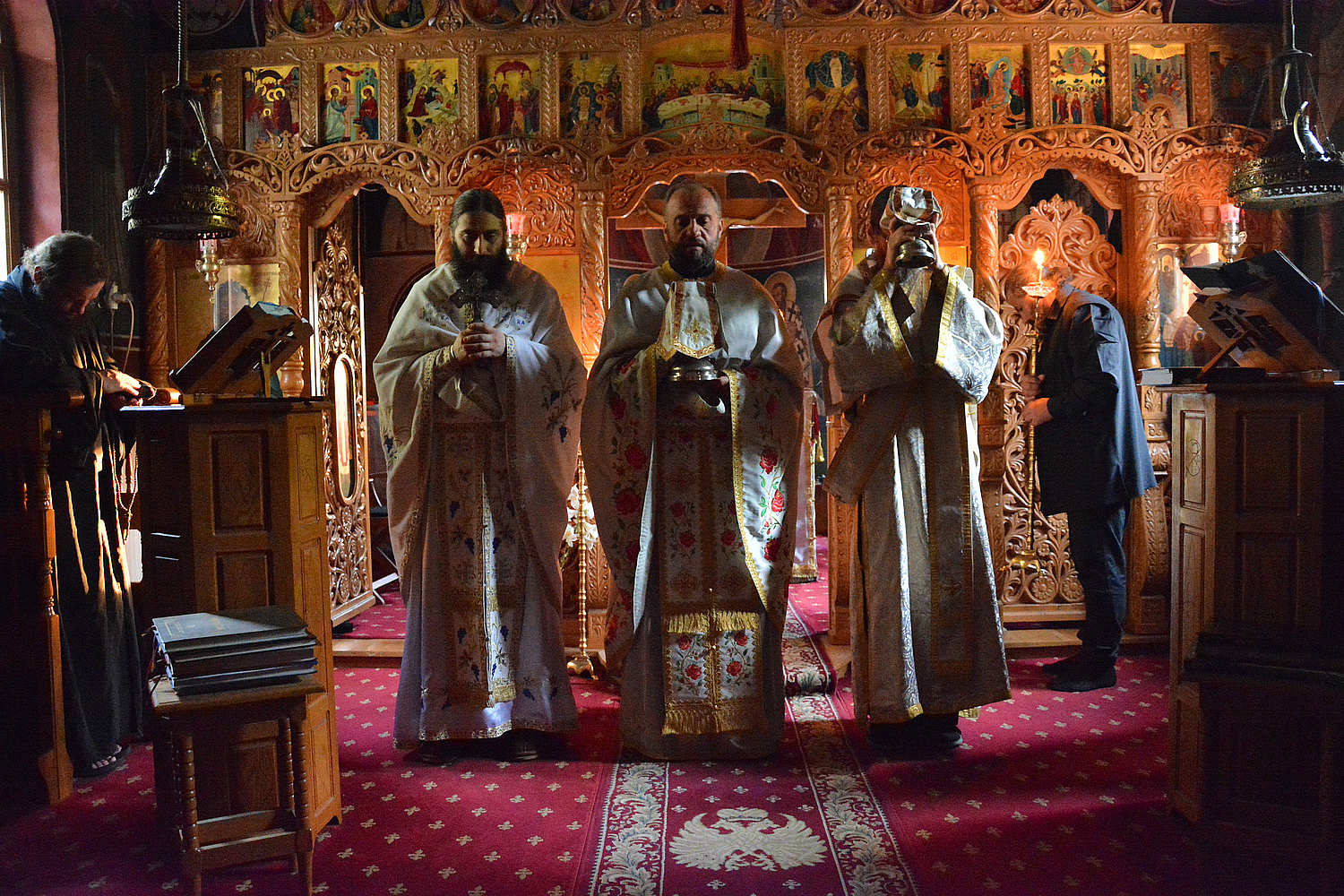
You Can Pray All the Time Because God Hears You – Father Pimen, Lucian Apopei
15 April 2023
The Resurrection Is the State of Man Delivered from Sin – Fr. Theologos, Remus Rădulescu (Trinitas TV)
17 April 2023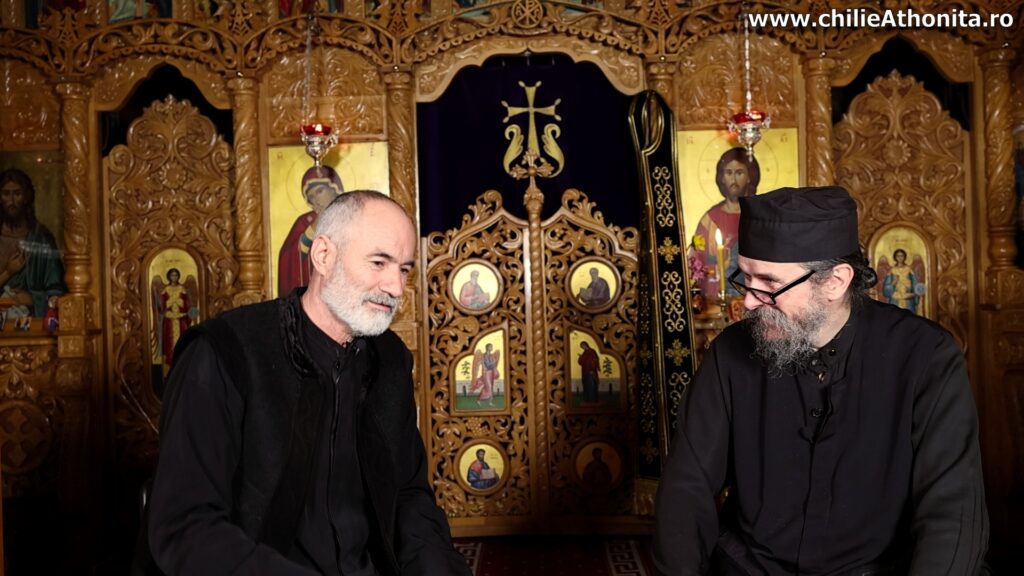
Listen to a warm discussion in which Gheorghe Axinte and Father Theologos share testimonies and miracles of the Romanian martyrs and saints from the prisons—testimonies meant to deepen our reverence towards them.
Enjoy!
Fr. Theologos: Glory to the Father, and to the Son, and to the Holy Spirit, now and forever and unto the ages of ages. Amen. Through the prayers of our Holy Fathers, Lord Jesus Christ, Son of God, have mercy on us! Amen.
Dear ones, we are, once again, with Gheorghe Axinte. I hope you have seen the other podcast; if you haven’t, I will give a brief introduction: Gheorghe Axinte is, first of all, a person that’s very dear to me, because of his character, number one, and number two, because he is the administrator, or I don’t know what to call him, of the Pitești prison—the former prison, or I don’t know how to call it, in any case, the place where, in my opinion, the greatest treasure in Romania exists, meaning the most grace in Romania, because many Romanian martyrs died there during the communist era. There are some very great saints there, and whenever I find a moment, an opportunity, I always try to promote these great saints.
Why? Because, brethren, as I said, it is our wealth, our treasure, and unfortunately, we tend to renounce our treasure, we forget about it, and because of that, although we are actually very rich as a nation, in everyday life we are very, very poor. Why? Because we do not use this treasure. So, because of that, many of us believe that we are poor, that we are a sold-out country, and so on. Now, I do not want to get into politics, especially since I am not skilled in such matters and I don’t think it is appropriate, but what matters most is, as I said, the spiritual side because the soul is greater than the body. And on the spiritual side, we are very, very rich. Now I would ask Mr. Gheorghe…
Gheorghe Axinte: Brother…
Fr. T.: Brother Gheorghe, please tell us a little about the evidence of the wealth of the Romanian saints from the prisons—events, miracles, anything, absolutely anything.
G.A.: Yes, it is… Good evening, right?
Fr. T.: Right, please forgive me!
G.A.: It is difficult for me to speak about such people, because maybe those who do not know what happened in Pitești can talk, but those who know what happened in Pitești, I believe, should not speak about what happened there… Well, we could say that the first… we had Mr. Manciu here – Father Ghedeon, who came to Colciu and became a monk. He has passed on to the Lord a few years ago.
Fr. T.: Yes, yes…
G.A.: He was one of the confessors who went through Pitești, few people know, I believe. We should know that he is a pillar of Orthodoxy – right? – Romanian Orthodoxy.
Fr. T: Yes, yes, absolutely, absolutely…
G.A.: Mr. Gelu Gheorghiu recounted – I met him at the end of his life – he recounted that when Țurcanu, the one who handled all the evil that happened in Pitești prison, when he would enter their room, their cell, and our saint, Ghedeon, looked at him, Țurcanu would simply leave the room.
Fr. T.: Glory to God!
G.A.: He could not bear the gaze, he wasn’t tall—he wasn’t tall in stature… He was about one meter and probably 65 – 70 centimeters. Mr. Gheorghiu wasn’t a tall man either. He was a bit more robust, but at that moment, when he entered, and this Mr. Manciu—this father Ghedeon looked him in the eyes, Țurcanu fled.
Fr. T.: He fled… Glory to God!
G.A.: You can imagine what power he had in his gaze!
Fr. T.: Yes…
G.A.: Just as we talk about prayer, since we were in the Holy Week of the Great Lent and had the prayer…
Fr. T.: What didn’t we have? [We had everything].
G.A.: That’s right. I started with Fr. Ghedeon because we are on the Holy Mountain and we started from here.
Fr. T.: Yes…
G.A.: There are many who went through Pitești, if we talk about St. Valeriu Gafencu…
Fr. T.: Yes…
G.A.: Who also went through the Pitești prison.
Fr. T.: Yes, sanctified today.
G.A.: He is a saint for us… He passed away from this life in Târgu Ocna. We have a testimony at our chapel, about how holy St. Valeriu is.
Fr. T.: Can you tell the story?
G.A.: Yes. It’s better for those who listen to come and see what is there and they will find out…
Fr. T.: We ask you very much to go to Pitești to see! Because beyond the exhibits, there is the spirit, the grace of that place. Please continue! Tell us about the testimony…
G.A.: You know we talked before, someone from America told me, Father Ghiță Calciu, at one point, was in Bucharest, sick, towards the last period of his earthly life. And while he was in America, in California, there were some nuns who were under his obedience. He told them about Romania. They had a small church there, a little non-compliant with what it should be like in order to stay in it, and they received blessing and moved elsewhere. I can’t remember now, but if I’m not mistaken, it was where father – our famous father who passed to the Lord – the disciple of Saint Joseph the Hesychast was.
Fr. T.: Ephraim of Arizona.
G.A.: They left for Arizona. And in Arizona, of course, Father Ephraim was their spiritual father, he took them under his care and they built a small church there. They wanted to make an iconostasis like the one we have behind us. Eventually, they came to Romania, said they found a “village” called Neamț – although we know it’s not a village – and they made the iconostasis and, while traveling through Romania, they received holy relics from the saints of the communist prisons. They didn’t know where they were from, they didn’t know who they were—unknown.
They heard that Father Ghiță Calciu was at the hospital in Bucharest and they went there, received his blessing, but before they arrived, Father Ghiță Calciu said: “How could Constantin Oprișan come to me?”
Fr. T.: Glory to God!
G.A.: The nuns said, “But who’s Constantin Oprișan? We don’t know, we received some…” They thought [Fr. Ghiță Calciu] was greeting them, but anyway… And then Fr. Ghiță Calciu told them who St. Constantin Oprișan was. [The nuns] came and said: “We received some holy relics indeed, but we don’t know who they are. They are unknown saints.” And, look, a revelation!
Fr. T.: A revelation! Constantin Oprișan, the great… Speaking of which—don’t forget your stories—someone else also took relics, but this time from Aiud – if I’m not mistaken – and these relics also emitted an extraordinary fragrance. And the man went to England because that’s where he was living, and he kept praying, “But who are you?!” The relics had a great grace and an extraordinary fragrance. And after I don’t know how many weeks of prayer with tears, fasting, and everything else, Mircea Vulcănescu appeared to him in a vision and said: “It’s me.” Yes, the great Romanian philosopher…
G.A.: Extraordinary… The saints work miracles.
Fr. T.: They work miracles, yes…
G.A.: They work miracles! We don’t know how to see that the saints work miracles at every step, of course they do.
Fr. T.: We don’t open ourselves up [to see it].
G.A.: We don’t open ourselves up, yes.
Fr. T.: Do young people come there? What happens? Because I know there is a great layer of misinformation regarding all these saints. They try to put a lid on them, they try to slander them, that they were in all sorts of ways and so on. How could we promote them to young people or to other people who don’t know?
G.A.: Certainly, by using the internet, using YouTube, using technology… these phones that do everything… I think that’s how we could promote them, but it is also a gift from God, but it is a gift with strings attached. At Pitești, those who take care of the Pitești Prison Memorial are young people.
Fr. T.: Really? Glory to God! We are glad!
G.A.: They are young people. Maria Axinte, she bears my name, but she is a child who graduated in London, and came to Romania to take care of the Pitești Prison Memorial.
Fr. T.: Glory to God!
G.A.: And she is indeed successfully managing it, I mean, I see that she organizes events – she holds the summer school every year.
Fr. T.: You have a summer school, right?
G.A.: We have a summer school. Next week, they have an event because on March 9 we commemorate the holy confessors and Heroes’ Day. There are two celebrations. First, we have the heroes whom we always celebrate on March 9, and at the same time, we also celebrate the day of the saints from the prisons, those who suffered in the communist prisons. And then, there will be an exhibition, the Divine Liturgy will be served in the morning. We already frequently serve the Divine Liturgy at the memorial, in “Hospital Room 4” – where all the horrors and everything that happened took place, the entire phenomenon of re-education through torture, starvation, and everything that was there.
Fr. T.: Yes, and I think that it truly was a phenomenon of re-education, but not in the way they thought, rather a re-education, an elevation of the nation, which today… I see that it is not really promoted, not really used, so to speak, not exploited in the good sense of the word.
G.A.: Yes, I met Mr. Tache Rodas.
Fr. T.: How was that? You must tell us!
G.A.: Mr. Tache Rodas was a wonderful man, he was…
Fr. T.: I understand that he was the only one who resisted, meaning the only one who didn’t whimper, who didn’t say a word, who…
G.A.: Yes, many tell that when they were beaten, they simply felt nothing.
Fr. T.: Really? Glory to God!
G.A.: Yes. They did not feel the beating. If I am not mistaken, even Mr. Tache said that many times he did not feel it. Marcel Petrișor recounts – may God rest his soul, as well as Mr. Tache Rodas, may God rest them! Mr. Marcel Petrișor always humorously recounted how he received 25 lashes on his backside.
Fr. T.: Really? Glory to God!
G.A.: And they used to joke about this, just so you see what… they were still playing, they were young. And they used to say: “Hey, let’s see how many it takes before you cry out!”
Fr. T.: God forbid!
G.A.: I mean, imagine, they would hit you with a hose and you had nothing to cover your back…
Fr. T.: Yes, God forbid!
G.A.: And they would also throw water all over your back, and when they hit you with the cable, there was a wire rope, and at the end of it, there was a screw, and when the screw reached you, it would tear the flesh off you.
Fr. T.: Yes, obviously.
G.A.: And he said: “Well, I endured a few, and then I started to scream because I couldn’t take it anymore.”
Fr. T.: Yes, oh, Lord!
G.A.: You can imagine that afterwards, they couldn’t sit on a chair, they could only stand, what was happening there was…
Fr. T.: God forbid!
G.A.: But let’s get back to Mr. Tache Rodas. He was of Greek descent.
Fr. T.: Aromanian.
G.A.: Aromanian, yes. His grandfather is St. Chrysostomos [of Smyrna], if I’m not mistaken. I might be wrong, and if I am, please forgive me! [The saint is Mr. Tache’s grandfather’s brother]. But anyway, he recounted that his grandfather is a saint listed in the calendar…
Fr. T.: Seriously?
G.A.: Yes, from Constantinople. Mr. Tache Rodas, that’s true, he was very steadfast, very strong, with a very strong character, but also a very good man. They beat him at Aiud, I think, or at Gherla. I think it was Gherla. I don’t know, I am not well-read. I absolutely cannot read the books written by martyrs and about martyrs. I can tell you, I can declare that I came to the Holy Mountain with Mr. Marcel Petrișor, I shared a room with him, and he said: “How come, master, you can’t read?” That’s what he called me, “Master.” “You can’t read my book?” I said: “Marcel, now that you’re here, let’s try!” I read the first page, and when I got to the second, I closed it. “What happened?” “Nothing happened, but I can’t read what’s written here!”
Fr. T.: Glory to God!
G.A.: “But if that’s how it happened?”
“What do you mean, ‘that’s how it happened’?”
… Let’s get back to Mr. Tache Rodas. They beat him on the head with a wet rope until they destroyed one of his ears. He prayed to the Mother of God not to go insane. “Mother of God, please help me not to go insane!” And the Mother of God performed a miracle with him.
Fr. T.: Glory to God!
G.A.: He didn’t go insane. That’s because there, in the prison where he ended up, he told what happened at Pitești and the commanders, of course, found out and then they punished him. So, they would take him from cell to cell, with a sack over his head. When he arrived in the cell, they would lift the sack and he was forced to say, “Whoever does like me, may they suffer like me.”
Fr. T.: God forbid!
G.A.: So you can only imagine what was there…
Fr. T.: And above all, we have to tell the listeners that beating someone on the head is one of the cruelest and most certain ways to drive someone insane. The moment they hit you and you can’t defend yourself and it never ends.
G.A.: And what do you know? After he got out of prison, he married a party secretary.
Fr. T.: Really?
G.A.: Mrs. Matilda was the head of the party, the most powerful in Ploiești.
Fr. T.: Seriously? And how? I mean… [It was] from God…
G.A.: [It was] from God. She liked him and married him, “This one is mine, my Tăchiță,” that’s what she always called him.
Fr. T.: Really? Glory to God! But didn’t she have any trouble? Didn’t she… I don’t know what to say…
G.A.: She said, “I had to marry this one.” They got married back then at the Ghighiu Monastery.
Fr. T.: At the monastery?
G.A.: At Ghighiu, yes.
Fr. T.: Really? The party secretary…
G.A.: The party secretary dressed nicely and went to the monastery with the former political prisoner.
Fr. T.: Whom she’d beaten… [not personally]
G.A.: Whom she’d beaten, yes…
Fr. T.: Glory to God!
G.A.: Mr. Tache came to us many times, we got to know each other very well, he passed to the Lord from Aiud, from Fr. Gavriil.
Fr. T.: Glory to God!
G.A.: Father Gavriil, when he talks about Mr. Tache, has tears in his eyes. Many miracles happened there while Mr. Tache was alive. And it can’t be any other way. First Mrs. Matilda passed away and then Mr. Tache passed away—and look—he lived over 90 years.
Fr. T.: Yes, yes!
G.A.: With all the beatings and everything else…
Fr. T.: …The torments, because we are talking about unimaginable torments.
G.A.: You can’t imagine, yes.
Fr. T.: How do you see, how do you compare the people back then with the ones today?
G.A.: Well, I’ll tell you about myself, right? How could I talk about someone else?
Fr. T.: I don’t know. I’m asking you.
G.A.: Well, if we walk down the street and you look at me, I’ll say, “What’s your problem with me, sir?” or if you say something I don’t like, I’m the one that’s right, right away. How not? It’s not like here – obedience, [always], “May the Lord help us! Forgive me!”
Fr. T.: Yes, I think that nowadays people can no longer endure anything, they have absolutely no patience left. They can no longer humble themselves, we can no longer humble ourselves.
G.A.: Yes, because we don’t understand the meaning of grace. We all have grace, God gave grace to all of us at baptism and then through all the mysteries that are performed, but we don’t understand it. We are too proud, we don’t know how to humble ourselves. I notice in the media how it’s written – “I am proud of what I have done!” Our Lord Jesus Christ never said He was proud!
Fr. T.: Yes, of what He has done…
G.A.: And I believe He has done… I mean, not “I believe He has done” – forgive me, Lord! – because He has indeed done.
Fr. T.: I believe He was the only one Who did something in the entire history of mankind, and only those who were connected to our Lord Jesus Christ also did something in the history of mankind. From there on, whatever… stones and so on…
G.A.: Amen. I met a very good engineer, who… I can’t recall his name now, I haven’t thought about him in a while and now I’ve forgotten…
Fr. T.: It doesn’t matter…
G.A.: There were two engineers: one was a design engineer in Pitești, he returned to prison as a design engineer and was imprisoned in Pitești and you can imagine that after that he came to work at this unit that was established after ’77.
Fr. T.: Oh, really?
G.A.: At the construction trust, he was there.
Fr. T.: Oh, I understand.
G.A.: His name is Constantin, but I can’t remember the last name…
Fr. T.: It doesn’t matter…
G.A.: The other one is Iulian Constantin. This man designed the Agigea Lock. When he would enter “Hospital Room 4″… I knew him for a short time because he passed into eternal life right after. When he would enter “Hospital Room 4,” he would stop and look towards the proskomidi, towards the icon on the right side of the chapel, towards the Mother of God. I don’t remember for sure, but he said that Cornel Niță was put up on the wall and martyred there.
Fr. T.: Yes, the first martyr.
G.A.: The first martyr from Pitești, yes. Ceaușescu wanted to award engineer Constantin Iulian, but when he found out he was a political prisoner, he pushed him aside and they didn’t even accept him for a doctorate. He earned his doctorate after ’90. He is a doctor in construction. He was, or rather, he is…
Fr. T.: He is…
G.A.: Because he passed to the Lord a little while after, yes…
Fr. T.: Cornel Niță – for those who don’t know – the torturers nailed him to the wall in the sign of the cross and tortured him until he died. They crucified him in mockery… Yes… blaspheming our Lord Jesus Christ and that’s how he died. He was very young, if I’m not mistaken [He was martyred at 23 years old].
G.A.: Yes, but they were all young, none of them were old… They were students…
Fr. T.: Yes, yes…
G.A.: They were all students. As was Țurcanu, he was also a student.
Fr. T.: But he was drawn to a bright future, as had been proposed to him. Wasn’t he? Lord, Lord, what it means not to have the experience of the truth of Jesus Christ! Because if you don’t have the experience of the truth, you can be manipulated… God forbid! They can do anything with you, absolutely anything. What I wanted to ask you – regarding the ladies, because until now we have only talked about martyrs, male martyrs. What about female martyrs?
G.A: Yes, I knew Mrs. [Elena] Arnăuțoiu very well.
Fr. T.: Really?
G.A.: Yes. In memoriam, Maria Axinte erected a cross in their village, where they grew up, in Nucșoara, and several times I have also been to her home. She lived 102 years.
Fr. T.: Glory to God!
G.A.: Or over 100 years.
Fr. T.: Glory to God! And with all the drama her brother went through… or who was it?
G.A.: The mother, the brother… —the brothers. She said she was in prison in Jilava and… could hear those who were going to interrogation or coming back from interrogation crying and screaming. And she was with her mother in the cell and they were ashamed because the brothers – Petre and their other brother, Ioan – had a notebook in which they wrote down from whom they received food, goods, so they could live in the mountains to survive, thinking that when all the horrors and persecution ended, they would thank the people—they might forget [otherwise]. And the secret police got the notebook and then took them all for interrogation.
Fr. T.: God forbid!
G.A.: They shot the two brothers at Jilava, the mother and Mrs. Arnăuțoiu came home, but you can imagine how it was… she was from Câmpulung Muscel. Extraordinary people. An extraordinary woman, with such a clear mind, like actually, all of them.
Fr. T.: Yes, that impresses me, that they are all extraordinary, meaning they became saints in prison. Mrs. Galina Răduleanu, for whom we have boundless love and respect, said in one of the clips… that she regretted coming out of prison, I mean, she became a saint in prison. May Mrs. Galina Răduleanu forgive me for speaking like this about her! In prison, she advanced spiritually. Do you understand? And this is what I see in all those in prisons – they talk about this. And Mr. Mărgineanu, who made the film about his father, Nicolae Mărgineanu, who was also a political prisoner, a spiritual prisoner. From political prisoners, they transformed into spiritual prisoners. He even made the film with his wife and lady, Mrs. Maria Ploae, to whom we send all our love and respect, and the film was called “Binecuvântată ești închisoare.” (“Bless You, Prison” 2002)
Now I sit and wonder: of course we do not want today’s youth to go to prison, God forbid! God forbid, but don’t you think they should have a slightly more ascetic program, a little further from the condition life is lived today?
G.A.: You should know that young people really come to our church, they really come to the chapel…
Fr. T.: Glory to God!
G.A.: Those who are married come with their children too. Those from schools have already started coming with the “Different School” program.
Fr. T.: Glory to God!
G.A.: And they really come, and it is an encouraging thing.
Fr. T.: Something is happening.
G.A.: Something is really happening. Things are moving. I think this thing with… is good.
Fr. T.: With filming… With prayer.
G.A.: Both filming and prayer… Yes, because the young people have understood that they need to kneel in prayer and come to Jesus Christ, and you can only come to Jesus Christ on your knees; you cannot come proud and arrogant.
Fr. T.: Yes. Like “[Look] at the things I’ve done!” As we were discussing earlier…
G.A.: A father from here, from the Holy Mountain, was telling a story earlier that there were some visits here and the first one who entered broke his nose, the second one cut his eye, the third one… Because they came here proud. Here, to Jesus Christ and in the garden of the Mother of God, you lower your head because you have time to go outside [of it] and do something else.
Yes, so Mrs. Galina Răduleanu, I met her. Well, we are… if Mrs. Galina allows me to say so, I would say we are friends. I was in Moldova… Fr. Boris Răduleanu, Mrs. Galina’s father, was also imprisoned. Mrs. Galina Răduleanu recounted that she was taken from her workplace. She was a doctor in a certain village or commune in the mountains.
Fr. T.: Psychiatrist, right?
G.A.: Yes. And they came and took her directly because she wrote something in a notebook, I don’t know what, or, well, they made up something there. In any case, her father was in prison, she knew nothing about her father, she knew nothing about the others at home, just like the others in prison, if we talk about those I mentioned. No one knew what happened to them.
Fr. T.: Yes, yes. They were alone with hell in front of them and heaven in their hearts.
G.A.: That’s right! Those were the times, those were the days, they lived with dignity. Mr. Nicolae Purcărea recounted that only the prayers of the Mother of God and the Lord Jesus Christ kept him… Speaking of Mr. Nicolae Purcărea who wrote “Urlă haita” (The Pack Howls), he recounted that when they beat them on the heel, on the sole, and hit them with a hammer, he only felt the first blow, directly in his head…
Fr. T.: God forbid!
G.A.: And that was it, he didn’t feel the others anymore. So when they hit him with a hammer on the heel, you can imagine what…
Fr. T.: Mother of God!
G.A.: He said that they could no longer wear shoes after that, they could no longer walk in boots. The foot wouldn’t fit because it was swollen.
Fr. T.: The whole foot was actually broken.
G.A.: And despite all that, look… Just like the others, Mr. Nicolae lived over 90 years.
Fr. T.: Glory to God!
G.A.: He wrote the book around the age of 87, if I’m not mistaken, he had finished writing it by the time he turned 90.
Fr. T.: Yes, well, today we are not even able to write a book at 40 years old, I mean, what more can we say…
G.A.: I don’t even know how to write two lines, that’s another matter. These phones make it so that you don’t even put the comma where it should be, you don’t use punctuation marks anymore, it’s something like…
So, everyone said that the Savior and the Church and faith saved them, helped them get through this.
Fr. T.: Yes, because if you don’t have this inner heaven, you can’t withstand the hell outside!
G.A.: Mr. Andronescu, our poet, used to tell stories… Well, there are many stories. He tells how he used to talk through a cup, through the wall, in Morse code with Nichifor Crainic, with Manu… something like this, and he said, “I never thought I could find them here.” What is interesting about Mr. Demostene [Andronescu] is that he wanted to get sent to solitary confinement.
Fr. T.: Really?
G.A.: Yes, to write poetry.
Fr. T.: To write poetry, yes, to reach a higher state in order to write poetry.
G.A.: He got used to sleeping standing up. You couldn’t sit down in solitary confinement because if you slept there, you would die. And in that cell, what could he do? He walked around. He probably had three square meters and he wrote poetry. And it was quiet, no one disturbed him, and then he wrote poetry. He wrote, wrote, wrote, and he recounted that after he got out of prison he wrote poems, some of the poems, on a sweater.
Fr. T.: Really?
G.A.: He wrote them in Morse code.
Fr. T.: Glory to God!
G.A.: And he went to his sister’s house, and his sister found it somewhere there, you can imagine it was patched up, torn as it was when he came out of prison, poor him. And she threw it away. When he realized, he looked for it… The poetry! He couldn’t find it anymore.
“What happened?”
“Well, I threw it in the trash because it was torn!”
“Oh Lord, forgive me!”
Fr. T.: We were not worthy! We hope, however, to be worthy of this great heritage, of this great treasure that we have, and to be able to carry it forward as worthy successors! This is what I reckon… and each of us contributes our small offering.
May the good Lord help us!
G.A.: Amen.
Fr. T.: Through the prayers of our Holy Fathers, Lord Jesus Christ, Son of God, have mercy on us! Amen. Thank you very much!
G.A.: Thank you! I was about to tell you something, but remember this: I met Tudor Gheorghe’s father, Mr. Ilie. Before I met him, I received a book from Suceava. I read it, I cried. Ilie Tudor came home from prison. He arrives at his home. In the garden, the dog recognized him and didn’t bark. He didn’t go into the house so as not to disturb anyone. He stayed in the hayloft. There, he said, “So, I saw a big shirt on the clothesline, a big man’s shirt. Maybe my wife got married, who knows… And I stayed until morning to see whose it was… It was my son’s.”
Fr. T.: Glory to God! Tudor Gheorghe, the great rhapsode.
G.A.: And Mr. Ilie told me that when he was in solitary confinement, he fell asleep. He couldn’t not anymore, the floor was icy cold and he fell asleep. And he wasn’t cold at all.
Fr. T.: Glory to God!
G.A.: Around him it was dry and the jailer came to take him to the morgue because they hadn’t heard anything from him. He looked through the peephole, didn’t see him, and kicked him. He got up, jumped up, he was alive!
Fr. T.: Glory to God!
G. A.: He was alive!
Fr. T.: And he was living well, I mean… above nature.
G.A.: That’s right! The things which are impossible with men…
Fr. T.: …Are possible with God.
G.A.: Amen.
Fr. T.: Glory to God! Thank you very much!
G.A.: Let me remember the name of the engineer… I have been to his home several times.
Fr. T.: In the next episode.
G.A.: Amen. We have his picture at home, on the table.
Fr. T.: May the good Lord help us! Lord help us! Thank you!
Online commemoration lists and donations
May the Lord help us!
Online Commemoration Lists and Donations
May the Lord help us!
If you have a bank card and wish to send commemoration lists and donations online using your card, and/or to support our philanthropic activity, including this site, please fill out the form below to make a small donation. The form is secure – we use Stripe for payment processing – a world leader in this field. We do not collect your personal data.
If you do not have a card, or do not wish to use it, visit the webpage for Online Donations and Commemoration Lists.
We will pray for your loved ones! (Please do not include inessential details like wishes, degree of kinship, introductions etc. JUST the name!)
Especially for recurring commemoration lists, we ask that you please keep them to under 20 names long. If you include a member of the family, we add “and for their families.”