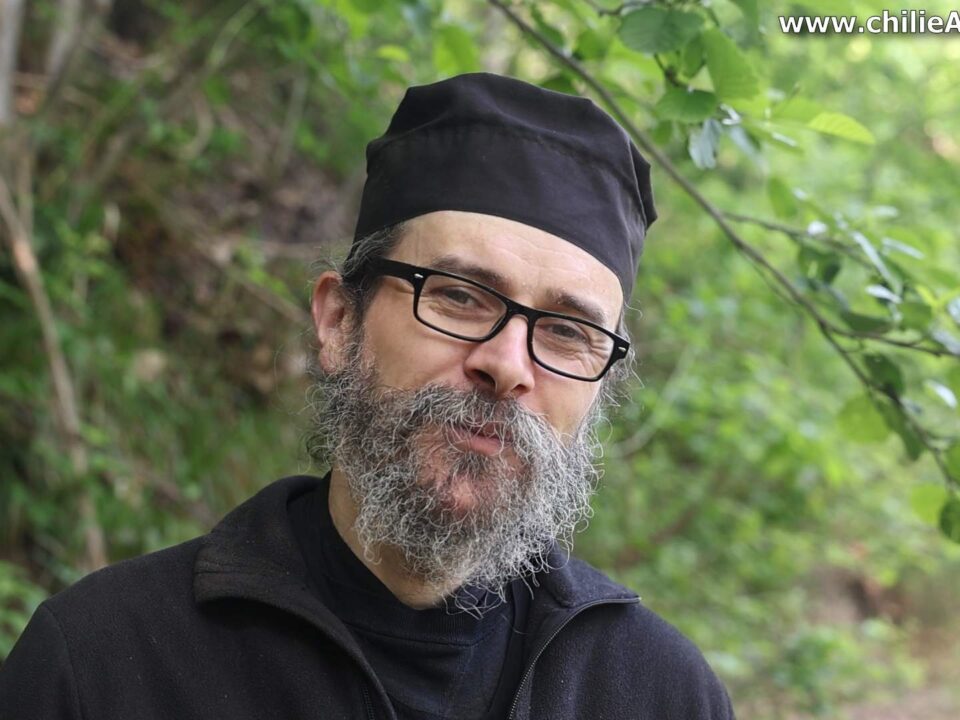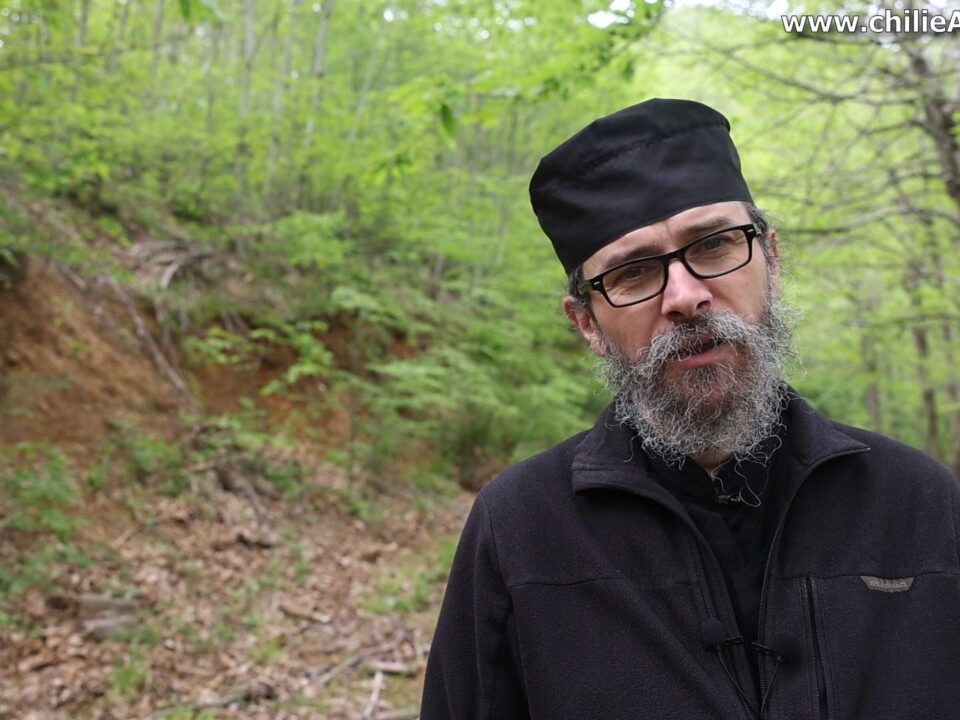



The Myrrh-Bearing Women, christian woman and the love – Fr. Theologos
4 June 2026
Great spiritual fathers of Sihăstria Monastery – Fr. Cosma Giosanu, Fr. Theologos
24 June 2026
What is the contemporary resonance of a seemingly minor event – an encounter between Christ and a Samaritan woman? In fact, no event involving Christ is a minor event because Christ transcends time.
This event transcends time even more because it has reverberations beyond time into eternity – mainly related to the way of learning and to interhuman relationships that, whose problems are the same across centuries.
Enjoy watching!
Through the prayers of our Holy Fathers, O Lord Jesus Christ, Son of God, have mercy on us! Amen.
Christ is Risen!
We see that at the beginning of His missionary work, Christ blessed the wedding, the marriage – He blessed the family, as Saint John the Theologian tells us in his Gospel. After that, Saint John the Theologian notes the righteous disturbances that Christ caused by driving out the merchants from the Temple and by telling the Jews, Destroy this temple, and in three days I will raise it up!
The Lord was speaking in spirit and truth, that is, He was speaking about the temple of His Body, while the Jews were thinking on a physical level, considering the Temple in Jerusalem – the actual building – which is why they were outraged when they heard the Lord say that He could rebuild such a large building in just three days.
Now, brethren, of course Christ could have done this because He was God, but the Jews did not even believe this – meaning, the fact that a prophet of God, as they saw Him at best, much less God incarnate, if some of them had seen Him that way, they did not believe that He could rebuild such a structure in only three days. Their material and materialistic thinking did not allow them to conceive that something which had been built in 46 years could be rebuilt by a spiritual man in three days.
You see that the physical is very limited, and Christ tries to lead them out of it towards spirituality through the righteous disturbance we discussed more extensively in the video about the weaklings.
After this, in the next chapter, Saint John raises us even higher and presents the beginning of spiritualization through the conversation between Saint Nicodemus, who was a Pharisee and a secret disciple of Christ, in which baptism is discussed as being born of water and the Holy Spirit. We again see Jesus’ constant concern to lift people from the physical plane to the spiritual plane, to offer them a new perspective that would bring them out of the death of the body into the life of the Spirit, even if people become troubled—with a good disturbance, as we said— by this new teaching.
Remember how Saint Nicodemus asked: Can one enter a second time into his mother’s womb, and be born anew? Do you understand? The Lord offers His teaching using analogies and symbols from the physical universe with which His interlocutors were familiar, in order to elevate them to the spiritual level. As I mentioned in the episode about the weaklings, water often appears as a symbol of the Spirit because water is soft, humble, and life-giving on a physical level. So is the Spirit on a spiritual level. It resembles water, do you understand? Yes, the Spirit is a Person, He is God.
Another disturbance arises – also related to water and the Spirit, to spiritual cleansing – between the disciples of St. John the Baptist and the disciples of the Lord. Why between the disciples? Because the Lord, being a hesychast, did not baptize, but His disciples, as noted by St. John. When asked to defend his position, St. John the Baptist not only does not defend it, but on the contrary, he validates the Lord as the Christ, as the One Who took everything from Heaven. As the absolute spirituality. Do you understand?
After this, Christ acts even more spiritually and hesychastically. That is, when He realizes that the Pharisees have found out that His disciples baptize more than St. John the Baptist, then the Lord withdraws to Galilee. He does not press the pedal, nor does He oppose directly. He withdraws.
To withdraw to Galilee, he had to pass through Samaria, a region considered unclean by the Jews who regarded themselves as pure, unmingled with other peoples. The Samaritans were unclean to the Jews because, historically, they had intermingled with other peoples. Well, it’s a whole history.
Now, we must understand that, indeed, God had told the Jews during the Old Testament period not to mingle with other peoples, but not for reasons of racism—God forbid!— but because those other peoples had very erroneous, soul-destroying teachings, going as far as child sacrifices. Do you understand?
Brethren, this is why we must love our own people: because in it there is a successful teaching of faith. Brethren, we do not love our people because we hate other people—God forbid!— and consider ourselves better; that is a form of pride, of racism which, as you see, led to terrible consequences during the Second World War.
What is very interesting here is the fact that the Jews were very proud of their so-called pure past, yet, as the Savior also reminds them, the reality is that they were killers of prophets and idolaters themselves. If you don’t believe it, read the books of Kings and there you will see what happens.
In the case of the Savior, we see the perfect example of behavior toward sinners: we love the sinner and hate the sin. We hate the sin. Do you understand? This is very clearly seen in the case of the Samaritan woman.
The encounter between Christ and the Samaritan woman is full of joy, delicacy, but also deep meanings. You see that Christ sat down, tired from the journey, at Jacob’s Well – the water source of the Old Testament. Meanwhile, His disciples had gone away into the city to buy food.
This also shows that Christ was truly human, not only God, but also a true man who grows tired, who becomes weary; yet beyond that, it once again shows the hesychastic character of Christ. You see, He was much more tired than the others who had the strength to go into the city. This shows that Christ fasted much more than the others. Do you understand? And He liked the silence.
Thus, a Samaritan woman comes to draw water at the sixth hour, that is, at noon, brethren. Why does Saint John the Theologian note that she comes at the sixth hour? Perhaps also to indicate that Christ was weary from the heat, as a human – I do not know. However, some say that women were not allowed to go alone to public places at noon because it was hot and they were more lightly dressed – it was not appropriate. Do you understand? So the Samaritan woman came, somewhat, rather illicitly there. Do you understand?
Nevertheless, the Savior pretends not to see her somewhat material intentions, so to speak, and begins to speak with her, saying, Give Me a drink! The Lord does this because He knew her soul, which was nonetheless concerned with higher things.
Brethren, now a brief parenthesis: we should never judge a person by their appearance or behavior. The act, of course, is judged, but not the person. We never know who the other is or why they do what they do.
You see, in the case of the Samaritan woman, she, poor thing, did not know any better; that is how she was taught. She was brought up with a physical faith— she believed that God could only be found in the temple on Mount Gerizim where they were. Because of this physical way of thinking, you see that she is surprised by the fact that Jesus asks her for a drink, and instead of serving Him, she responds in shock with a question, wondering how He could ask her for something, He, a Jewish man.
He speaks with a Samaritan woman and, above all, humbles Himself by asking her for something. Why? Because, as I mentioned, the Samaritans were considered unclean by the Jews and, beyond that, according to the mentality of the time, of course, a woman was regarded as inferior to a man, and therefore, a Jewish man was not expected to humble himself before a Samaritan woman. He was under no obligation to be polite to her. Not at all. Do you understand?
Brethren, you must know that Christianity brought about an enormous change in a very brutal world, a barbaric world, a materialistic world in which those with stronger bodies, more money, and greater physical power tyrannized the weaker ones. Crimes, robberies, rapes, wars, injustices, and all kinds of sins were a common occurrence. Do you understand? And not only in ancient times. We see that this is true in any society that is not influenced by Christianity or that is moving away from Christianity.
In Japan, for example, towards the end of the Middle Ages and the beginning of the industrial era, that is, before Christian influences appeared, if a ronin – that is, a peasant – did not bow sufficiently before a noble, the noble would cut off his head without asking his name or whether he had children… Also, a samurai could cut down a simple peasant with his sword just because he saw him on the street and was bored, or simply to test his sword… Do you understand?
This can still be seen today in Africa, in more isolated areas where physical sin and oppression are at their worst, where Christianity hasn’t made its way. According to the last price catalog from Nigeria that I heard of a few years ago, a woman was equivalent to a cow or four goats. This is the price at which a man buys a woman and can do whatever he wants with her. On the other hand, the bride’s family also knows this and sometimes demands— depending on the market—very high prices to sell their daughter, who is actually treated as a slave. Also, you should know that if the woman wants a divorce, she must pay her husband the price he paid for her, which in that society is usually completely impossible, and because of this, many women are trapped in very abusive relationships. Good and Holy God forbid!
Speaking of Africa and the closeness or distance from Christianity as a factor of spiritual growth or brutalization of people, we see that today the North Atlantic ideological bloc in which we find ourselves has lost all of Africa, and this is due to sin— due to distancing from Christianity. First of all, because of the heresies into which they have fallen, they began to exploit Africans unscrupulously. Keep in mind, even more in the last 200 years; sometimes even in the name of Christ—without, of course, these people having any connection with the Lord. Do you understand?
And today, the last straw, beyond arrogance, is the attempt to impose the great sins of the flesh that are linked to the sexual distortions so prevalent in the West. Africans, being by nature of their poverty closer to creation and, therefore, to the Creator, have rejected all of this and have criminalized sexual distortions, sins against nature, against creation, through laws. You know that laws were passed this or last year prohibiting sins against nature. Although Western media and politicians have pressured them, speaking down to them, they have silenced them and said that from now on they disassociate themselves from Europeans and, especially, from Americans and are negotiating with the Chinese, who, until now, have shown themselves to be less sinful.
Well, you could say there is an interest at stake, but… Do you get it? That’s a big problem. This is a very serious blow to the Westerners because, of course, they will be left without resources from Africa. It is a big problem, brethren, and as you see, the main cause is sin, the lack of spirituality. Do you understand?
The Samaritan woman was also physical, yet you see she was open to dialogue. Christ, seeing this, does not answer her physical question regarding the ethnic segregation between Jews and Samaritans, but goes directly to spirituality, as we said, trying to elevate her to a more spiritual approach to life, and then the physical problems of segregation and so forth fade, become secondary, and are somewhat resolved.
Thus, the Savior responds to her with no connection to what she wanted to know at that moment about segregation, saying to her, If you knew the gift of God and Who it is Who says to you, Give Me a drink, you would have asked Him, and He would have given you living water. Do you understand? This awakens the woman’s interest because the Lord is a very good shepherd in the case of people desiring spirituality. The Savior spoke with great love and courtesy. It is enough for a person to want, and then the Lord fulfills.
However, the woman remains on the physical level and says, Sir, you have nothing to draw with, and the well is deep. Where then do You get that living water? Are You greater than our father Jacob? Even though she does not understand how the Jew before her can obtain living water without a bucket, nevertheless, she begins to realize that it is possible that something exists beyond this physical level.
Christ gradually lifts her to a higher plane and begins to reveal to her that the water He speaks of is spiritual. Now, of course, we know that this is the grace of the Holy Spirit, but I remind you once again that people far from the true teaching of Christ are very physical. Because of this, the Lord speaks to her at her level as a beginner, as a child in matters of faith.
He tells her that anyone who drinks from Jacob’s well, that is, from the teaching of the Old Law, will thirst again just as the woman thirsts. But whoever drinks from the water He gives, that is, from the water of His teaching, the New Testament, will never thirst, for this water will become in him a fountain of water springing up into everlasting life. In other words, it is the grace of the Holy Spirit that gives us life and leads us toward the blissful eternity of Heaven. Of course, this happens if we obey and shape our minds without foreign thoughts, but rather follow the flow of the water from the life-giving spring. Do you understand?
This closing of the mind into the channel of the spring of spiritual springing water, into the channel of grace, presupposes first of all a renunciation of the flesh, a renunciation of information received through the senses. Do you understand? To put it more ascetically. But let us return to the Samaritan woman.
The woman begins to feel something; her mind gradually brightens, and she no longer speaks of buckets but directly says, Sir, give me this water, so that I may never be thirsty or come all the way here to draw. She no longer speaks of buckets, yet she still somewhat remains on a physical level because she relates the living and spiritual water of grace to water as a liquid necessary for bodily functions. Nevertheless, as you can see, there is a noticeable progress in her attitude.
When the Savior sees that He has somewhat lifted her from the physical plane, that He has disturbed her with a good disturbance, He then shakes her a little more strongly and tells her something logically unrelated to what they had discussed before. He says to her: Go, call your husband, and come here. To which the woman cautiously replies that she has no husband.
Then the Savior steps on the accelerator to lift her even higher through repentance – through this existential shaking – and reveals her sin as the All-Knowing One He was, for God He was, and He says to her: You said well I have no husband, for you have had five husbands, and the one whom you now have is not your husband. This you have said truthfully. The woman said to Him, Sir, I perceive that You are a prophet! again deeply disturbed with the good disturbance because it was evident to her that the Jew before her could not have known all these details of her life unless He were a prophet. Do you understand?
You see that Christ accepts her as a person, but does not accept her sin. I say this in relation to the extremes concerning the body in Western society that I mentioned earlier – if someone sins, especially if they have sins against nature, it is completely destructive to accept their sin just because we accept them. The sinner is one thing, and sin is another. We love the sinner, we do not accept the sin.
Let us not forget that these sins against nature lead to the extinction of a people, especially today when we have a major problem with birth rates. Do you understand? If we promote such sins, we condemn ourselves as a people and head toward extinction. Beyond the fact that hell awaits us. Do you understand?
However, if a person repents, then they become spiritual, detaching from the physical plane, but for that, they must know Christ.
Now, the woman, having known Christ and speaking with Him, was completely detached from the physical plane and asks something that, again, has no logical connection to their discussion, but it was the spiritual issue that troubled her, in her ignorance, of course. The question was spiritual, but her religion’s vision was still physical because she was actually asking where one should worship God – on Mount Gerizim or in Jerusalem?
Although the Lord makes it very clear to her that salvation is from the Jews, meaning that not every religion or sect is true, Christ then elevates her even further, into love, into spirit. And after a brief introduction, so as not to completely unsettle her – an introduction in which He says, Woman, believe Me, the hour is coming when you will neither on this mountain, nor in Jerusalem, worship the Father. – after this short preparation, He again says, But the hour is coming, and now is, when the true worshipers will worship the Father in spirit and truth; for the Father is seeking such to worship Him.
Bang! Do you understand? The total destruction of the physical plane and the transformation of man into a spiritual being capable of union with God, Who is totally loving, spiritual, and true. Because of this, Christ continued: God is Spirit, and those who worship Him must worship in spirit and truth. Do you understand?
For those who are free and worship in spirit and truth, God is everywhere and, therefore, they can have unceasing prayer and unceasing joy even if they recognize places of worship as especially suitable locations for prayer. Man is free and can pray anywhere. Unceasing prayer. Man begins to experience Heaven in his heart even here on earth. This is the flight towards freedom through spirituality.
Freedom cannot come from matter because matter is based on limitation, concern. Freedom comes only from the Almighty and loving Spirit from the absolute Person. Because of this, freedom is, in fact, the possibility of reaching God’s eternal personal perfection, the possibility of coming to live the Truth and perfect existence. Freedom is not for accumulating material things, brethren. The moment we accumulate matter and physical things in our life, we actually limit our freedom.
As I said, Christ always avoided the world with His thinking. He avoided the world because He had a spiritual thinking, and the world has a physical thinking. Do you understand? And Christ tried to be a hesychast. You see, when the disciples returned from the city and saw Him speaking with a woman face to face, they were astonished, Wow! How is the Lord, Rabbi speaking with a woman? Do you understand? Because He never spoke face to face with women. Of course, no one dared to rebuke the Lord, because they knew Christ was spiritual and therefore free. That is, yes, He knows what He is doing.
To reach freedom, brethren, however, it is necessary NOT to know many things and NOT to trust what we know, but to be honest and to have a humble and open heart toward the spirituality of Christ, like the heart of the Samaritan woman. Brethren, today we know too many things that do not lead to salvation, informational noise that covers the wings we need to break away from the physical plane. Do you understand? We must break away from the physical plane. But if we are loaded with things, we will not be able to detach from the bodily plane. Do you understand? We must be as light as possible.
You see that the Samaritan woman was simple and knew very little, and she was led like a child by Christ to the truth, even though she was sinful. She even says, I know that Messiah is coming, Who is called Christ. When He comes, He will tell us all things. And Christ confirms this position, simply replying: I am He, the One Who is speaking to you. Do you understand?
Sadly, today’s modern global and globalist education does not aim at spirituality, spiritualization, or the spiritual development of children; on the contrary, it targets their entrapment in the physical, the material, and the technological. Children are taught passions rather than virtues. They are taught how to make money and to shut down their competition—the neighbor, the enemy who is regarded with suspicion. They are not taught how to love. They are taught to do their own selfish will and not to be obedient or merciful.
The violence, brutality, and speed with which they are taught do not lead children to happiness and joy, but rather to depression and anxiety. To a lack of love and grace, and therefore to a lack of meaning. The inability to love and truly love each other, that is, to love each other spiritually. Do you understand?
Today we have a great need for spiritual examples. They can still be found within the people, but they are overshadowed by this informational noise, by this pseudo-teaching that comes from outside.
When I speak now, brethren, of the education system, I am not referring only to what is taught in Romanian schools where, for better or worse, there are certain teachers who, with their spirituality, still try to maintain a certain balance. I am referring to the entire informational avalanche, to all the cultural imperialism and Western ideology that come to us through all channels of information, which destroy tradition in the name of chaotic progress without spiritual meaning—a progress that seeks to destroy the spiritual tradition because the Orthodox spiritual tradition generates freedom from matter, liberation from control and slavery. Do you understand?
That doesn’t suit their agenda. There is an attempt to destroy the family and the Church because that is where tradition, love, and spirituality are taught. A loving person is free. A lonely person becomes passionate and therefore a slave, controllable.
Only the Living Christ, Who will speak to us as He spoke to the Samaritan woman, will transform us into radiant saints just as He transformed her. You know that the Samaritan woman is Saint Photini, and Saint Photini means in Greek: the Enlightened One, the holy bearer of light. Fos in Greek means light.
Thank you for striving to be more spiritual and to rise a little above our earthly thoughts, with the help of the Lord. Let us be more radiant! Christ is Risen! Through the prayers of our Holy Fathers, O Lord Jesus Christ, Son of God, have mercy on us! Amen.
Online commemoration lists and donations
May the Lord help us!
Online Commemoration Lists and Donations
May the Lord help us!
If you have a bank card and wish to send commemoration lists and donations online using your card, and/or to support our philanthropic activity, including this site, please fill out the form below to make a small donation. The form is secure – we use Stripe for payment processing – a world leader in this field. We do not collect your personal data.
If you do not have a card, or do not wish to use it, visit the webpage for Online Donations and Commemoration Lists.
We will pray for your loved ones! (Please do not include inessential details like wishes, degree of kinship, introductions etc. JUST the name!)
Especially for recurring commemoration lists, we ask that you please keep them to under 20 names long. If you include a member of the family, we add “and for their families.”